

320
R. Hänninen et al.
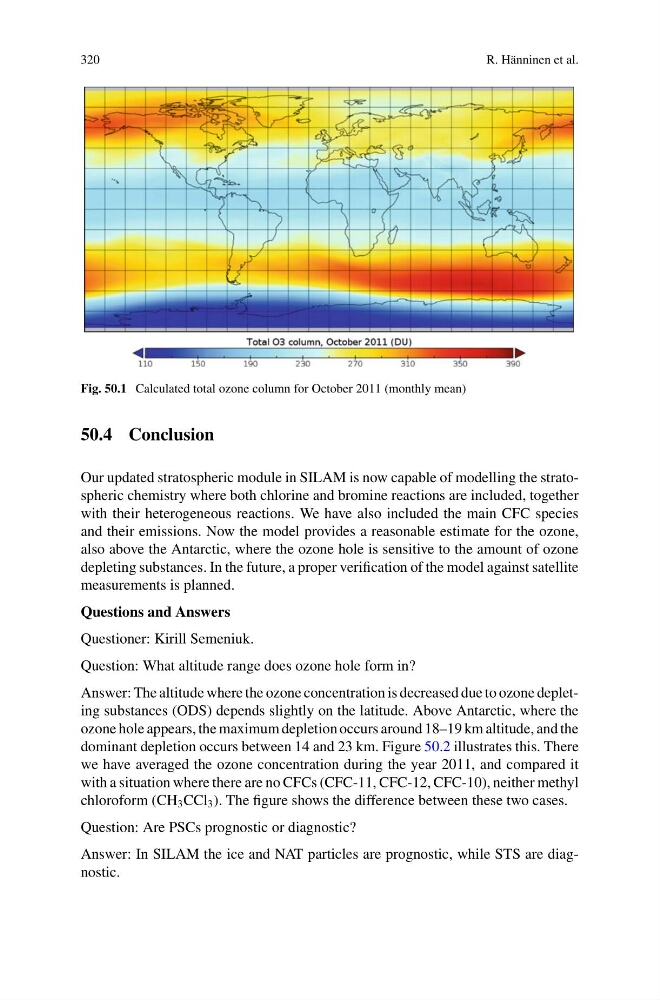
Fig. 50.1 Calculated total ozone column for October 2011 (monthly mean)
50.4 Conclusion
Our updated stratospheric module in SILAM is now capable of modelling the stratospheric chemistry where both chlorine and bromine reactions are included, together
with their heterogeneous reactions. We have also included the main CFC species
and their emissions. Now the model provides a reasonable estimate for the ozone,
also above the Antarctic, where the ozone hole is sensitive to the amount of ozone
depleting substances. In the future, a proper verification of the model against satellite
measurements is planned.
Questions and Answers
Questioner: Kirill Semeniuk.
Question: What altitude range does ozone hole form in?
Answer: The altitude where the ozone concentration is decreased due to ozone depleting substances (ODS) depends slightly on the latitude. Above Antarctic, where the
ozone hole appears, the maximum depletion occurs around 18–19 km altitude, and the
dominant depletion occurs between 14 and 23 km. Figure 50.2 illustrates this. There
we have averaged the ozone concentration during the year 2011, and compared it
with a situation where there are no CFCs (CFC-11, CFC-12, CFC-10), neither methyl
chloroform (CH 3 CCl 3 ). The figure shows the difference between these two cases.
Question: Are PSCs prognostic or diagnostic?
Answer: In SILAM the ice and NAT particles are prognostic, while STS are diagnostic.
R. Hänninen et al.
Fig. 50.1 Calculated total ozone column for October 2011 (monthly mean)
50.4 Conclusion
Our updated stratospheric module in SILAM is now capable of modelling the stratospheric chemistry where both chlorine and bromine reactions are included, together
with their heterogeneous reactions. We have also included the main CFC species
and their emissions. Now the model provides a reasonable estimate for the ozone,
also above the Antarctic, where the ozone hole is sensitive to the amount of ozone
depleting substances. In the future, a proper verification of the model against satellite
measurements is planned.
Questions and Answers
Questioner: Kirill Semeniuk.
Question: What altitude range does ozone hole form in?
Answer: The altitude where the ozone concentration is decreased due to ozone depleting substances (ODS) depends slightly on the latitude. Above Antarctic, where the
ozone hole appears, the maximum depletion occurs around 18–19 km altitude, and the
dominant depletion occurs between 14 and 23 km. Figure 50.2 illustrates this. There
we have averaged the ozone concentration during the year 2011, and compared it
with a situation where there are no CFCs (CFC-11, CFC-12, CFC-10), neither methyl
chloroform (CH 3 CCl 3 ). The figure shows the difference between these two cases.
Question: Are PSCs prognostic or diagnostic?
Answer: In SILAM the ice and NAT particles are prognostic, while STS are diagnostic.