

256
A. Robichaud et al.
USEPA’s Total Deposition (TDEP) method, and surface measurements not used in
the analysis where available. It was found that the biggest sources of uncertainties
are the dry deposition velocities and error statistics (weight matrix used to produce
OA). Therefore, more work is needed to reduce these uncertainties.
40.1 Introduction
This paper describes a new method to obtain atmospheric dry and wet deposition
maps in Canada and US. The methodology is based on optimal interpolation for
air quality [3] and sensitivity tests for error statistics. Deposition maps use GEMMACH, v2 [2] output combined with quality-controlled and screened observations
of different monitoring networks in Canada and the US (CAPMON, NAPS, AMON,
AQS, and CASTNET). Wet, dry and total deposition from the ADAGIO project will
replace krigged maps of wet-only deposition currently used to evaluate N and S
deposition to Canadian and US emissions [5].
40.2 Methods
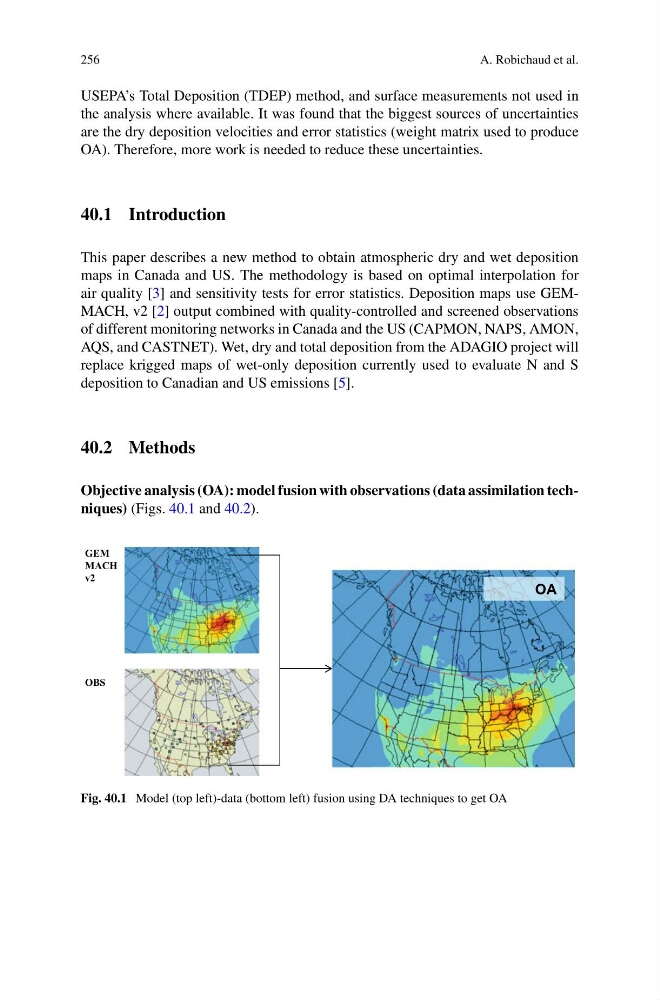
Objective analysis (OA): model fusion with observations (data assimilation techniques) (Figs. 40.1 and 40.2).
GEM
MACH
v2
OBS
OA
Fig. 40.1 Model (top left)-data (bottom left) fusion using DA techniques to get OA
A. Robichaud et al.
USEPA’s Total Deposition (TDEP) method, and surface measurements not used in
the analysis where available. It was found that the biggest sources of uncertainties
are the dry deposition velocities and error statistics (weight matrix used to produce
OA). Therefore, more work is needed to reduce these uncertainties.
40.1 Introduction
This paper describes a new method to obtain atmospheric dry and wet deposition
maps in Canada and US. The methodology is based on optimal interpolation for
air quality [3] and sensitivity tests for error statistics. Deposition maps use GEMMACH, v2 [2] output combined with quality-controlled and screened observations
of different monitoring networks in Canada and the US (CAPMON, NAPS, AMON,
AQS, and CASTNET). Wet, dry and total deposition from the ADAGIO project will
replace krigged maps of wet-only deposition currently used to evaluate N and S
deposition to Canadian and US emissions [5].
40.2 Methods
Objective analysis (OA): model fusion with observations (data assimilation techniques) (Figs. 40.1 and 40.2).
GEM
MACH
v2
OBS
OA
Fig. 40.1 Model (top left)-data (bottom left) fusion using DA techniques to get OA