

182
M. O. P. Ramacher et al.
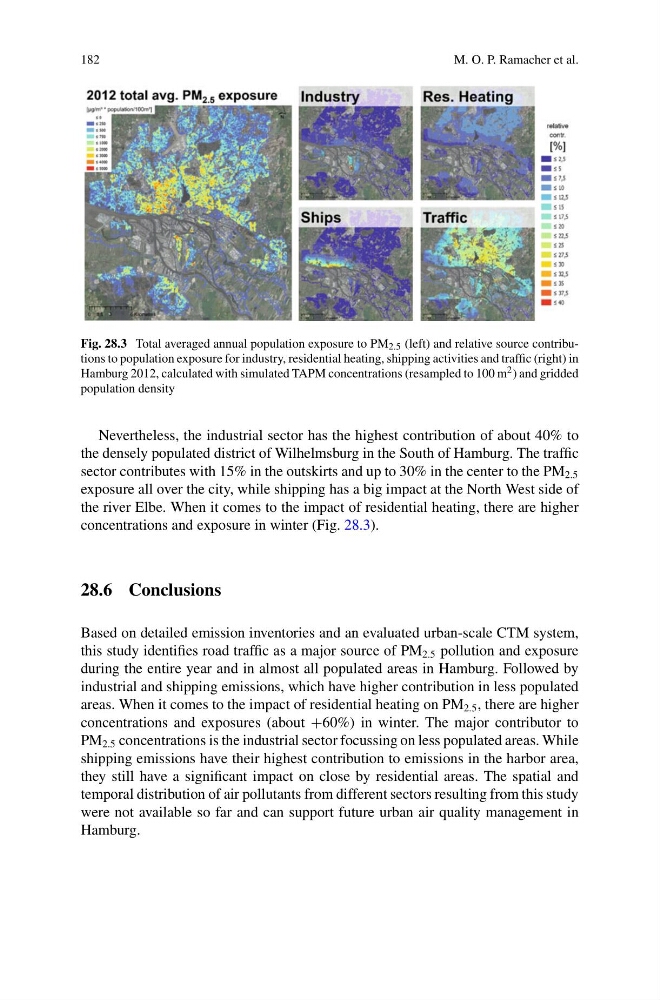
Fig. 28.3 Total averaged annual population exposure to PM 2.5 (left) and relative source contributions to population exposure for industry, residential heating, shipping activities and traffic (right) in
Hamburg 2012, calculated with simulated TAPM concentrations (resampled to 100 m 2 ) and gridded
population density
Nevertheless, the industrial sector has the highest contribution of about 40% to
the densely populated district of Wilhelmsburg in the South of Hamburg. The traffic
sector contributes with 15% in the outskirts and up to 30% in the center to the PM 2.5
exposure all over the city, while shipping has a big impact at the North West side of
the river Elbe. When it comes to the impact of residential heating, there are higher
concentrations and exposure in winter (Fig. 28.3).
28.6 Conclusions
Based on detailed emission inventories and an evaluated urban-scale CTM system,
this study identifies road traffic as a major source of PM 2.5 pollution and exposure
during the entire year and in almost all populated areas in Hamburg. Followed by
industrial and shipping emissions, which have higher contribution in less populated
areas. When it comes to the impact of residential heating on PM 2.5 , there are higher
concentrations and exposures (about +60%) in winter. The major contributor to
PM 2.5 concentrations is the industrial sector focussing on less populated areas. While
shipping emissions have their highest contribution to emissions in the harbor area,
they still have a significant impact on close by residential areas. The spatial and
temporal distribution of air pollutants from different sectors resulting from this study
were not available so far and can support future urban air quality management in
Hamburg.
M. O. P. Ramacher et al.
Fig. 28.3 Total averaged annual population exposure to PM 2.5 (left) and relative source contributions to population exposure for industry, residential heating, shipping activities and traffic (right) in
Hamburg 2012, calculated with simulated TAPM concentrations (resampled to 100 m 2 ) and gridded
population density
Nevertheless, the industrial sector has the highest contribution of about 40% to
the densely populated district of Wilhelmsburg in the South of Hamburg. The traffic
sector contributes with 15% in the outskirts and up to 30% in the center to the PM 2.5
exposure all over the city, while shipping has a big impact at the North West side of
the river Elbe. When it comes to the impact of residential heating, there are higher
concentrations and exposure in winter (Fig. 28.3).
28.6 Conclusions
Based on detailed emission inventories and an evaluated urban-scale CTM system,
this study identifies road traffic as a major source of PM 2.5 pollution and exposure
during the entire year and in almost all populated areas in Hamburg. Followed by
industrial and shipping emissions, which have higher contribution in less populated
areas. When it comes to the impact of residential heating on PM 2.5 , there are higher
concentrations and exposures (about +60%) in winter. The major contributor to
PM 2.5 concentrations is the industrial sector focussing on less populated areas. While
shipping emissions have their highest contribution to emissions in the harbor area,
they still have a significant impact on close by residential areas. The spatial and
temporal distribution of air pollutants from different sectors resulting from this study
were not available so far and can support future urban air quality management in
Hamburg.