

21 Atmospheric Pollution: Experience from Mexico City …
135
Control
agricultural
burning
Catalytic
converters
+ standards
for industry
Eliminate Pb in gasoline;
diesel - 300ppm S
Retired
polluting
buses
Ban open
burning
t
o
Arrival of
Arrival of CNG,
diesel S to
1500 ppm
S to 1500
Retire 500
polluting buses
Rred2200
Retired 2200
buses; diesel
S to 50 ppm
Cut Argentina
natural gas
LNG
Quintero
Control
industrial
NOx & SO2
Env. health
alert
Strengthen
technical
review
requirements
Transantiago
Diesel S
to1000 ppm
Diesel S
to15 ppm
Diesel S from
5000 ppm to
3000 ppm
Chile PM2.5 standard 20 μg/m 3
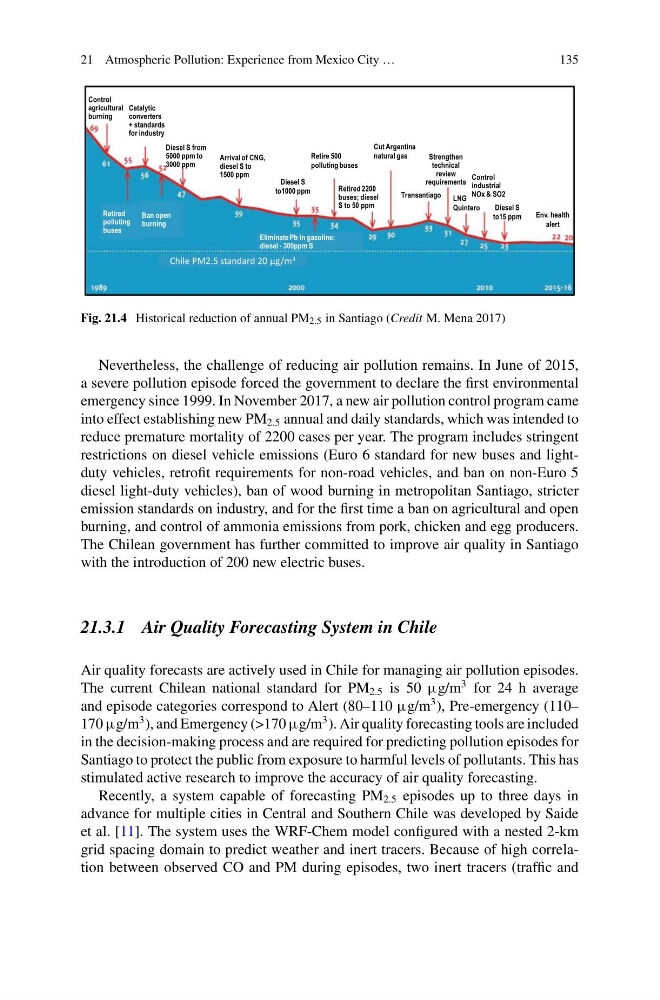
Fig. 21.4 Historical reduction of annual PM 2.5 in Santiago (Credit M. Mena 2017)
Nevertheless, the challenge of reducing air pollution remains. In June of 2015,
a severe pollution episode forced the government to declare the first environmental
emergency since 1999. In November 2017, a new air pollution control program came
into effect establishing new PM 2.5 annual and daily standards, which was intended to
reduce premature mortality of 2200 cases per year. The program includes stringent
restrictions on diesel vehicle emissions (Euro 6 standard for new buses and lightduty vehicles, retrofit requirements for non-road vehicles, and ban on non-Euro 5
diesel light-duty vehicles), ban of wood burning in metropolitan Santiago, stricter
emission standards on industry, and for the first time a ban on agricultural and open
burning, and control of ammonia emissions from pork, chicken and egg producers.
The Chilean government has further committed to improve air quality in Santiago
with the introduction of 200 new electric buses.
21.3.1 Air Quality Forecasting System in Chile
Air quality forecasts are actively used in Chile for managing air pollution episodes.
The current Chilean national standard for PM 2.5 is 50 µg/m
3 for 24 h average
and episode categories correspond to Alert (80–110 µg/m
3 ), Pre-emergency (110–
170 µg/m
3 ), and Emergency (>170 µg/m
3 ). Air quality forecasting tools are included
in the decision-making process and are required for predicting pollution episodes for
Santiago to protect the public from exposure to harmful levels of pollutants. This has
stimulated active research to improve the accuracy of air quality forecasting.
Recently, a system capable of forecasting PM 2.5 episodes up to three days in
advance for multiple cities in Central and Southern Chile was developed by Saide
et al. [11]. The system uses the WRF-Chem model configured with a nested 2-km
grid spacing domain to predict weather and inert tracers. Because of high correlation between observed CO and PM during episodes, two inert tracers (traffic and
135
Control
agricultural
burning
Catalytic
converters
+ standards
for industry
Eliminate Pb in gasoline;
diesel - 300ppm S
Retired
polluting
buses
Ban open
burning
t
o
Arrival of
Arrival of CNG,
diesel S to
1500 ppm
S to 1500
Retire 500
polluting buses
Rred2200
Retired 2200
buses; diesel
S to 50 ppm
Cut Argentina
natural gas
LNG
Quintero
Control
industrial
NOx & SO2
Env. health
alert
Strengthen
technical
review
requirements
Transantiago
Diesel S
to1000 ppm
Diesel S
to15 ppm
Diesel S from
5000 ppm to
3000 ppm
Chile PM2.5 standard 20 μg/m 3
Fig. 21.4 Historical reduction of annual PM 2.5 in Santiago (Credit M. Mena 2017)
Nevertheless, the challenge of reducing air pollution remains. In June of 2015,
a severe pollution episode forced the government to declare the first environmental
emergency since 1999. In November 2017, a new air pollution control program came
into effect establishing new PM 2.5 annual and daily standards, which was intended to
reduce premature mortality of 2200 cases per year. The program includes stringent
restrictions on diesel vehicle emissions (Euro 6 standard for new buses and lightduty vehicles, retrofit requirements for non-road vehicles, and ban on non-Euro 5
diesel light-duty vehicles), ban of wood burning in metropolitan Santiago, stricter
emission standards on industry, and for the first time a ban on agricultural and open
burning, and control of ammonia emissions from pork, chicken and egg producers.
The Chilean government has further committed to improve air quality in Santiago
with the introduction of 200 new electric buses.
21.3.1 Air Quality Forecasting System in Chile
Air quality forecasts are actively used in Chile for managing air pollution episodes.
The current Chilean national standard for PM 2.5 is 50 µg/m
3 for 24 h average
and episode categories correspond to Alert (80–110 µg/m
3 ), Pre-emergency (110–
170 µg/m
3 ), and Emergency (>170 µg/m
3 ). Air quality forecasting tools are included
in the decision-making process and are required for predicting pollution episodes for
Santiago to protect the public from exposure to harmful levels of pollutants. This has
stimulated active research to improve the accuracy of air quality forecasting.
Recently, a system capable of forecasting PM 2.5 episodes up to three days in
advance for multiple cities in Central and Southern Chile was developed by Saide
et al. [11]. The system uses the WRF-Chem model configured with a nested 2-km
grid spacing domain to predict weather and inert tracers. Because of high correlation between observed CO and PM during episodes, two inert tracers (traffic and