

18 Development and Current Status of the GEM-MACH-Global …
109
O 2 + hv → O 3 P
: jval_O 2
(1)
NO + hv → O1d + N
: jval_NO
(2)
N 2 O + hv → O1d + N 2
: jval_N 2 O
(3)
N 2 O 5 + hv → NO 2 + NO 3
: jval_N 2 O 5
(4)
N 2 O 5 + hv → NO + O 3 P + NO 3
: jval_NO 2 NOO
(5)
CH 4 + hv → 2HO 2 + CO + H 2 {+ 2H}
: jval_CH 4
(6)
N + NO → N2 + O 3 P
: a = 2.10E-11, b = 0.0, c = 100.0
(7)*
N + O2 → NO + O 3 P
: a = 1.50E-11, b = 0.0, c = −3600.0
(8)*
N + NO 2 → N 2 O + O3P
: a = 5.80E-12, b = 0.0, c = 220.0
(9)*
O1D + N 2 O → 2.0 NO
: a = 7.25E-11, b = 0.0, c = 20.0
(10)*
O1D + N 2 O → N2 + O 2
: a = 4.63E-11, b = 0.0, c = 20.0
(11)*
O1D + O 3 → O3P + 1.5 O 2
: 1.2 E-10
(12)
* Arrhenius equation for reaction rate: ARR = a * EXP(-b/Temp) * (Temp/300.0)ˆc
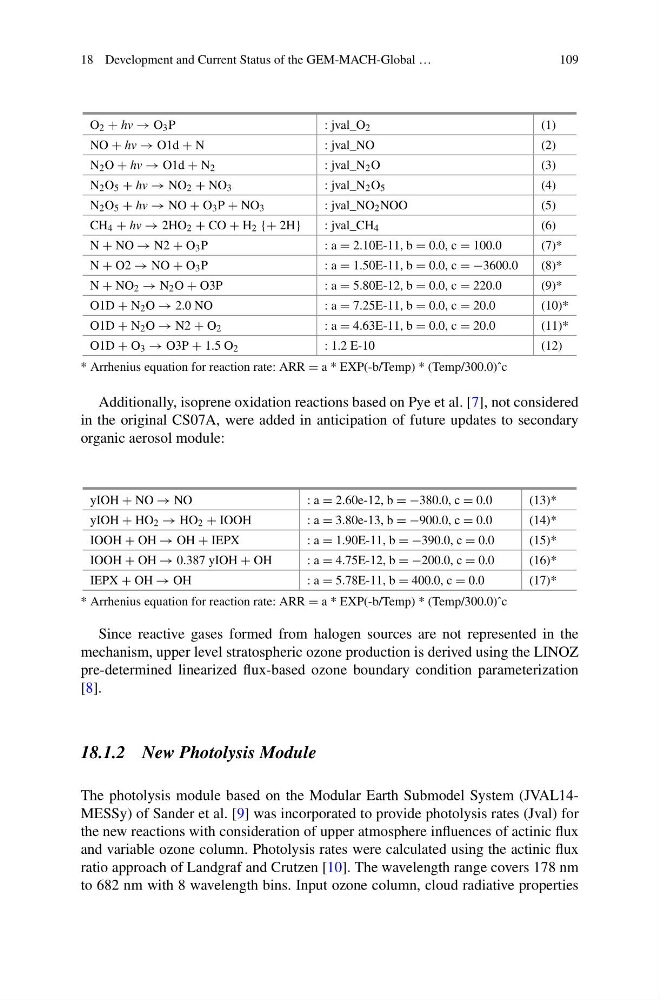
Additionally, isoprene oxidation reactions based on Pye et al. [7], not considered
in the original CS07A, were added in anticipation of future updates to secondary
organic aerosol module:
yIOH + NO → NO
: a = 2.60e-12, b = −380.0, c = 0.0
(13)*
yIOH + HO 2 → HO 2 + IOOH
: a = 3.80e-13, b = −900.0, c = 0.0
(14)*
IOOH + OH → OH + IEPX
: a = 1.90E-11, b = −390.0, c = 0.0
(15)*
IOOH + OH → 0.387 yIOH + OH
: a = 4.75E-12, b = −200.0, c = 0.0
(16)*
IEPX + OH → OH
: a = 5.78E-11, b = 400.0, c = 0.0
(17)*
* Arrhenius equation for reaction rate: ARR = a * EXP(-b/Temp) * (Temp/300.0)ˆc
Since reactive gases formed from halogen sources are not represented in the
mechanism, upper level stratospheric ozone production is derived using the LINOZ
pre-determined linearized flux-based ozone boundary condition parameterization
[8].
18.1.2 New Photolysis Module
The photolysis module based on the Modular Earth Submodel System (JVAL14MESSy) of Sander et al. [9] was incorporated to provide photolysis rates (Jval) for
the new reactions with consideration of upper atmosphere influences of actinic flux
and variable ozone column. Photolysis rates were calculated using the actinic flux
ratio approach of Landgraf and Crutzen [10]. The wavelength range covers 178 nm
to 682 nm with 8 wavelength bins. Input ozone column, cloud radiative properties
109
O 2 + hv → O 3 P
: jval_O 2
(1)
NO + hv → O1d + N
: jval_NO
(2)
N 2 O + hv → O1d + N 2
: jval_N 2 O
(3)
N 2 O 5 + hv → NO 2 + NO 3
: jval_N 2 O 5
(4)
N 2 O 5 + hv → NO + O 3 P + NO 3
: jval_NO 2 NOO
(5)
CH 4 + hv → 2HO 2 + CO + H 2 {+ 2H}
: jval_CH 4
(6)
N + NO → N2 + O 3 P
: a = 2.10E-11, b = 0.0, c = 100.0
(7)*
N + O2 → NO + O 3 P
: a = 1.50E-11, b = 0.0, c = −3600.0
(8)*
N + NO 2 → N 2 O + O3P
: a = 5.80E-12, b = 0.0, c = 220.0
(9)*
O1D + N 2 O → 2.0 NO
: a = 7.25E-11, b = 0.0, c = 20.0
(10)*
O1D + N 2 O → N2 + O 2
: a = 4.63E-11, b = 0.0, c = 20.0
(11)*
O1D + O 3 → O3P + 1.5 O 2
: 1.2 E-10
(12)
* Arrhenius equation for reaction rate: ARR = a * EXP(-b/Temp) * (Temp/300.0)ˆc
Additionally, isoprene oxidation reactions based on Pye et al. [7], not considered
in the original CS07A, were added in anticipation of future updates to secondary
organic aerosol module:
yIOH + NO → NO
: a = 2.60e-12, b = −380.0, c = 0.0
(13)*
yIOH + HO 2 → HO 2 + IOOH
: a = 3.80e-13, b = −900.0, c = 0.0
(14)*
IOOH + OH → OH + IEPX
: a = 1.90E-11, b = −390.0, c = 0.0
(15)*
IOOH + OH → 0.387 yIOH + OH
: a = 4.75E-12, b = −200.0, c = 0.0
(16)*
IEPX + OH → OH
: a = 5.78E-11, b = 400.0, c = 0.0
(17)*
* Arrhenius equation for reaction rate: ARR = a * EXP(-b/Temp) * (Temp/300.0)ˆc
Since reactive gases formed from halogen sources are not represented in the
mechanism, upper level stratospheric ozone production is derived using the LINOZ
pre-determined linearized flux-based ozone boundary condition parameterization
[8].
18.1.2 New Photolysis Module
The photolysis module based on the Modular Earth Submodel System (JVAL14MESSy) of Sander et al. [9] was incorporated to provide photolysis rates (Jval) for
the new reactions with consideration of upper atmosphere influences of actinic flux
and variable ozone column. Photolysis rates were calculated using the actinic flux
ratio approach of Landgraf and Crutzen [10]. The wavelength range covers 178 nm
to 682 nm with 8 wavelength bins. Input ozone column, cloud radiative properties