

74
A. Delcloo et al.
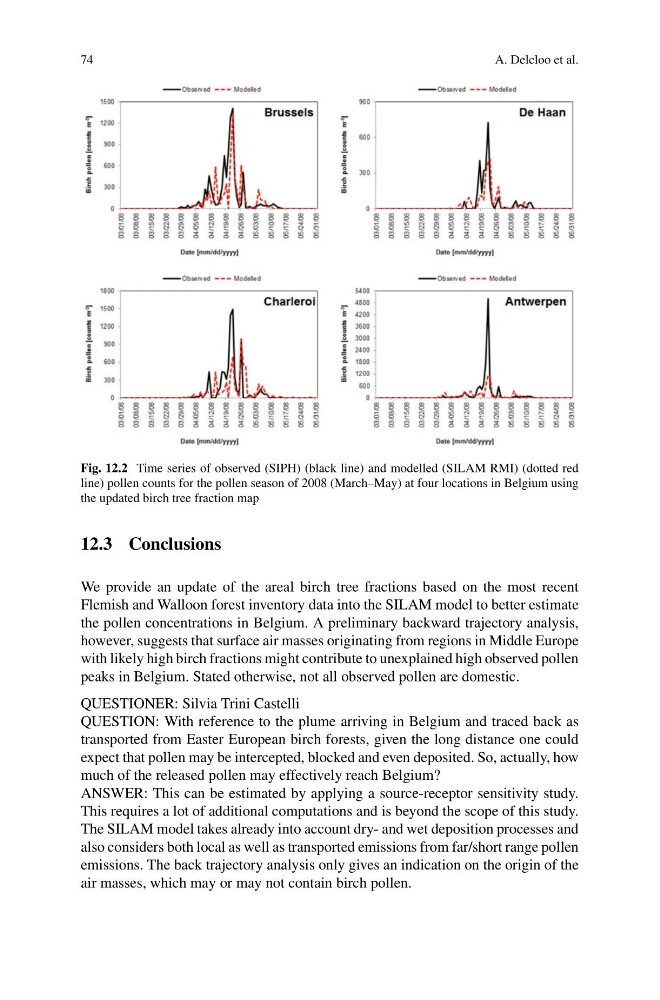
Fig. 12.2 Time series of observed (SIPH) (black line) and modelled (SILAM RMI) (dotted red
line) pollen counts for the pollen season of 2008 (March–May) at four locations in Belgium using
the updated birch tree fraction map
12.3 Conclusions
We provide an update of the areal birch tree fractions based on the most recent
Flemish and Walloon forest inventory data into the SILAM model to better estimate
the pollen concentrations in Belgium. A preliminary backward trajectory analysis,
however, suggests that surface air masses originating from regions in Middle Europe
with likely high birch fractions might contribute to unexplained high observed pollen
peaks in Belgium. Stated otherwise, not all observed pollen are domestic.
QUESTIONER: Silvia Trini Castelli
QUESTION: With reference to the plume arriving in Belgium and traced back as
transported from Easter European birch forests, given the long distance one could
expect that pollen may be intercepted, blocked and even deposited. So, actually, how
much of the released pollen may effectively reach Belgium?
ANSWER: This can be estimated by applying a source-receptor sensitivity study.
This requires a lot of additional computations and is beyond the scope of this study.
The SILAM model takes already into account dry- and wet deposition processes and
also considers both local as well as transported emissions from far/short range pollen
emissions. The back trajectory analysis only gives an indication on the origin of the
air masses, which may or may not contain birch pollen.
A. Delcloo et al.
Fig. 12.2 Time series of observed (SIPH) (black line) and modelled (SILAM RMI) (dotted red
line) pollen counts for the pollen season of 2008 (March–May) at four locations in Belgium using
the updated birch tree fraction map
12.3 Conclusions
We provide an update of the areal birch tree fractions based on the most recent
Flemish and Walloon forest inventory data into the SILAM model to better estimate
the pollen concentrations in Belgium. A preliminary backward trajectory analysis,
however, suggests that surface air masses originating from regions in Middle Europe
with likely high birch fractions might contribute to unexplained high observed pollen
peaks in Belgium. Stated otherwise, not all observed pollen are domestic.
QUESTIONER: Silvia Trini Castelli
QUESTION: With reference to the plume arriving in Belgium and traced back as
transported from Easter European birch forests, given the long distance one could
expect that pollen may be intercepted, blocked and even deposited. So, actually, how
much of the released pollen may effectively reach Belgium?
ANSWER: This can be estimated by applying a source-receptor sensitivity study.
This requires a lot of additional computations and is beyond the scope of this study.
The SILAM model takes already into account dry- and wet deposition processes and
also considers both local as well as transported emissions from far/short range pollen
emissions. The back trajectory analysis only gives an indication on the origin of the
air masses, which may or may not contain birch pollen.