

62
6 Herz’s Task
M
N
=
(1 − e 2 )[K(e) − E(e)]
E(e) − (1 − e 2 )K(e)
,
M + N = πbc(k 1 + k 2 )
E(e)
(1 − e 2 )a 2 .
(6.29)
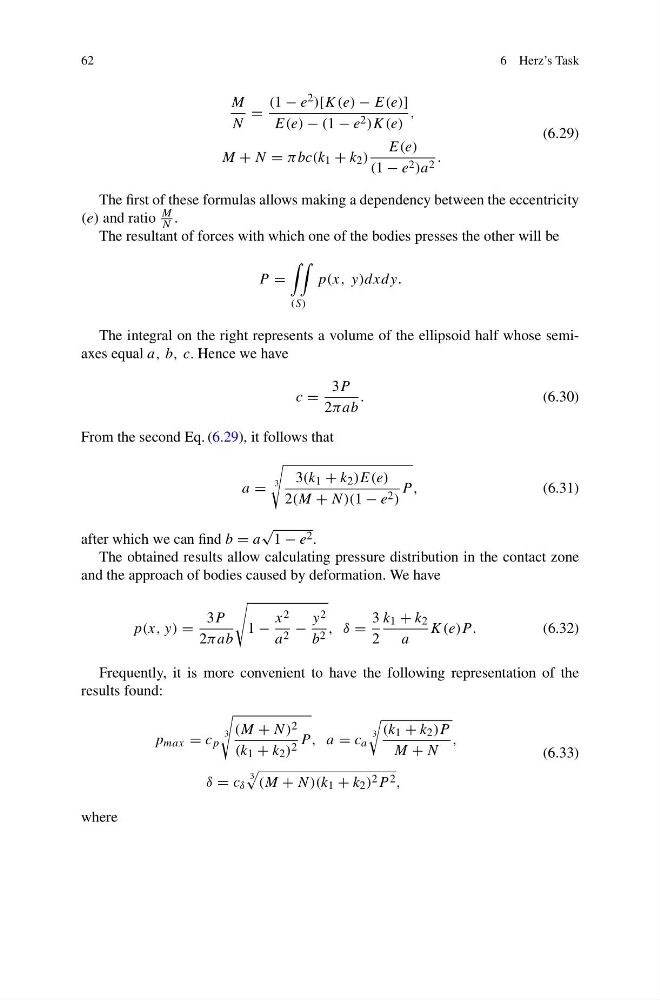
The first of these formulas allows making a dependency between the eccentricity
(e) and ratio
M
N .
The resultant of forces with which one of the bodies presses the other will be
P =
(S)
p(x, y)dxdy.
The integral on the right represents a volume of the ellipsoid half whose semiaxes equal a, b, c. Hence we have
c =
3P
2πab
.
(6.30)
From the second Eq. (6.29), it follows that
a =
3
3(k 1 + k 2 )E(e)
2(M + N)(1 − e 2 )
P ,
(6.31)
after which we can find b = a
√
1 − e 2 .
The obtained results allow calculating pressure distribution in the contact zone
and the approach of bodies caused by deformation. We have
p(x, y) =
3P
2πab
1 −
x 2
a 2 −
y 2
b 2 , δ =
3
2
k 1 + k 2
a
K(e)P .
(6.32)
Frequently, it is more convenient to have the following representation of the
results found:
p max = c p
3
(M + N) 2
(k 1 + k 2 ) 2 P , a = c a
3
(k 1 + k 2 )P
M + N
,
δ = c δ
3
(M + N)(k 1 + k 2 ) 2 P 2 ,
(6.33)
where
6 Herz’s Task
M
N
=
(1 − e 2 )[K(e) − E(e)]
E(e) − (1 − e 2 )K(e)
,
M + N = πbc(k 1 + k 2 )
E(e)
(1 − e 2 )a 2 .
(6.29)
The first of these formulas allows making a dependency between the eccentricity
(e) and ratio
M
N .
The resultant of forces with which one of the bodies presses the other will be
P =
(S)
p(x, y)dxdy.
The integral on the right represents a volume of the ellipsoid half whose semiaxes equal a, b, c. Hence we have
c =
3P
2πab
.
(6.30)
From the second Eq. (6.29), it follows that
a =
3
3(k 1 + k 2 )E(e)
2(M + N)(1 − e 2 )
P ,
(6.31)
after which we can find b = a
√
1 − e 2 .
The obtained results allow calculating pressure distribution in the contact zone
and the approach of bodies caused by deformation. We have
p(x, y) =
3P
2πab
1 −
x 2
a 2 −
y 2
b 2 , δ =
3
2
k 1 + k 2
a
K(e)P .
(6.32)
Frequently, it is more convenient to have the following representation of the
results found:
p max = c p
3
(M + N) 2
(k 1 + k 2 ) 2 P , a = c a
3
(k 1 + k 2 )P
M + N
,
δ = c δ
3
(M + N)(k 1 + k 2 ) 2 P 2 ,
(6.33)
where