

56
6 Herz’s Task
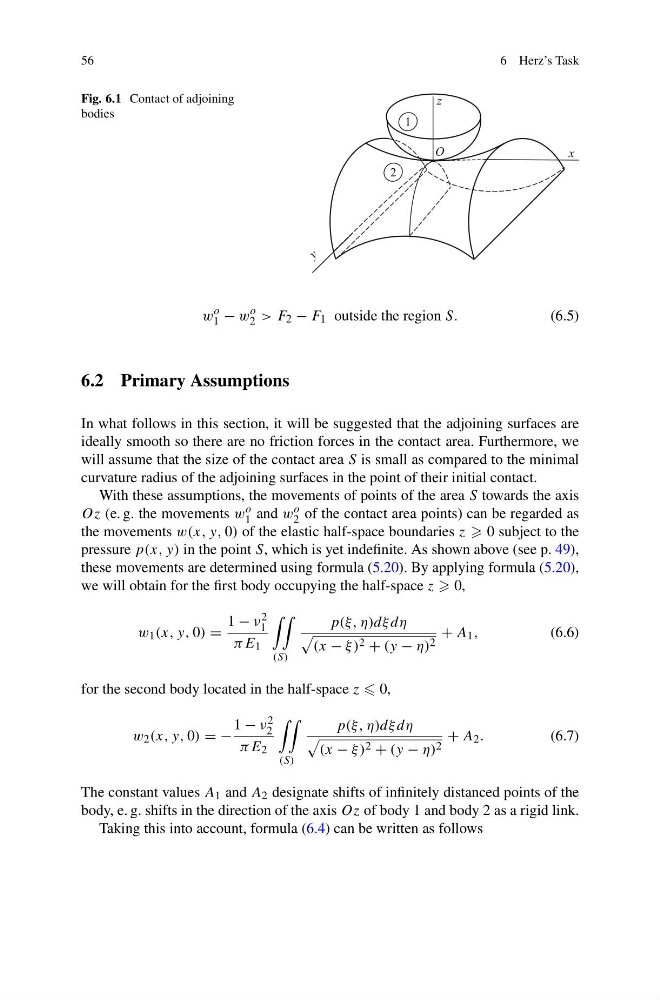
Fig. 6.1 Contact of adjoining
bodies
w
o
1 − w
o
2 > F 2 − F 1 outside the region S.
(6.5)
6.2 Primary Assumptions
In what follows in this section, it will be suggested that the adjoining surfaces are
ideally smooth so there are no friction forces in the contact area. Furthermore, we
will assume that the size of the contact area S is small as compared to the minimal
curvature radius of the adjoining surfaces in the point of their initial contact.
With these assumptions, the movements of points of the area S towards the axis
Oz (e. g. the movements w o
1 and w o
2 of the contact area points) can be regarded as
the movements w(x, y, 0) of the elastic half-space boundaries z 0 subject to the
pressure p(x, y) in the point S, which is yet indefinite. As shown above (see p. 49),
these movements are determined using formula (5.20). By applying formula (5.20),
we will obtain for the first body occupying the half-space z 0,
w 1 (x, y, 0) =
1 − ν 2
1
πE 1
(S)
p(ξ, η)dξ dη
(x − ξ) 2 + (y − η) 2
+ A 1 ,
(6.6)
for the second body located in the half-space z 0,
w 2 (x, y, 0) = −
1 − ν 2
2
πE 2
(S)
p(ξ, η)dξ dη
(x − ξ) 2 + (y − η) 2
+ A 2 .
(6.7)
The constant values A 1 and A 2 designate shifts of infinitely distanced points of the
body, e. g. shifts in the direction of the axis Oz of body 1 and body 2 as a rigid link.
Taking this into account, formula (6.4) can be written as follows
6 Herz’s Task
Fig. 6.1 Contact of adjoining
bodies
w
o
1 − w
o
2 > F 2 − F 1 outside the region S.
(6.5)
6.2 Primary Assumptions
In what follows in this section, it will be suggested that the adjoining surfaces are
ideally smooth so there are no friction forces in the contact area. Furthermore, we
will assume that the size of the contact area S is small as compared to the minimal
curvature radius of the adjoining surfaces in the point of their initial contact.
With these assumptions, the movements of points of the area S towards the axis
Oz (e. g. the movements w o
1 and w o
2 of the contact area points) can be regarded as
the movements w(x, y, 0) of the elastic half-space boundaries z 0 subject to the
pressure p(x, y) in the point S, which is yet indefinite. As shown above (see p. 49),
these movements are determined using formula (5.20). By applying formula (5.20),
we will obtain for the first body occupying the half-space z 0,
w 1 (x, y, 0) =
1 − ν 2
1
πE 1
(S)
p(ξ, η)dξ dη
(x − ξ) 2 + (y − η) 2
+ A 1 ,
(6.6)
for the second body located in the half-space z 0,
w 2 (x, y, 0) = −
1 − ν 2
2
πE 2
(S)
p(ξ, η)dξ dη
(x − ξ) 2 + (y − η) 2
+ A 2 .
(6.7)
The constant values A 1 and A 2 designate shifts of infinitely distanced points of the
body, e. g. shifts in the direction of the axis Oz of body 1 and body 2 as a rigid link.
Taking this into account, formula (6.4) can be written as follows