

432
32 On Boundary Value Problems of Inelastic Body Mechanics
1 (z 1 ) = −2c ·
R 2
1 R 2
2
R 2
2 − R 2
1
ln
R 2
R 1
·
1
z 2
1
; R 1 |z 1 | R 2 ;
c =
E
8π(1 − ν 2 )
,
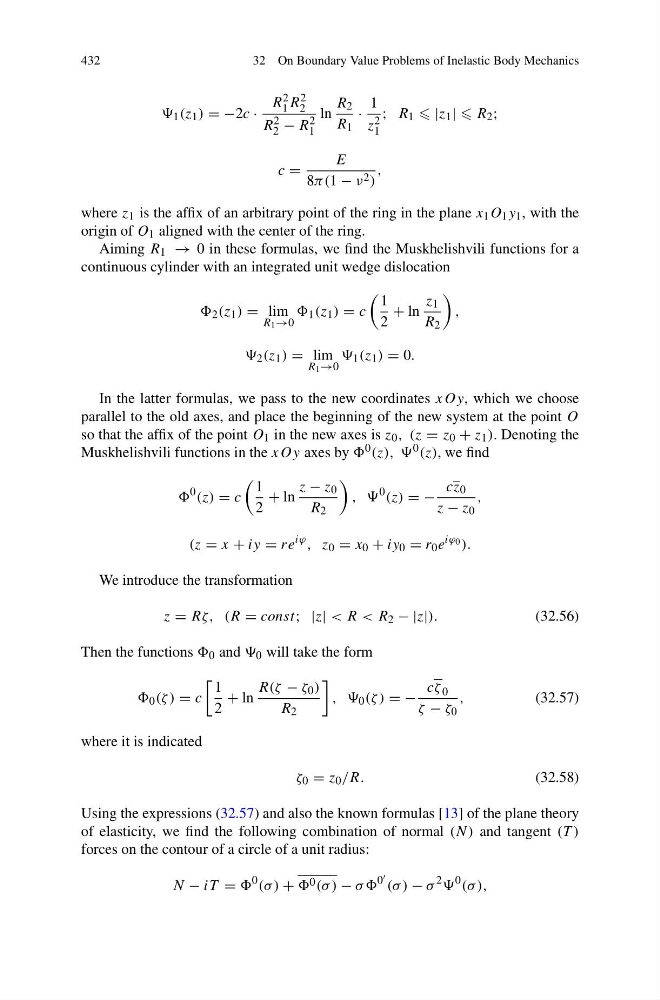
where z 1 is the affix of an arbitrary point of the ring in the plane x 1 O 1 y 1 , with the
origin of O 1 aligned with the center of the ring.
Aiming R 1 → 0 in these formulas, we find the Muskhelishvili functions for a
continuous cylinder with an integrated unit wedge dislocation
2 (z 1 ) = lim
R 1 →0
1 (z 1 ) = c
1
2
+ ln
z 1
R 2
,
2 (z 1 ) = lim
R 1 →0
1 (z 1 ) = 0.
In the latter formulas, we pass to the new coordinates xOy, which we choose
parallel to the old axes, and place the beginning of the new system at the point O
so that the affix of the point O 1 in the new axes is z 0 , (z = z 0 + z 1 ). Denoting the
Muskhelishvili functions in the xOy axes by 0 (z), , 0 (z), we find
0 (z) = c
1
2
+ ln
z − z 0
R 2
, ,
0 (z) = −
cz 0
z − z 0
,
(z = x + iy = re
iϕ , z 0 = x 0 + iy 0 = r 0 e
iϕ 0 ).
We introduce the transformation
z = Rζ, (R = const; |z| < R < R 2 − |z|).
(32.56)
Then the functions 0 and 0 will take the form
0 (ζ ) = c
1
2
+ ln
R(ζ − ζ 0 )
R 2
, , 0 (ζ ) = −
cζ 0
ζ − ζ 0
,
(32.57)
where it is indicated
ζ 0 = z 0 /R.
(32.58)
Using the expressions (32.57) and also the known formulas [13] of the plane theory
of elasticity, we find the following combination of normal (N) and tangent (T )
forces on the contour of a circle of a unit radius:
N − iT =
0 (σ ) + 0 (σ ) − σ σ
0 (σ ) − σ
2
0 (σ ),
32 On Boundary Value Problems of Inelastic Body Mechanics
1 (z 1 ) = −2c ·
R 2
1 R 2
2
R 2
2 − R 2
1
ln
R 2
R 1
·
1
z 2
1
; R 1 |z 1 | R 2 ;
c =
E
8π(1 − ν 2 )
,
where z 1 is the affix of an arbitrary point of the ring in the plane x 1 O 1 y 1 , with the
origin of O 1 aligned with the center of the ring.
Aiming R 1 → 0 in these formulas, we find the Muskhelishvili functions for a
continuous cylinder with an integrated unit wedge dislocation
2 (z 1 ) = lim
R 1 →0
1 (z 1 ) = c
1
2
+ ln
z 1
R 2
,
2 (z 1 ) = lim
R 1 →0
1 (z 1 ) = 0.
In the latter formulas, we pass to the new coordinates xOy, which we choose
parallel to the old axes, and place the beginning of the new system at the point O
so that the affix of the point O 1 in the new axes is z 0 , (z = z 0 + z 1 ). Denoting the
Muskhelishvili functions in the xOy axes by 0 (z), , 0 (z), we find
0 (z) = c
1
2
+ ln
z − z 0
R 2
, ,
0 (z) = −
cz 0
z − z 0
,
(z = x + iy = re
iϕ , z 0 = x 0 + iy 0 = r 0 e
iϕ 0 ).
We introduce the transformation
z = Rζ, (R = const; |z| < R < R 2 − |z|).
(32.56)
Then the functions 0 and 0 will take the form
0 (ζ ) = c
1
2
+ ln
R(ζ − ζ 0 )
R 2
, , 0 (ζ ) = −
cζ 0
ζ − ζ 0
,
(32.57)
where it is indicated
ζ 0 = z 0 /R.
(32.58)
Using the expressions (32.57) and also the known formulas [13] of the plane theory
of elasticity, we find the following combination of normal (N) and tangent (T )
forces on the contour of a circle of a unit radius:
N − iT =
0 (σ ) + 0 (σ ) − σ σ
0 (σ ) − σ
2
0 (σ ),