

32.8 The Application of Kröner’s Method to the Brazilian Test
431
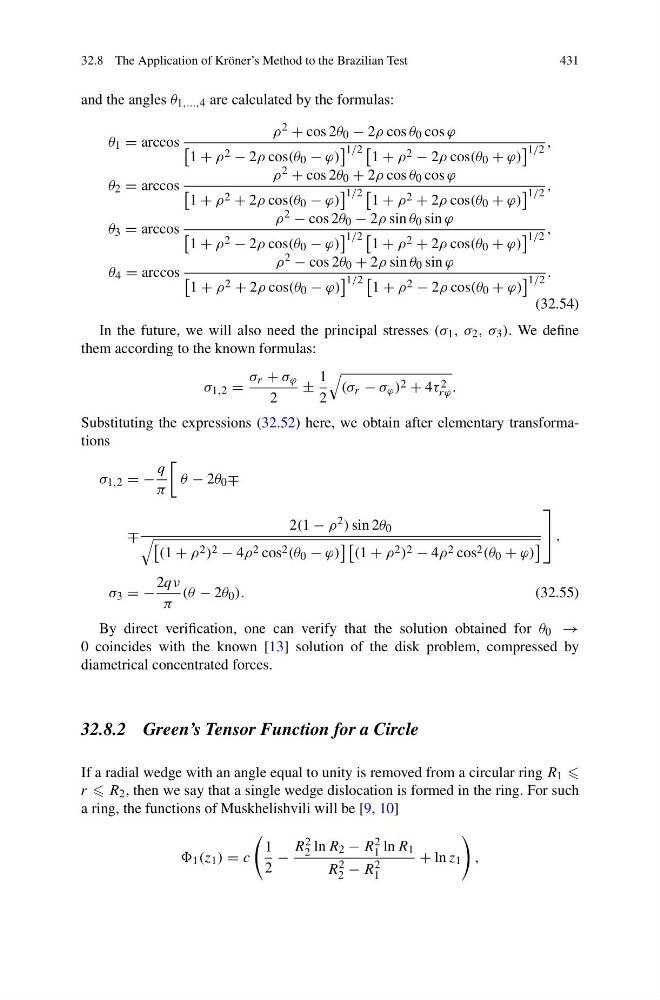
and the angles θ 1,...,4 are calculated by the formulas:
θ 1 = arccos
ρ 2 + cos 2θ 0 − 2ρ cos θ 0 cos ϕ
1 + ρ 2 − 2ρ cos(θ 0 − ϕ)
1/2
1 + ρ 2 − 2ρ cos(θ 0 + ϕ)
1/2 ,
θ 2 = arccos
ρ 2 + cos 2θ 0 + 2ρ cos θ 0 cos ϕ
1 + ρ 2 + 2ρ cos(θ 0 − ϕ)
1/2
1 + ρ 2 + 2ρ cos(θ 0 + ϕ)
1/2 ,
θ 3 = arccos
ρ 2 − cos 2θ 0 − 2ρ sin θ 0 sin ϕ
1 + ρ 2 − 2ρ cos(θ 0 − ϕ)
1/2
1 + ρ 2 + 2ρ cos(θ 0 + ϕ)
1/2 ,
θ 4 = arccos
ρ 2 − cos 2θ 0 + 2ρ sin θ 0 sin ϕ
1 + ρ 2 + 2ρ cos(θ 0 − ϕ)
1/2
1 + ρ 2 − 2ρ cos(θ 0 + ϕ)
1/2 .
(32.54)
In the future, we will also need the principal stresses (σ 1 , σ 2 , σ 3 ). We define
them according to the known formulas:
σ 1,2 =
σ r + σ ϕ
2
±
1
2
(σ r − σ ϕ ) 2 + 4τ 2
rϕ .
Substituting the expressions (32.52) here, we obtain after elementary transformations
σ 1,2 = −
q
π
θ − 2θ 0 ∓
∓
2(1 − ρ 2 ) sin 2θ 0
(1 + ρ 2 ) 2 − 4ρ 2 cos 2 (θ 0 − ϕ)
(1 + ρ 2 ) 2 − 4ρ 2 cos 2 (θ 0 + ϕ)
⎤
⎦ ,
σ 3 = −
2qν
π
(θ − 2θ 0 ).
(32.55)
By direct verification, one can verify that the solution obtained for θ 0 →
0 coincides with the known [13] solution of the disk problem, compressed by
diametrical concentrated forces.
32.8.2 Green’s Tensor Function for a Circle
If a radial wedge with an angle equal to unity is removed from a circular ring R 1
r R 2 , then we say that a single wedge dislocation is formed in the ring. For such
a ring, the functions of Muskhelishvili will be [9, 10]
1 (z 1 ) = c
1
2
−
R 2
2 ln R 2 − R 2
1 ln R 1
R 2
2 − R 2
1
+ ln z 1
,
431
and the angles θ 1,...,4 are calculated by the formulas:
θ 1 = arccos
ρ 2 + cos 2θ 0 − 2ρ cos θ 0 cos ϕ
1 + ρ 2 − 2ρ cos(θ 0 − ϕ)
1/2
1 + ρ 2 − 2ρ cos(θ 0 + ϕ)
1/2 ,
θ 2 = arccos
ρ 2 + cos 2θ 0 + 2ρ cos θ 0 cos ϕ
1 + ρ 2 + 2ρ cos(θ 0 − ϕ)
1/2
1 + ρ 2 + 2ρ cos(θ 0 + ϕ)
1/2 ,
θ 3 = arccos
ρ 2 − cos 2θ 0 − 2ρ sin θ 0 sin ϕ
1 + ρ 2 − 2ρ cos(θ 0 − ϕ)
1/2
1 + ρ 2 + 2ρ cos(θ 0 + ϕ)
1/2 ,
θ 4 = arccos
ρ 2 − cos 2θ 0 + 2ρ sin θ 0 sin ϕ
1 + ρ 2 + 2ρ cos(θ 0 − ϕ)
1/2
1 + ρ 2 − 2ρ cos(θ 0 + ϕ)
1/2 .
(32.54)
In the future, we will also need the principal stresses (σ 1 , σ 2 , σ 3 ). We define
them according to the known formulas:
σ 1,2 =
σ r + σ ϕ
2
±
1
2
(σ r − σ ϕ ) 2 + 4τ 2
rϕ .
Substituting the expressions (32.52) here, we obtain after elementary transformations
σ 1,2 = −
q
π
θ − 2θ 0 ∓
∓
2(1 − ρ 2 ) sin 2θ 0
(1 + ρ 2 ) 2 − 4ρ 2 cos 2 (θ 0 − ϕ)
(1 + ρ 2 ) 2 − 4ρ 2 cos 2 (θ 0 + ϕ)
⎤
⎦ ,
σ 3 = −
2qν
π
(θ − 2θ 0 ).
(32.55)
By direct verification, one can verify that the solution obtained for θ 0 →
0 coincides with the known [13] solution of the disk problem, compressed by
diametrical concentrated forces.
32.8.2 Green’s Tensor Function for a Circle
If a radial wedge with an angle equal to unity is removed from a circular ring R 1
r R 2 , then we say that a single wedge dislocation is formed in the ring. For such
a ring, the functions of Muskhelishvili will be [9, 10]
1 (z 1 ) = c
1
2
−
R 2
2 ln R 2 − R 2
1 ln R 1
R 2
2 − R 2
1
+ ln z 1
,