

32.3 An Example of Using the Birger Method
417
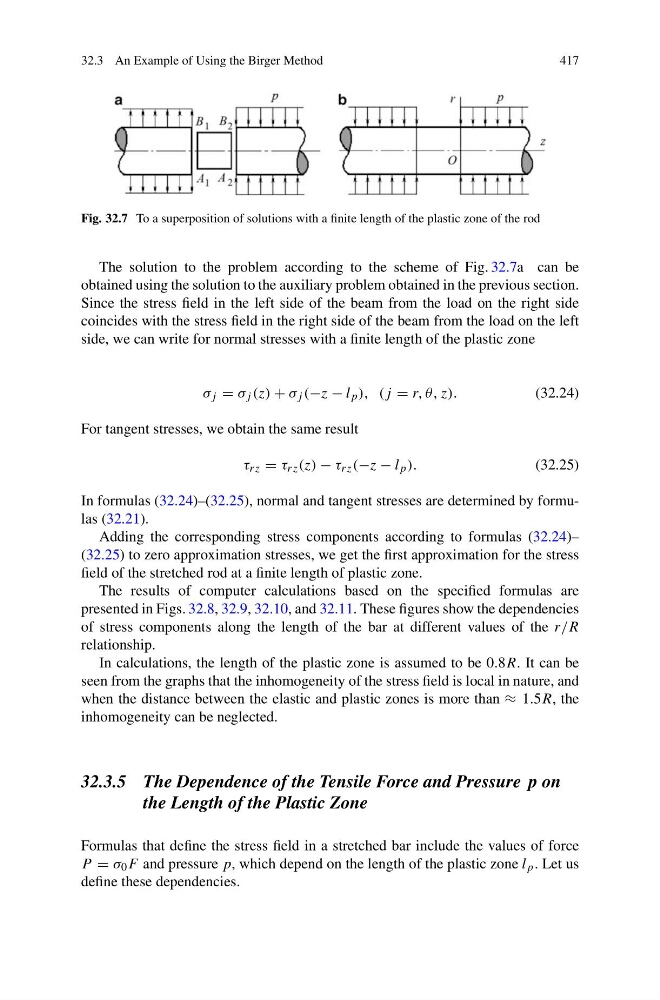
Fig. 32.7 To a superposition of solutions with a finite length of the plastic zone of the rod
The solution to the problem according to the scheme of Fig. 32.7a can be
obtained using the solution to the auxiliary problem obtained in the previous section.
Since the stress field in the left side of the beam from the load on the right side
coincides with the stress field in the right side of the beam from the load on the left
side, we can write for normal stresses with a finite length of the plastic zone
σ j = σ j (z) + σ j (−z − l p ), (j = r, θ, z).
(32.24)
For tangent stresses, we obtain the same result
τ rz = τ rz (z) − τ rz (−z − l p ).
(32.25)
In formulas (32.24)–(32.25), normal and tangent stresses are determined by formulas (32.21).
Adding the corresponding stress components according to formulas (32.24)–
(32.25) to zero approximation stresses, we get the first approximation for the stress
field of the stretched rod at a finite length of plastic zone.
The results of computer calculations based on the specified formulas are
presented in Figs. 32.8, 32.9, 32.10, and 32.11. These figures show the dependencies
of stress components along the length of the bar at different values of the r/R
relationship.
In calculations, the length of the plastic zone is assumed to be 0.8R. It can be
seen from the graphs that the inhomogeneity of the stress field is local in nature, and
when the distance between the elastic and plastic zones is more than ≈ 1.5R, the
inhomogeneity can be neglected.
32.3.5 The Dependence of the Tensile Force and Pressure p on
the Length of the Plastic Zone
Formulas that define the stress field in a stretched bar include the values of force
P = σ 0 F and pressure p, which depend on the length of the plastic zone l p . Let us
define these dependencies.
417
Fig. 32.7 To a superposition of solutions with a finite length of the plastic zone of the rod
The solution to the problem according to the scheme of Fig. 32.7a can be
obtained using the solution to the auxiliary problem obtained in the previous section.
Since the stress field in the left side of the beam from the load on the right side
coincides with the stress field in the right side of the beam from the load on the left
side, we can write for normal stresses with a finite length of the plastic zone
σ j = σ j (z) + σ j (−z − l p ), (j = r, θ, z).
(32.24)
For tangent stresses, we obtain the same result
τ rz = τ rz (z) − τ rz (−z − l p ).
(32.25)
In formulas (32.24)–(32.25), normal and tangent stresses are determined by formulas (32.21).
Adding the corresponding stress components according to formulas (32.24)–
(32.25) to zero approximation stresses, we get the first approximation for the stress
field of the stretched rod at a finite length of plastic zone.
The results of computer calculations based on the specified formulas are
presented in Figs. 32.8, 32.9, 32.10, and 32.11. These figures show the dependencies
of stress components along the length of the bar at different values of the r/R
relationship.
In calculations, the length of the plastic zone is assumed to be 0.8R. It can be
seen from the graphs that the inhomogeneity of the stress field is local in nature, and
when the distance between the elastic and plastic zones is more than ≈ 1.5R, the
inhomogeneity can be neglected.
32.3.5 The Dependence of the Tensile Force and Pressure p on
the Length of the Plastic Zone
Formulas that define the stress field in a stretched bar include the values of force
P = σ 0 F and pressure p, which depend on the length of the plastic zone l p . Let us
define these dependencies.