

388
29 Plane-Plastic Strain
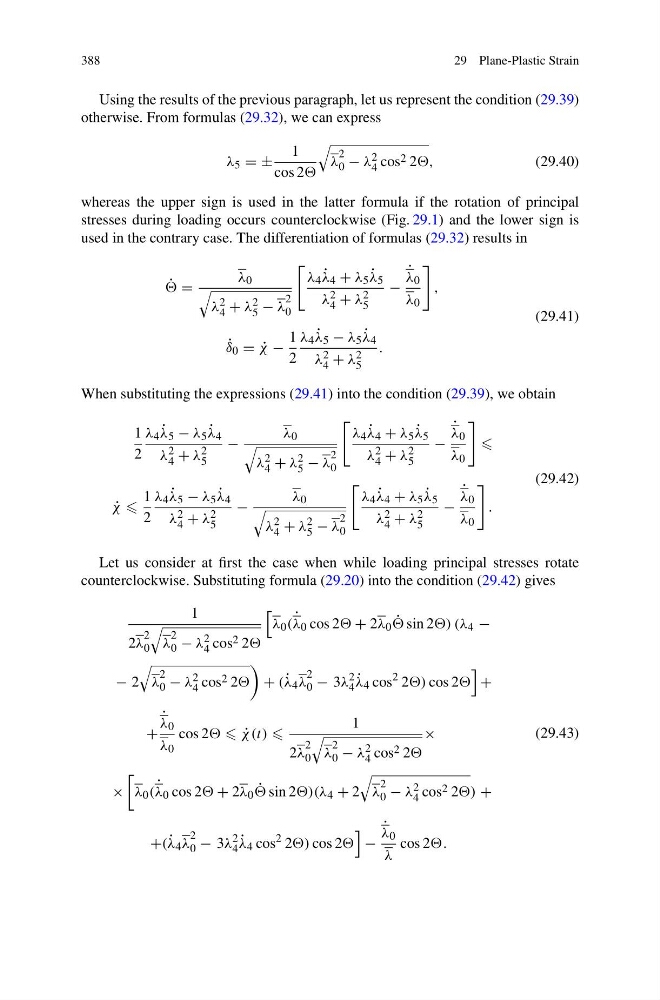
Using the results of the previous paragraph, let us represent the condition (29.39)
otherwise. From formulas (29.32), we can express
λ 5 = ±
1
cos 2
λ
2
0 − λ 2
4 cos 2 2,
(29.40)
whereas the upper sign is used in the latter formula if the rotation of principal
stresses during loading occurs counterclockwise (Fig. 29.1) and the lower sign is
used in the contrary case. The differentiation of formulas (29.32) results in
˙
=
λ 0
λ 2
4 + λ 2
5 − λ
2
0
λ 4 ˙
λ 4 + λ 5 ˙
λ 5
λ 2
4 + λ 2
5
−
˙
λ 0
λ 0
,
˙
δ 0 = ˙
χ −
1
2
λ 4 ˙
λ 5 − λ 5 ˙
λ 4
λ 2
4 + λ 2
5
.
(29.41)
When substituting the expressions (29.41) into the condition (29.39), we obtain
1
2
λ 4 ˙
λ 5 − λ 5 ˙
λ 4
λ 2
4 + λ 2
5
−
λ 0
λ 2
4 + λ 2
5 − λ
2
0
λ 4 ˙
λ 4 + λ 5 ˙
λ 5
λ 2
4 + λ 2
5
−
˙
λ 0
λ 0
˙
χ
1
2
λ 4 ˙
λ 5 − λ 5 ˙
λ 4
λ 2
4 + λ 2
5
−
λ 0
λ 2
4 + λ 2
5 − λ
2
0
λ 4 ˙
λ 4 + λ 5 ˙
λ 5
λ 2
4 + λ 2
5
−
˙
λ 0
λ 0
.
(29.42)
Let us consider at first the case when while loading principal stresses rotate
counterclockwise. Substituting formula (29.20) into the condition (29.42) gives
1
2λ
2
0
λ
2
0 − λ 2
4 cos 2 2
λ 0 ( ˙
λ 0 cos 2 + 2λ 0 ˙
sin 2) (λ 4 −
− 2
λ
2
0 − λ 2
4 cos 2 2
+ ( ˙
λ 4 λ
2
0 − 3λ
2
4
˙
λ 4 cos
2 2) cos 2
+
+
˙
λ 0
λ 0
cos 2 ˙
χ(t)
1
2λ
2
0
λ
2
0 − λ 2
4 cos 2 2
×
×
λ 0 ( ˙
λ 0 cos 2 + 2λ 0 ˙
sin 2)(λ 4 + 2
λ
2
0 − λ 2
4 cos 2 2) +
+( ˙
λ 4 λ
2
0 − 3λ
2
4
˙
λ 4 cos
2 2) cos 2
−
˙
λ 0
λ
cos 2.
(29.43)
29 Plane-Plastic Strain
Using the results of the previous paragraph, let us represent the condition (29.39)
otherwise. From formulas (29.32), we can express
λ 5 = ±
1
cos 2
λ
2
0 − λ 2
4 cos 2 2,
(29.40)
whereas the upper sign is used in the latter formula if the rotation of principal
stresses during loading occurs counterclockwise (Fig. 29.1) and the lower sign is
used in the contrary case. The differentiation of formulas (29.32) results in
˙
=
λ 0
λ 2
4 + λ 2
5 − λ
2
0
λ 4 ˙
λ 4 + λ 5 ˙
λ 5
λ 2
4 + λ 2
5
−
˙
λ 0
λ 0
,
˙
δ 0 = ˙
χ −
1
2
λ 4 ˙
λ 5 − λ 5 ˙
λ 4
λ 2
4 + λ 2
5
.
(29.41)
When substituting the expressions (29.41) into the condition (29.39), we obtain
1
2
λ 4 ˙
λ 5 − λ 5 ˙
λ 4
λ 2
4 + λ 2
5
−
λ 0
λ 2
4 + λ 2
5 − λ
2
0
λ 4 ˙
λ 4 + λ 5 ˙
λ 5
λ 2
4 + λ 2
5
−
˙
λ 0
λ 0
˙
χ
1
2
λ 4 ˙
λ 5 − λ 5 ˙
λ 4
λ 2
4 + λ 2
5
−
λ 0
λ 2
4 + λ 2
5 − λ
2
0
λ 4 ˙
λ 4 + λ 5 ˙
λ 5
λ 2
4 + λ 2
5
−
˙
λ 0
λ 0
.
(29.42)
Let us consider at first the case when while loading principal stresses rotate
counterclockwise. Substituting formula (29.20) into the condition (29.42) gives
1
2λ
2
0
λ
2
0 − λ 2
4 cos 2 2
λ 0 ( ˙
λ 0 cos 2 + 2λ 0 ˙
sin 2) (λ 4 −
− 2
λ
2
0 − λ 2
4 cos 2 2
+ ( ˙
λ 4 λ
2
0 − 3λ
2
4
˙
λ 4 cos
2 2) cos 2
+
+
˙
λ 0
λ 0
cos 2 ˙
χ(t)
1
2λ
2
0
λ
2
0 − λ 2
4 cos 2 2
×
×
λ 0 ( ˙
λ 0 cos 2 + 2λ 0 ˙
sin 2)(λ 4 + 2
λ
2
0 − λ 2
4 cos 2 2) +
+( ˙
λ 4 λ
2
0 − 3λ
2
4
˙
λ 4 cos
2 2) cos 2
−
˙
λ 0
λ
cos 2.
(29.43)