

29.3 Monotonous Plane-Plastic Strain
387
γ m (t) + ε ˙
γ m (t) =
λ 4 (t)τ m (t)
gτ xy (t)
N(() cos 2 sin 2χ 1 (t).
(29.35)
Having in mind the designations (29.25), we will find
γ m (t) + ε ˙
γ m (t) =
τ m (t) + AA
gg[t]
·
−
1
4 sin 4
1 +
c
g
−
1
4 sin 4
.
(29.36)
Finally, from Eq. (29.36) and the first of formulas (29.16), we obtain
cos 2 =
λ 0 (t)
λ 2
5 (t) +
τ m (t) + AA
[t][1 + (( − 0.25 sin 4
2
.
(29.37)
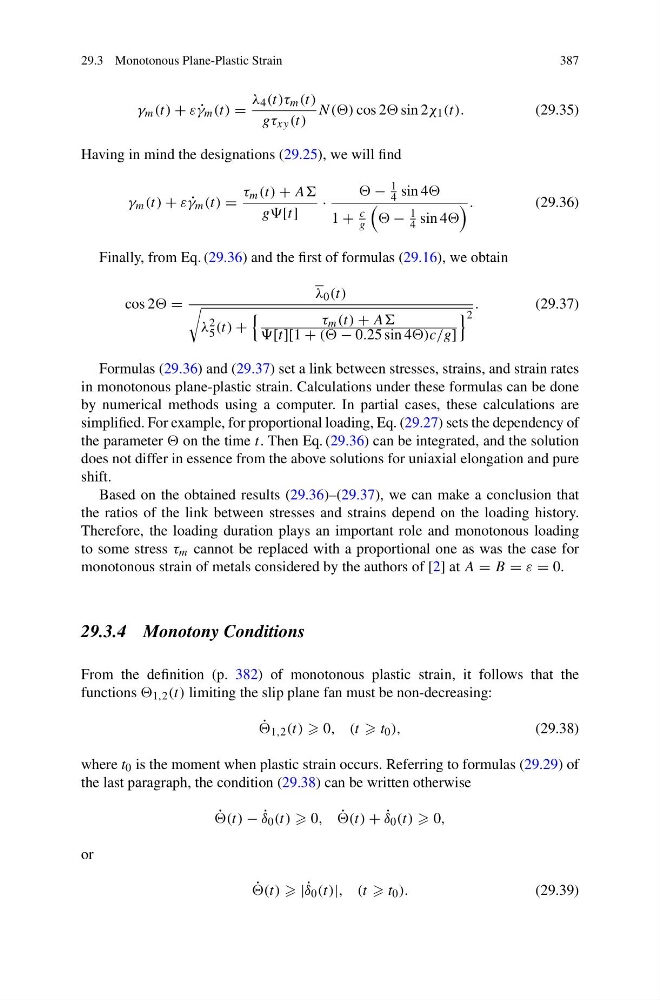
Formulas (29.36) and (29.37) set a link between stresses, strains, and strain rates
in monotonous plane-plastic strain. Calculations under these formulas can be done
by numerical methods using a computer. In partial cases, these calculations are
simplified. For example, for proportional loading, Eq. (29.27) sets the dependency of
the parameter on the time t. Then Eq. (29.36) can be integrated, and the solution
does not differ in essence from the above solutions for uniaxial elongation and pure
shift.
Based on the obtained results (29.36)–(29.37), we can make a conclusion that
the ratios of the link between stresses and strains depend on the loading history.
Therefore, the loading duration plays an important role and monotonous loading
to some stress τ m cannot be replaced with a proportional one as was the case for
monotonous strain of metals considered by the authors of [2] at A = B = ε = 0.
29.3.4 Monotony Conditions
From the definition (p. 382) of monotonous plastic strain, it follows that the
functions 1,2 (t) limiting the slip plane fan must be non-decreasing:
˙
1,2 (t) 0, (t t 0 ),
(29.38)
where t 0 is the moment when plastic strain occurs. Referring to formulas (29.29) of
the last paragraph, the condition (29.38) can be written otherwise
˙
− ˙
δ 0 (t) 0, ˙
(t) + ˙
δ 0 (t) 0,
or
˙
(t) | ˙
δ 0 (t)|, (t t 0 ).
(29.39)
387
γ m (t) + ε ˙
γ m (t) =
λ 4 (t)τ m (t)
gτ xy (t)
N(() cos 2 sin 2χ 1 (t).
(29.35)
Having in mind the designations (29.25), we will find
γ m (t) + ε ˙
γ m (t) =
τ m (t) + AA
gg[t]
·
−
1
4 sin 4
1 +
c
g
−
1
4 sin 4
.
(29.36)
Finally, from Eq. (29.36) and the first of formulas (29.16), we obtain
cos 2 =
λ 0 (t)
λ 2
5 (t) +
τ m (t) + AA
[t][1 + (( − 0.25 sin 4
2
.
(29.37)
Formulas (29.36) and (29.37) set a link between stresses, strains, and strain rates
in monotonous plane-plastic strain. Calculations under these formulas can be done
by numerical methods using a computer. In partial cases, these calculations are
simplified. For example, for proportional loading, Eq. (29.27) sets the dependency of
the parameter on the time t. Then Eq. (29.36) can be integrated, and the solution
does not differ in essence from the above solutions for uniaxial elongation and pure
shift.
Based on the obtained results (29.36)–(29.37), we can make a conclusion that
the ratios of the link between stresses and strains depend on the loading history.
Therefore, the loading duration plays an important role and monotonous loading
to some stress τ m cannot be replaced with a proportional one as was the case for
monotonous strain of metals considered by the authors of [2] at A = B = ε = 0.
29.3.4 Monotony Conditions
From the definition (p. 382) of monotonous plastic strain, it follows that the
functions 1,2 (t) limiting the slip plane fan must be non-decreasing:
˙
1,2 (t) 0, (t t 0 ),
(29.38)
where t 0 is the moment when plastic strain occurs. Referring to formulas (29.29) of
the last paragraph, the condition (29.38) can be written otherwise
˙
− ˙
δ 0 (t) 0, ˙
(t) + ˙
δ 0 (t) 0,
or
˙
(t) | ˙
δ 0 (t)|, (t t 0 ).
(29.39)