

24.5 Definition of the Plastic Zone Growth Rate
337
and ρ is the specimen material density.
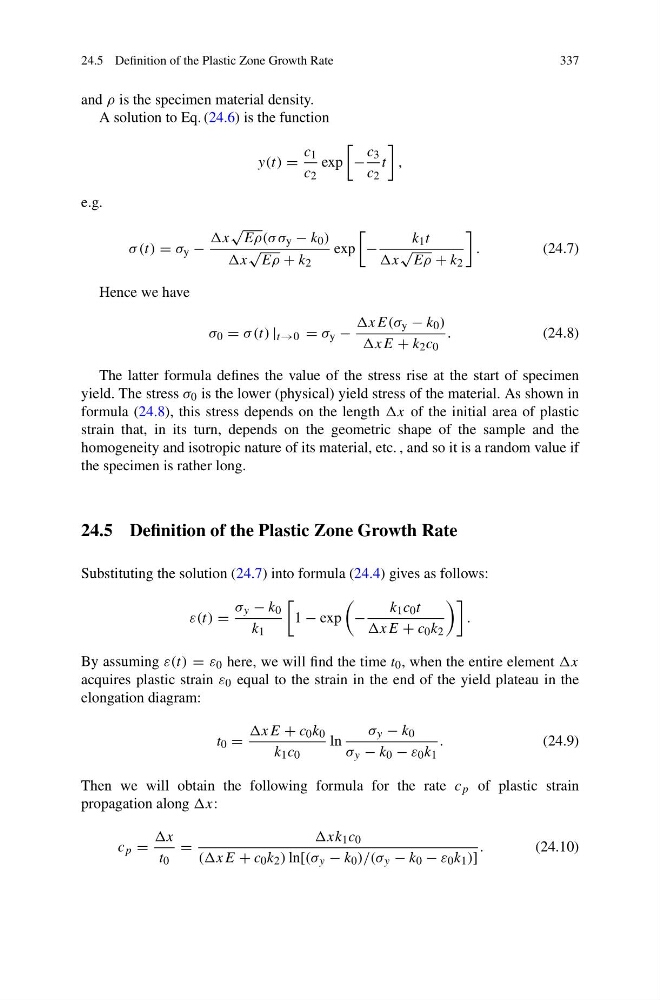
A solution to Eq. (24.6) is the function
y(t) =
c 1
c 2
exp
−
c 3
c 2
t
,
e.g.
σ (t) = σ y −
x
√
Eρ(σ σ y − k 0 )
x
√
Eρ + k 2
exp
−
k 1 t
x
√
Eρ + k 2
.
(24.7)
Hence we have
σ 0 = σ (t) | t→0 = σ y −
xE(σ y − k 0 )
xE + k 2 c 0
.
(24.8)
The latter formula defines the value of the stress rise at the start of specimen
yield. The stress σ 0 is the lower (physical) yield stress of the material. As shown in
formula (24.8), this stress depends on the length x of the initial area of plastic
strain that, in its turn, depends on the geometric shape of the sample and the
homogeneity and isotropic nature of its material, etc. , and so it is a random value if
the specimen is rather long.
24.5 Definition of the Plastic Zone Growth Rate
Substituting the solution (24.7) into formula (24.4) gives as follows:
ε(t) =
σ y − k 0
k 1
1 − exp
−
k 1 c 0 t
xE + c 0 k 2
.
By assuming ε(t) = ε 0 here, we will find the time t 0 , when the entire element x
acquires plastic strain ε 0 equal to the strain in the end of the yield plateau in the
elongation diagram:
t 0 =
+ c 0 k 0
k 1 c 0
ln
σ y − k 0
σ y − k 0 − ε 0 k 1
.
(24.9)
Then we will obtain the following formula for the rate c p of plastic strain
propagation along x:
c p =
x
t 0
=
1 c 0
((xE + c 0 k 2 ) ln[(σ y − k 0 )/(σ y − k 0 − ε 0 k 1 )]
.
(24.10)
337
and ρ is the specimen material density.
A solution to Eq. (24.6) is the function
y(t) =
c 1
c 2
exp
−
c 3
c 2
t
,
e.g.
σ (t) = σ y −
x
√
Eρ(σ σ y − k 0 )
x
√
Eρ + k 2
exp
−
k 1 t
x
√
Eρ + k 2
.
(24.7)
Hence we have
σ 0 = σ (t) | t→0 = σ y −
xE(σ y − k 0 )
xE + k 2 c 0
.
(24.8)
The latter formula defines the value of the stress rise at the start of specimen
yield. The stress σ 0 is the lower (physical) yield stress of the material. As shown in
formula (24.8), this stress depends on the length x of the initial area of plastic
strain that, in its turn, depends on the geometric shape of the sample and the
homogeneity and isotropic nature of its material, etc. , and so it is a random value if
the specimen is rather long.
24.5 Definition of the Plastic Zone Growth Rate
Substituting the solution (24.7) into formula (24.4) gives as follows:
ε(t) =
σ y − k 0
k 1
1 − exp
−
k 1 c 0 t
xE + c 0 k 2
.
By assuming ε(t) = ε 0 here, we will find the time t 0 , when the entire element x
acquires plastic strain ε 0 equal to the strain in the end of the yield plateau in the
elongation diagram:
t 0 =
+ c 0 k 0
k 1 c 0
ln
σ y − k 0
σ y − k 0 − ε 0 k 1
.
(24.9)
Then we will obtain the following formula for the rate c p of plastic strain
propagation along x:
c p =
x
t 0
=
1 c 0
((xE + c 0 k 2 ) ln[(σ y − k 0 )/(σ y − k 0 − ε 0 k 1 )]
.
(24.10)