

References
319
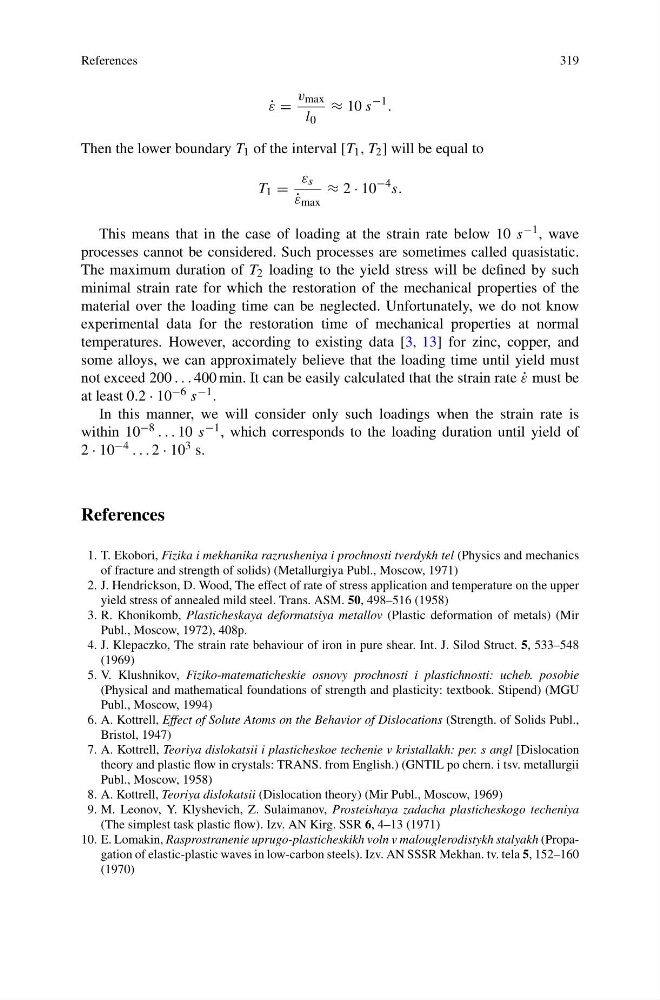
˙
ε =
v max
l 0
≈ 10 s
−1 .
Then the lower boundary T 1 of the interval [T 1 , T 2 ] will be equal to
T 1 =
ε s
˙
ε max
≈ 2 · 10
−4 s.
This means that in the case of loading at the strain rate below 10 s −1 , wave
processes cannot be considered. Such processes are sometimes called quasistatic.
The maximum duration of T 2 loading to the yield stress will be defined by such
minimal strain rate for which the restoration of the mechanical properties of the
material over the loading time can be neglected. Unfortunately, we do not know
experimental data for the restoration time of mechanical properties at normal
temperatures. However, according to existing data [3, 13] for zinc, copper, and
some alloys, we can approximately believe that the loading time until yield must
not exceed 200 . . . 400 min. It can be easily calculated that the strain rate ˙
ε must be
at least 0.2 · 10 −6 s −1 .
In this manner, we will consider only such loadings when the strain rate is
within 10 −8 . . . 10 s −1 , which corresponds to the loading duration until yield of
2 · 10 −4 . . . 2 · 10 3 s.
References
1. T. Ekobori, Fizika i mekhanika razrusheniya i prochnosti tverdykh tel (Physics and mechanics
of fracture and strength of solids) (Metallurgiya Publ., Moscow, 1971)
2. J. Hendrickson, D. Wood, The effect of rate of stress application and temperature on the upper
yield stress of annealed mild steel. Trans. ASM. 50, 498–516 (1958)
3. R. Khonikomb, Plasticheskaya deformatsiya metallov (Plastic deformation of metals) (Mir
Publ., Moscow, 1972), 408p.
4. J. Klepaczko, The strain rate behaviour of iron in pure shear. Int. J. Silod Struct. 5, 533–548
(1969)
5. V. Klushnikov, Fiziko-matematicheskie osnovy prochnosti i plastichnosti: ucheb. posobie
(Physical and mathematical foundations of strength and plasticity: textbook. Stipend) (MGU
Publ., Moscow, 1994)
6. A. Kottrell, Effect of Solute Atoms on the Behavior of Dislocations (Strength. of Solids Publ.,
Bristol, 1947)
7. A. Kottrell, Teoriya dislokatsii i plasticheskoe techenie v kristallakh: per. s angl [Dislocation
theory and plastic flow in crystals: TRANS. from English.) (GNTIL po chern. i tsv. metallurgii
Publ., Moscow, 1958)
8. A. Kottrell, Teoriya dislokatsii (Dislocation theory) (Mir Publ., Moscow, 1969)
9. M. Leonov, Y. Klyshevich, Z. Sulaimanov, Prosteishaya zadacha plasticheskogo techeniya
(The simplest task plastic flow). Izv. AN Kirg. SSR 6, 4–13 (1971)
10. E. Lomakin, Rasprostranenie uprugo-plasticheskikh voln v malouglerodistykh stalyakh (Propagation of elastic-plastic waves in low-carbon steels). Izv. AN SSSR Mekhan. tv. tela 5, 152–160
(1970)
319
˙
ε =
v max
l 0
≈ 10 s
−1 .
Then the lower boundary T 1 of the interval [T 1 , T 2 ] will be equal to
T 1 =
ε s
˙
ε max
≈ 2 · 10
−4 s.
This means that in the case of loading at the strain rate below 10 s −1 , wave
processes cannot be considered. Such processes are sometimes called quasistatic.
The maximum duration of T 2 loading to the yield stress will be defined by such
minimal strain rate for which the restoration of the mechanical properties of the
material over the loading time can be neglected. Unfortunately, we do not know
experimental data for the restoration time of mechanical properties at normal
temperatures. However, according to existing data [3, 13] for zinc, copper, and
some alloys, we can approximately believe that the loading time until yield must
not exceed 200 . . . 400 min. It can be easily calculated that the strain rate ˙
ε must be
at least 0.2 · 10 −6 s −1 .
In this manner, we will consider only such loadings when the strain rate is
within 10 −8 . . . 10 s −1 , which corresponds to the loading duration until yield of
2 · 10 −4 . . . 2 · 10 3 s.
References
1. T. Ekobori, Fizika i mekhanika razrusheniya i prochnosti tverdykh tel (Physics and mechanics
of fracture and strength of solids) (Metallurgiya Publ., Moscow, 1971)
2. J. Hendrickson, D. Wood, The effect of rate of stress application and temperature on the upper
yield stress of annealed mild steel. Trans. ASM. 50, 498–516 (1958)
3. R. Khonikomb, Plasticheskaya deformatsiya metallov (Plastic deformation of metals) (Mir
Publ., Moscow, 1972), 408p.
4. J. Klepaczko, The strain rate behaviour of iron in pure shear. Int. J. Silod Struct. 5, 533–548
(1969)
5. V. Klushnikov, Fiziko-matematicheskie osnovy prochnosti i plastichnosti: ucheb. posobie
(Physical and mathematical foundations of strength and plasticity: textbook. Stipend) (MGU
Publ., Moscow, 1994)
6. A. Kottrell, Effect of Solute Atoms on the Behavior of Dislocations (Strength. of Solids Publ.,
Bristol, 1947)
7. A. Kottrell, Teoriya dislokatsii i plasticheskoe techenie v kristallakh: per. s angl [Dislocation
theory and plastic flow in crystals: TRANS. from English.) (GNTIL po chern. i tsv. metallurgii
Publ., Moscow, 1958)
8. A. Kottrell, Teoriya dislokatsii (Dislocation theory) (Mir Publ., Moscow, 1969)
9. M. Leonov, Y. Klyshevich, Z. Sulaimanov, Prosteishaya zadacha plasticheskogo techeniya
(The simplest task plastic flow). Izv. AN Kirg. SSR 6, 4–13 (1971)
10. E. Lomakin, Rasprostranenie uprugo-plasticheskikh voln v malouglerodistykh stalyakh (Propagation of elastic-plastic waves in low-carbon steels). Izv. AN SSSR Mekhan. tv. tela 5, 152–160
(1970)