

318
21 Strain Specifics of Plastic Bodies
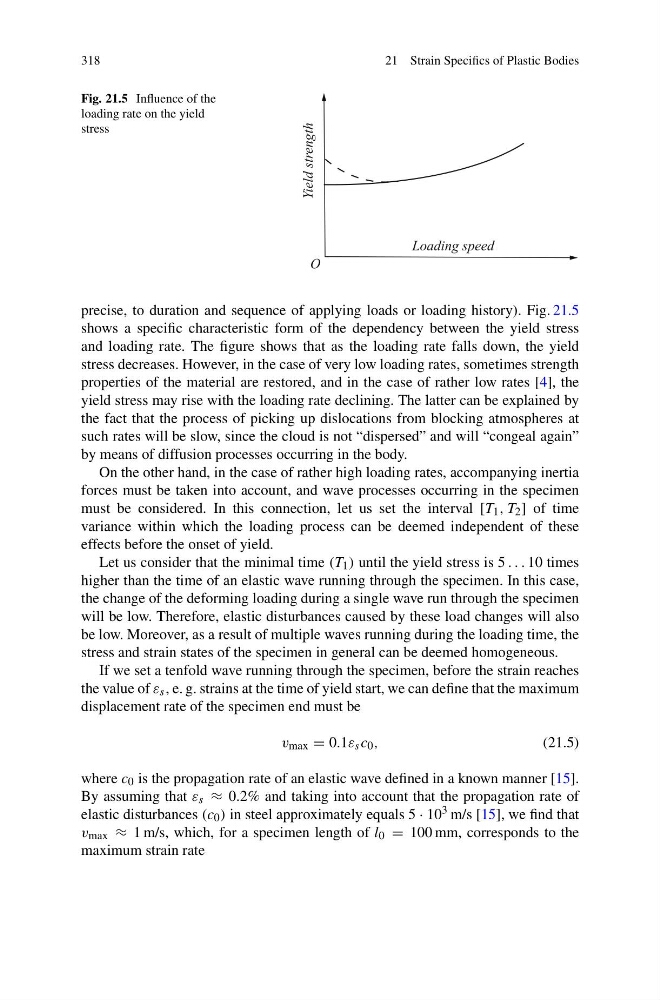
Fig. 21.5 Influence of the
loading rate on the yield
stress
precise, to duration and sequence of applying loads or loading history). Fig. 21.5
shows a specific characteristic form of the dependency between the yield stress
and loading rate. The figure shows that as the loading rate falls down, the yield
stress decreases. However, in the case of very low loading rates, sometimes strength
properties of the material are restored, and in the case of rather low rates [4], the
yield stress may rise with the loading rate declining. The latter can be explained by
the fact that the process of picking up dislocations from blocking atmospheres at
such rates will be slow, since the cloud is not “dispersed” and will “congeal again”
by means of diffusion processes occurring in the body.
On the other hand, in the case of rather high loading rates, accompanying inertia
forces must be taken into account, and wave processes occurring in the specimen
must be considered. In this connection, let us set the interval [T 1 , T 2 ] of time
variance within which the loading process can be deemed independent of these
effects before the onset of yield.
Let us consider that the minimal time (T 1 ) until the yield stress is 5 . . . 10 times
higher than the time of an elastic wave running through the specimen. In this case,
the change of the deforming loading during a single wave run through the specimen
will be low. Therefore, elastic disturbances caused by these load changes will also
be low. Moreover, as a result of multiple waves running during the loading time, the
stress and strain states of the specimen in general can be deemed homogeneous.
If we set a tenfold wave running through the specimen, before the strain reaches
the value of ε s , e. g. strains at the time of yield start, we can define that the maximum
displacement rate of the specimen end must be
v max = 0.1ε s c 0 ,
(21.5)
where c 0 is the propagation rate of an elastic wave defined in a known manner [15].
By assuming that ε s ≈ 0.2% and taking into account that the propagation rate of
elastic disturbances (c 0 ) in steel approximately equals 5 · 10 3 m/s [15], we find that
v max ≈ 1 m/s, which, for a specimen length of l 0 = 100 mm, corresponds to the
maximum strain rate
21 Strain Specifics of Plastic Bodies
Fig. 21.5 Influence of the
loading rate on the yield
stress
precise, to duration and sequence of applying loads or loading history). Fig. 21.5
shows a specific characteristic form of the dependency between the yield stress
and loading rate. The figure shows that as the loading rate falls down, the yield
stress decreases. However, in the case of very low loading rates, sometimes strength
properties of the material are restored, and in the case of rather low rates [4], the
yield stress may rise with the loading rate declining. The latter can be explained by
the fact that the process of picking up dislocations from blocking atmospheres at
such rates will be slow, since the cloud is not “dispersed” and will “congeal again”
by means of diffusion processes occurring in the body.
On the other hand, in the case of rather high loading rates, accompanying inertia
forces must be taken into account, and wave processes occurring in the specimen
must be considered. In this connection, let us set the interval [T 1 , T 2 ] of time
variance within which the loading process can be deemed independent of these
effects before the onset of yield.
Let us consider that the minimal time (T 1 ) until the yield stress is 5 . . . 10 times
higher than the time of an elastic wave running through the specimen. In this case,
the change of the deforming loading during a single wave run through the specimen
will be low. Therefore, elastic disturbances caused by these load changes will also
be low. Moreover, as a result of multiple waves running during the loading time, the
stress and strain states of the specimen in general can be deemed homogeneous.
If we set a tenfold wave running through the specimen, before the strain reaches
the value of ε s , e. g. strains at the time of yield start, we can define that the maximum
displacement rate of the specimen end must be
v max = 0.1ε s c 0 ,
(21.5)
where c 0 is the propagation rate of an elastic wave defined in a known manner [15].
By assuming that ε s ≈ 0.2% and taking into account that the propagation rate of
elastic disturbances (c 0 ) in steel approximately equals 5 · 10 3 m/s [15], we find that
v max ≈ 1 m/s, which, for a specimen length of l 0 = 100 mm, corresponds to the
maximum strain rate