

21.1 Elongation Diagram of a Plastic Material Specimen
315
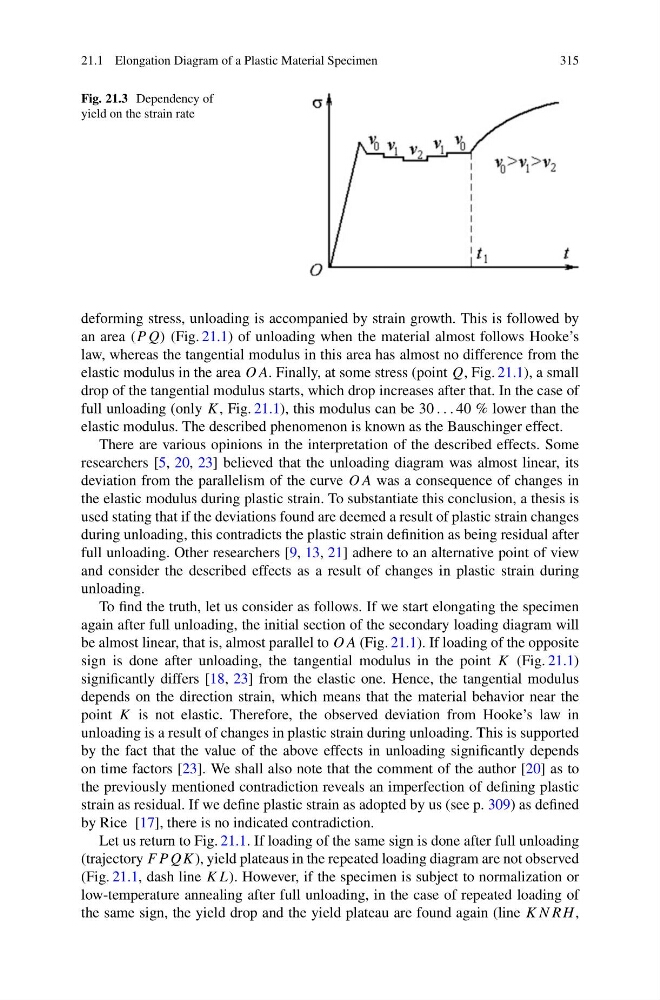
Fig. 21.3 Dependency of
yield on the strain rate
deforming stress, unloading is accompanied by strain growth. This is followed by
an area (P Q) (Fig. 21.1) of unloading when the material almost follows Hooke’s
law, whereas the tangential modulus in this area has almost no difference from the
elastic modulus in the area OA. Finally, at some stress (point Q, Fig. 21.1), a small
drop of the tangential modulus starts, which drop increases after that. In the case of
full unloading (only K, Fig. 21.1), this modulus can be 30 . . . 40 % lower than the
elastic modulus. The described phenomenon is known as the Bauschinger effect.
There are various opinions in the interpretation of the described effects. Some
researchers [5, 20, 23] believed that the unloading diagram was almost linear, its
deviation from the parallelism of the curve OA was a consequence of changes in
the elastic modulus during plastic strain. To substantiate this conclusion, a thesis is
used stating that if the deviations found are deemed a result of plastic strain changes
during unloading, this contradicts the plastic strain definition as being residual after
full unloading. Other researchers [9, 13, 21] adhere to an alternative point of view
and consider the described effects as a result of changes in plastic strain during
unloading.
To find the truth, let us consider as follows. If we start elongating the specimen
again after full unloading, the initial section of the secondary loading diagram will
be almost linear, that is, almost parallel to OA (Fig. 21.1). If loading of the opposite
sign is done after unloading, the tangential modulus in the point K (Fig. 21.1)
significantly differs [18, 23] from the elastic one. Hence, the tangential modulus
depends on the direction strain, which means that the material behavior near the
point K is not elastic. Therefore, the observed deviation from Hooke’s law in
unloading is a result of changes in plastic strain during unloading. This is supported
by the fact that the value of the above effects in unloading significantly depends
on time factors [23]. We shall also note that the comment of the author [20] as to
the previously mentioned contradiction reveals an imperfection of defining plastic
strain as residual. If we define plastic strain as adopted by us (see p. 309) as defined
by Rice [17], there is no indicated contradiction.
Let us return to Fig. 21.1. If loading of the same sign is done after full unloading
(trajectory F P QK), yield plateaus in the repeated loading diagram are not observed
(Fig. 21.1, dash line KL). However, if the specimen is subject to normalization or
low-temperature annealing after full unloading, in the case of repeated loading of
the same sign, the yield drop and the yield plateau are found again (line KNRH ,
315
Fig. 21.3 Dependency of
yield on the strain rate
deforming stress, unloading is accompanied by strain growth. This is followed by
an area (P Q) (Fig. 21.1) of unloading when the material almost follows Hooke’s
law, whereas the tangential modulus in this area has almost no difference from the
elastic modulus in the area OA. Finally, at some stress (point Q, Fig. 21.1), a small
drop of the tangential modulus starts, which drop increases after that. In the case of
full unloading (only K, Fig. 21.1), this modulus can be 30 . . . 40 % lower than the
elastic modulus. The described phenomenon is known as the Bauschinger effect.
There are various opinions in the interpretation of the described effects. Some
researchers [5, 20, 23] believed that the unloading diagram was almost linear, its
deviation from the parallelism of the curve OA was a consequence of changes in
the elastic modulus during plastic strain. To substantiate this conclusion, a thesis is
used stating that if the deviations found are deemed a result of plastic strain changes
during unloading, this contradicts the plastic strain definition as being residual after
full unloading. Other researchers [9, 13, 21] adhere to an alternative point of view
and consider the described effects as a result of changes in plastic strain during
unloading.
To find the truth, let us consider as follows. If we start elongating the specimen
again after full unloading, the initial section of the secondary loading diagram will
be almost linear, that is, almost parallel to OA (Fig. 21.1). If loading of the opposite
sign is done after unloading, the tangential modulus in the point K (Fig. 21.1)
significantly differs [18, 23] from the elastic one. Hence, the tangential modulus
depends on the direction strain, which means that the material behavior near the
point K is not elastic. Therefore, the observed deviation from Hooke’s law in
unloading is a result of changes in plastic strain during unloading. This is supported
by the fact that the value of the above effects in unloading significantly depends
on time factors [23]. We shall also note that the comment of the author [20] as to
the previously mentioned contradiction reveals an imperfection of defining plastic
strain as residual. If we define plastic strain as adopted by us (see p. 309) as defined
by Rice [17], there is no indicated contradiction.
Let us return to Fig. 21.1. If loading of the same sign is done after full unloading
(trajectory F P QK), yield plateaus in the repeated loading diagram are not observed
(Fig. 21.1, dash line KL). However, if the specimen is subject to normalization or
low-temperature annealing after full unloading, in the case of repeated loading of
the same sign, the yield drop and the yield plateau are found again (line KNRH ,