

314
21 Strain Specifics of Plastic Bodies
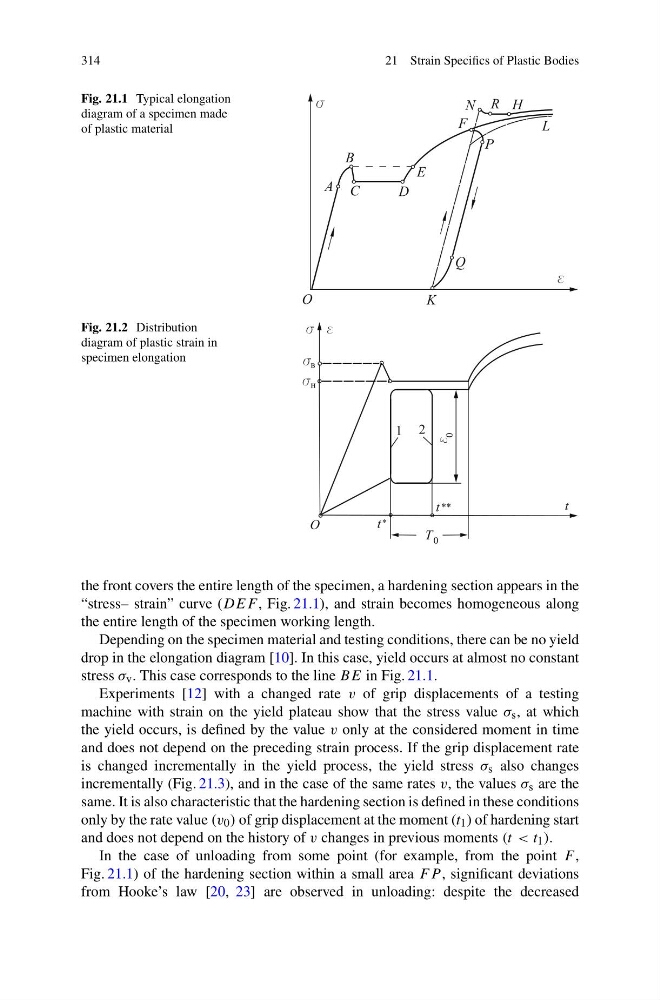
Fig. 21.1 Typical elongation
diagram of a specimen made
of plastic material
Fig. 21.2 Distribution
diagram of plastic strain in
specimen elongation
the front covers the entire length of the specimen, a hardening section appears in the
“stress– strain” curve (DEF , Fig. 21.1), and strain becomes homogeneous along
the entire length of the specimen working length.
Depending on the specimen material and testing conditions, there can be no yield
drop in the elongation diagram [10]. In this case, yield occurs at almost no constant
stress σ v . This case corresponds to the line BE in Fig. 21.1.
Experiments [12] with a changed rate v of grip displacements of a testing
machine with strain on the yield plateau show that the stress value σ s , at which
the yield occurs, is defined by the value v only at the considered moment in time
and does not depend on the preceding strain process. If the grip displacement rate
is changed incrementally in the yield process, the yield stress σ s also changes
incrementally (Fig. 21.3), and in the case of the same rates v, the values σ s are the
same. It is also characteristic that the hardening section is defined in these conditions
only by the rate value (v 0 ) of grip displacement at the moment (t 1 ) of hardening start
and does not depend on the history of v changes in previous moments (t < t 1 ).
In the case of unloading from some point (for example, from the point F ,
Fig. 21.1) of the hardening section within a small area F P , significant deviations
from Hooke’s law [20, 23] are observed in unloading: despite the decreased
21 Strain Specifics of Plastic Bodies
Fig. 21.1 Typical elongation
diagram of a specimen made
of plastic material
Fig. 21.2 Distribution
diagram of plastic strain in
specimen elongation
the front covers the entire length of the specimen, a hardening section appears in the
“stress– strain” curve (DEF , Fig. 21.1), and strain becomes homogeneous along
the entire length of the specimen working length.
Depending on the specimen material and testing conditions, there can be no yield
drop in the elongation diagram [10]. In this case, yield occurs at almost no constant
stress σ v . This case corresponds to the line BE in Fig. 21.1.
Experiments [12] with a changed rate v of grip displacements of a testing
machine with strain on the yield plateau show that the stress value σ s , at which
the yield occurs, is defined by the value v only at the considered moment in time
and does not depend on the preceding strain process. If the grip displacement rate
is changed incrementally in the yield process, the yield stress σ s also changes
incrementally (Fig. 21.3), and in the case of the same rates v, the values σ s are the
same. It is also characteristic that the hardening section is defined in these conditions
only by the rate value (v 0 ) of grip displacement at the moment (t 1 ) of hardening start
and does not depend on the history of v changes in previous moments (t < t 1 ).
In the case of unloading from some point (for example, from the point F ,
Fig. 21.1) of the hardening section within a small area F P , significant deviations
from Hooke’s law [20, 23] are observed in unloading: despite the decreased