

19.4 On the Methods of Physical Mesomechanics and Synergetics
297
˙
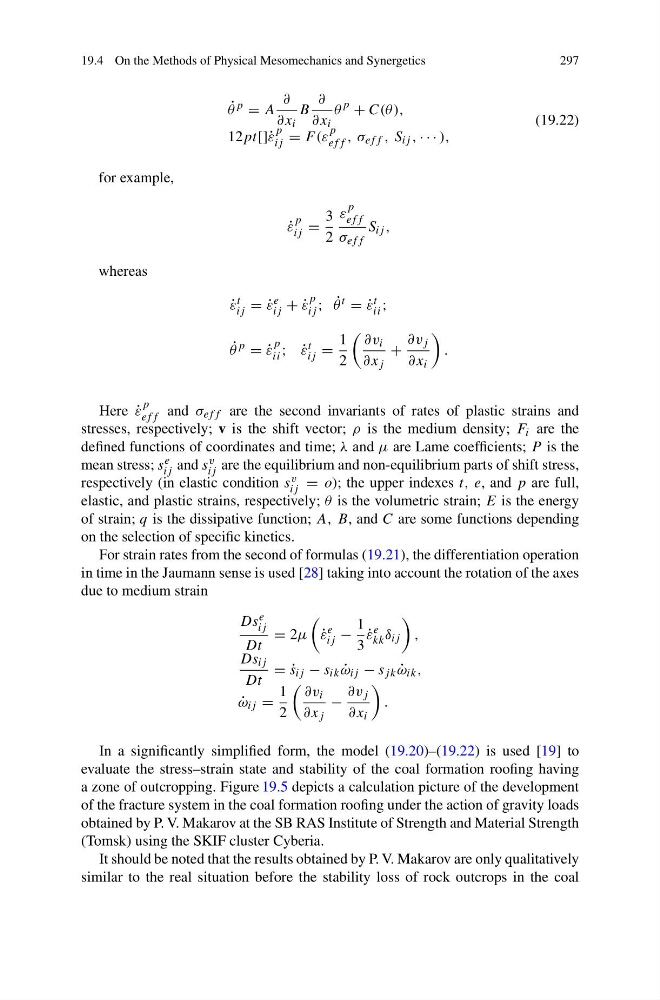
θ p = A
∂
∂x i
B
∂
∂x i
θ
p
+ C(θ),
12pt[]˙ ε
p
ij = F (ε
p
eff , σ eff , S ij , · · · ),
(19.22)
for example,
˙
ε
p
ij =
3
2
ε
p
eff
σ eff
S ij ,
whereas
˙
ε t
ij = ˙
ε e
ij + ˙
ε
p
ij ; ˙
θ t = ˙
ε t
ii ;
˙
θ p = ˙
ε
p
ii ; ˙
ε t
ij =
1
2
∂v i
∂x j
+
∂v j
∂x i
.
Here ˙
ε
p
eff and σ eff are the second invariants of rates of plastic strains and
stresses, respectively; v is the shift vector; ρ is the medium density; F i are the
defined functions of coordinates and time; λ and μ are Lame coefficients; P is the
mean stress; s e
ij and s v
ij are the equilibrium and non-equilibrium parts of shift stress,
respectively (in elastic condition s v
ij = o); the upper indexes t, e, and p are full,
elastic, and plastic strains, respectively; θ is the volumetric strain; E is the energy
of strain; q is the dissipative function; A, B, and C are some functions depending
on the selection of specific kinetics.
For strain rates from the second of formulas (19.21), the differentiation operation
in time in the Jaumann sense is used [28] taking into account the rotation of the axes
due to medium strain
Ds e
ij
Dt
= 2μ
˙
ε
e
ij −
1
3
˙
ε
e
kk δ ij
,
Ds ij
Dt
= ˙
s ij − s ik ˙
ω ij − s jk ˙
ω ik ,
˙
ω ij =
1
2
∂v i
∂x j
−
∂v j
∂x i
.
In a significantly simplified form, the model (19.20)–(19.22) is used [19] to
evaluate the stress–strain state and stability of the coal formation roofing having
a zone of outcropping. Figure 19.5 depicts a calculation picture of the development
of the fracture system in the coal formation roofing under the action of gravity loads
obtained by P. V. Makarov at the SB RAS Institute of Strength and Material Strength
(Tomsk) using the SKIF cluster Cyberia.
It should be noted that the results obtained by P. V. Makarov are only qualitatively
similar to the real situation before the stability loss of rock outcrops in the coal
297
˙
θ p = A
∂
∂x i
B
∂
∂x i
θ
p
+ C(θ),
12pt[]˙ ε
p
ij = F (ε
p
eff , σ eff , S ij , · · · ),
(19.22)
for example,
˙
ε
p
ij =
3
2
ε
p
eff
σ eff
S ij ,
whereas
˙
ε t
ij = ˙
ε e
ij + ˙
ε
p
ij ; ˙
θ t = ˙
ε t
ii ;
˙
θ p = ˙
ε
p
ii ; ˙
ε t
ij =
1
2
∂v i
∂x j
+
∂v j
∂x i
.
Here ˙
ε
p
eff and σ eff are the second invariants of rates of plastic strains and
stresses, respectively; v is the shift vector; ρ is the medium density; F i are the
defined functions of coordinates and time; λ and μ are Lame coefficients; P is the
mean stress; s e
ij and s v
ij are the equilibrium and non-equilibrium parts of shift stress,
respectively (in elastic condition s v
ij = o); the upper indexes t, e, and p are full,
elastic, and plastic strains, respectively; θ is the volumetric strain; E is the energy
of strain; q is the dissipative function; A, B, and C are some functions depending
on the selection of specific kinetics.
For strain rates from the second of formulas (19.21), the differentiation operation
in time in the Jaumann sense is used [28] taking into account the rotation of the axes
due to medium strain
Ds e
ij
Dt
= 2μ
˙
ε
e
ij −
1
3
˙
ε
e
kk δ ij
,
Ds ij
Dt
= ˙
s ij − s ik ˙
ω ij − s jk ˙
ω ik ,
˙
ω ij =
1
2
∂v i
∂x j
−
∂v j
∂x i
.
In a significantly simplified form, the model (19.20)–(19.22) is used [19] to
evaluate the stress–strain state and stability of the coal formation roofing having
a zone of outcropping. Figure 19.5 depicts a calculation picture of the development
of the fracture system in the coal formation roofing under the action of gravity loads
obtained by P. V. Makarov at the SB RAS Institute of Strength and Material Strength
(Tomsk) using the SKIF cluster Cyberia.
It should be noted that the results obtained by P. V. Makarov are only qualitatively
similar to the real situation before the stability loss of rock outcrops in the coal