

296
19 Other Variants of Plasticity Theories
Principle 6 The plastic strain of a solid body develops under the following pattern: primary (basic) stress concentrator—relaxation shift with stringent rotation—
further relaxation shift.
Principle 7 Self-organization of shifts in a deformable solid body reflects selfcoupling of elastic–plastic rotation modes related to shifts and flexure–torsion
zones: for a defined loading axis, the total turn and flexure–torsion in the hierarchy
of shifts of all scale levels must equal zero (condition of uniformity preservation). A
violation of this condition causes cracks as accommodation rotary modes of strain.
Principle 8 A global loss of shift stability and destruction occur at the place of the
stress macro-concentrator and are defined by the development mechanics of macrostripes of localized strain accommodated by the relaxation process at the meso- and
micro-scale levels.
Using the postulated principles, the problem of the elastic–plastic strain of a
solid body is included in the problem of self-organization that is the primary subject
of synergetics or non-linear dynamics. The researcher inevitably comes to a nontrivial problem of building an adequate mathematical model of system behavior
in the language of non-linear dynamics. The problems formulated based on such
models are called evolutionary. The most common feature of evolutionary problems
is their ability to describe the process not only in the smooth flow of events but also
in the conditions with aggravation characterized by radical changes, the formation
of new structures, and properties over rather short time intervals. They say that selforganization in the system takes place by means of passing through dynamic chaos,
the disintegration of old structures, and formation of new ones.
The so-called basic equations of synergetics are known [15, 20, 24] and widely
discussed in many publications. We will not mention evolution scenarios based on
them, conditions of system stability loss, various conditions of going into chaos, and
other interesting results. According to P.V. Makarov [19], we ask the question: what
synergetics and general properties of basic equations of non-linear dynamics studied
by it give us for researching the behavior of stress–strain state in solid bodies during
the deformation?
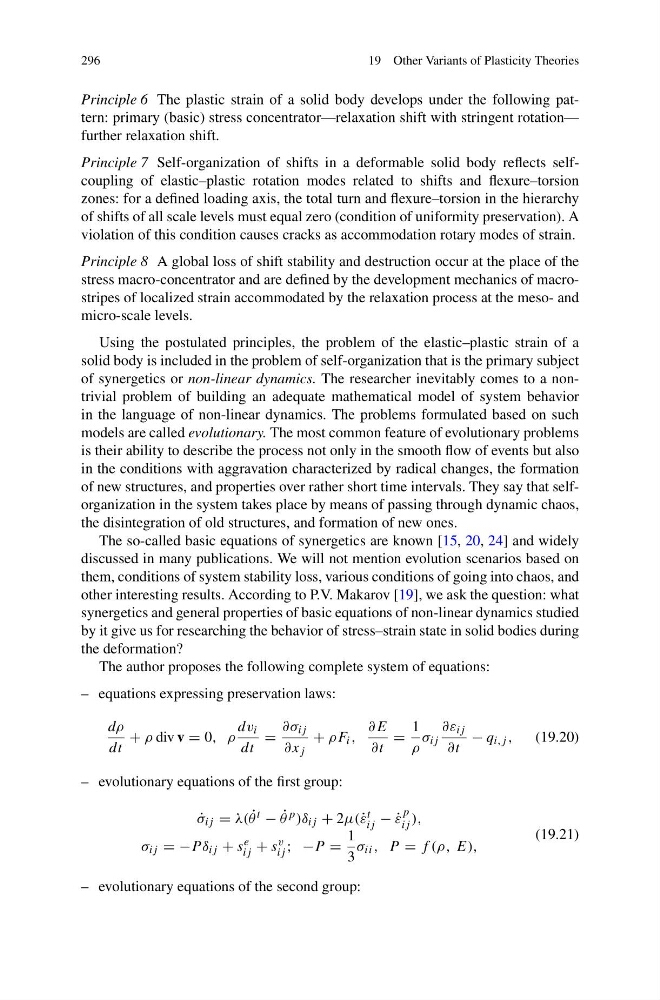
The author proposes the following complete system of equations:
– equations expressing preservation laws:
dρ
dt
+ ρ div v = 0, ρ
dv i
dt
=
∂σ ij
∂x j
+ ρF i ,
∂E
∂t
=
1
ρ
σ ij
∂ε ij
∂t
− q i,j ,
(19.20)
– evolutionary equations of the first group:
˙
σ ij = λ( ˙
θ t − ˙
θ p )δ ij + 2μ(˙ ε t
ij − ˙
ε
p
ij ),
σ ij = −P δ ij + s e
ij + s v
ij ; −P =
1
3
σ ii , P = f (ρ, E),
(19.21)
– evolutionary equations of the second group:
19 Other Variants of Plasticity Theories
Principle 6 The plastic strain of a solid body develops under the following pattern: primary (basic) stress concentrator—relaxation shift with stringent rotation—
further relaxation shift.
Principle 7 Self-organization of shifts in a deformable solid body reflects selfcoupling of elastic–plastic rotation modes related to shifts and flexure–torsion
zones: for a defined loading axis, the total turn and flexure–torsion in the hierarchy
of shifts of all scale levels must equal zero (condition of uniformity preservation). A
violation of this condition causes cracks as accommodation rotary modes of strain.
Principle 8 A global loss of shift stability and destruction occur at the place of the
stress macro-concentrator and are defined by the development mechanics of macrostripes of localized strain accommodated by the relaxation process at the meso- and
micro-scale levels.
Using the postulated principles, the problem of the elastic–plastic strain of a
solid body is included in the problem of self-organization that is the primary subject
of synergetics or non-linear dynamics. The researcher inevitably comes to a nontrivial problem of building an adequate mathematical model of system behavior
in the language of non-linear dynamics. The problems formulated based on such
models are called evolutionary. The most common feature of evolutionary problems
is their ability to describe the process not only in the smooth flow of events but also
in the conditions with aggravation characterized by radical changes, the formation
of new structures, and properties over rather short time intervals. They say that selforganization in the system takes place by means of passing through dynamic chaos,
the disintegration of old structures, and formation of new ones.
The so-called basic equations of synergetics are known [15, 20, 24] and widely
discussed in many publications. We will not mention evolution scenarios based on
them, conditions of system stability loss, various conditions of going into chaos, and
other interesting results. According to P.V. Makarov [19], we ask the question: what
synergetics and general properties of basic equations of non-linear dynamics studied
by it give us for researching the behavior of stress–strain state in solid bodies during
the deformation?
The author proposes the following complete system of equations:
– equations expressing preservation laws:
dρ
dt
+ ρ div v = 0, ρ
dv i
dt
=
∂σ ij
∂x j
+ ρF i ,
∂E
∂t
=
1
ρ
σ ij
∂ε ij
∂t
− q i,j ,
(19.20)
– evolutionary equations of the first group:
˙
σ ij = λ( ˙
θ t − ˙
θ p )δ ij + 2μ(˙ ε t
ij − ˙
ε
p
ij ),
σ ij = −P δ ij + s e
ij + s v
ij ; −P =
1
3
σ ii , P = f (ρ, E),
(19.21)
– evolutionary equations of the second group: