

294
19 Other Variants of Plasticity Theories
σ
ij = τ 0
dε
p
ij
dμ
+
μ
0
L(μ − μ
)
dε
ij
dμ dμ
,
dμ
dλ
=
1
m(λ, ˙
λ)
, dλ =
dε
p
ij dε
p
ij .
(19.16)
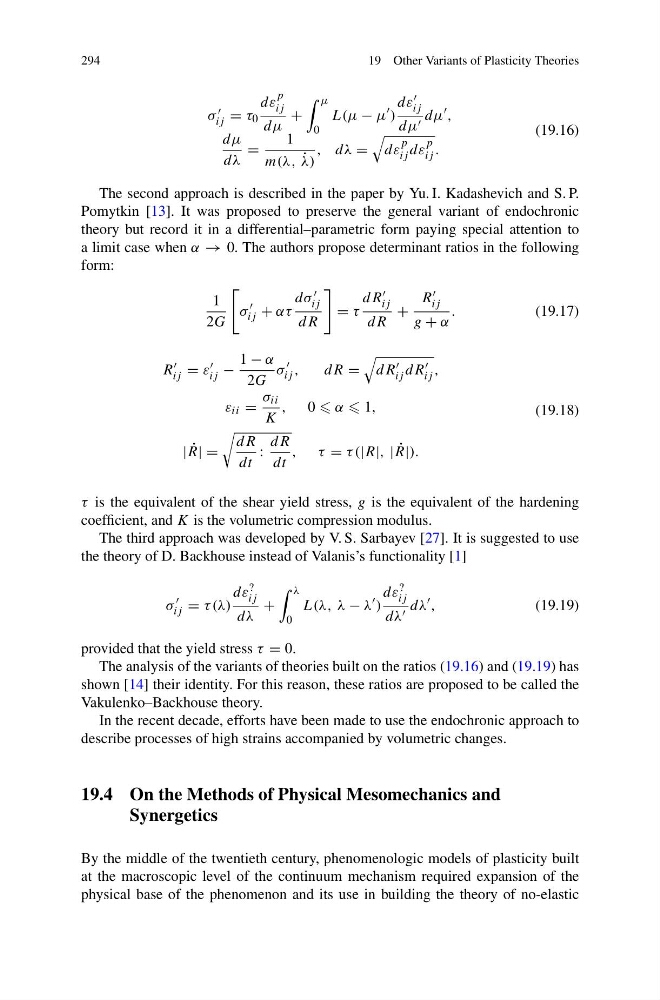
The second approach is described in the paper by Yu. I. Kadashevich and S. P.
Pomytkin [13]. It was proposed to preserve the general variant of endochronic
theory but record it in a differential–parametric form paying special attention to
a limit case when α → 0. The authors propose determinant ratios in the following
form:
1
2G
σ
ij + ατ
dσ
ij
dR
= τ
dR
ij
dR
+
R
ij
g + α
.
(19.17)
R
ij = ε
ij −
1 − α
2G
σ
ij ,
dR =
dR
ij dR
ij ,
ε ii =
σ ii
K
, 0 α 1,
| ˙
R| =
dR
dt
:
dR
dt
, τ = τ (|R|, | ˙
R|).
(19.18)
τ is the equivalent of the shear yield stress, g is the equivalent of the hardening
coefficient, and K is the volumetric compression modulus.
The third approach was developed by V. S. Sarbayev [27]. It is suggested to use
the theory of D. Backhouse instead of Valanis’s functionality [1]
σ
ij = τ (λ)
dε ?
ij
dλ
+
λ
0
L(λ, λ − λ
)
dε ?
ij
dλ dλ
,
(19.19)
provided that the yield stress τ = 0.
The analysis of the variants of theories built on the ratios (19.16) and (19.19) has
shown [14] their identity. For this reason, these ratios are proposed to be called the
Vakulenko–Backhouse theory.
In the recent decade, efforts have been made to use the endochronic approach to
describe processes of high strains accompanied by volumetric changes.
19.4 On the Methods of Physical Mesomechanics and
Synergetics
By the middle of the twentieth century, phenomenologic models of plasticity built
at the macroscopic level of the continuum mechanism required expansion of the
physical base of the phenomenon and its use in building the theory of no-elastic
19 Other Variants of Plasticity Theories
σ
ij = τ 0
dε
p
ij
dμ
+
μ
0
L(μ − μ
)
dε
ij
dμ dμ
,
dμ
dλ
=
1
m(λ, ˙
λ)
, dλ =
dε
p
ij dε
p
ij .
(19.16)
The second approach is described in the paper by Yu. I. Kadashevich and S. P.
Pomytkin [13]. It was proposed to preserve the general variant of endochronic
theory but record it in a differential–parametric form paying special attention to
a limit case when α → 0. The authors propose determinant ratios in the following
form:
1
2G
σ
ij + ατ
dσ
ij
dR
= τ
dR
ij
dR
+
R
ij
g + α
.
(19.17)
R
ij = ε
ij −
1 − α
2G
σ
ij ,
dR =
dR
ij dR
ij ,
ε ii =
σ ii
K
, 0 α 1,
| ˙
R| =
dR
dt
:
dR
dt
, τ = τ (|R|, | ˙
R|).
(19.18)
τ is the equivalent of the shear yield stress, g is the equivalent of the hardening
coefficient, and K is the volumetric compression modulus.
The third approach was developed by V. S. Sarbayev [27]. It is suggested to use
the theory of D. Backhouse instead of Valanis’s functionality [1]
σ
ij = τ (λ)
dε ?
ij
dλ
+
λ
0
L(λ, λ − λ
)
dε ?
ij
dλ dλ
,
(19.19)
provided that the yield stress τ = 0.
The analysis of the variants of theories built on the ratios (19.16) and (19.19) has
shown [14] their identity. For this reason, these ratios are proposed to be called the
Vakulenko–Backhouse theory.
In the recent decade, efforts have been made to use the endochronic approach to
describe processes of high strains accompanied by volumetric changes.
19.4 On the Methods of Physical Mesomechanics and
Synergetics
By the middle of the twentieth century, phenomenologic models of plasticity built
at the macroscopic level of the continuum mechanism required expansion of the
physical base of the phenomenon and its use in building the theory of no-elastic