

19.3 Endochronic Plasticity Theory
293
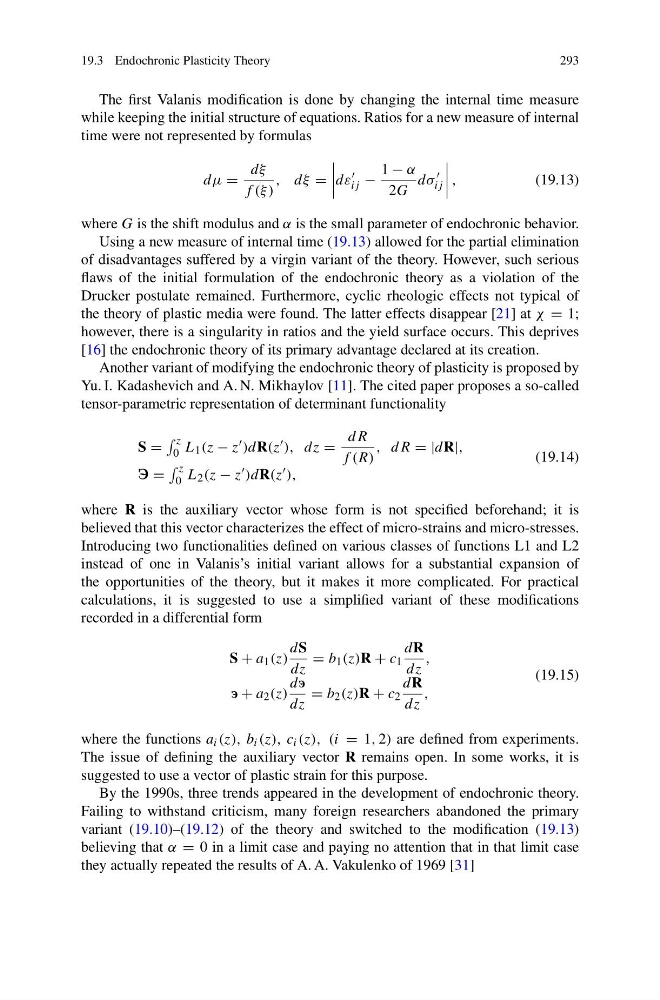
The first Valanis modification is done by changing the internal time measure
while keeping the initial structure of equations. Ratios for a new measure of internal
time were not represented by formulas
dμ =
dξ
f (ξ)
, dξ =
dε
ij −
1 − α
2G
dσ
ij
,
(19.13)
where G is the shift modulus and α is the small parameter of endochronic behavior.
Using a new measure of internal time (19.13) allowed for the partial elimination
of disadvantages suffered by a virgin variant of the theory. However, such serious
flaws of the initial formulation of the endochronic theory as a violation of the
Drucker postulate remained. Furthermore, cyclic rheologic effects not typical of
the theory of plastic media were found. The latter effects disappear [21] at χ = 1;
however, there is a singularity in ratios and the yield surface occurs. This deprives
[16] the endochronic theory of its primary advantage declared at its creation.
Another variant of modifying the endochronic theory of plasticity is proposed by
Yu. I. Kadashevich and A. N. Mikhaylov [11]. The cited paper proposes a so-called
tensor-parametric representation of determinant functionality
S =
z
0 L 1 (z − z )dR(z ), dz =
dR
f (R)
, dR = |dR|,
Э =
z
0 L 2 (z − z )dR(z ),
(19.14)
where R is the auxiliary vector whose form is not specified beforehand; it is
believed that this vector characterizes the effect of micro-strains and micro-stresses.
Introducing two functionalities defined on various classes of functions L1 and L2
instead of one in Valanis’s initial variant allows for a substantial expansion of
the opportunities of the theory, but it makes it more complicated. For practical
calculations, it is suggested to use a simplified variant of these modifications
recorded in a differential form
S + a 1 (z)
dS
dz
= b 1 (z)R + c 1
dR
dz
,
э + a 2 (z)
dэ
dz
= b 2 (z)R + c 2
dR
dz
,
(19.15)
where the functions a i (z), b i (z), c i (z), (i = 1, 2) are defined from experiments.
The issue of defining the auxiliary vector R remains open. In some works, it is
suggested to use a vector of plastic strain for this purpose.
By the 1990s, three trends appeared in the development of endochronic theory.
Failing to withstand criticism, many foreign researchers abandoned the primary
variant (19.10)–(19.12) of the theory and switched to the modification (19.13)
believing that α = 0 in a limit case and paying no attention that in that limit case
they actually repeated the results of A. A. Vakulenko of 1969 [31]
293
The first Valanis modification is done by changing the internal time measure
while keeping the initial structure of equations. Ratios for a new measure of internal
time were not represented by formulas
dμ =
dξ
f (ξ)
, dξ =
dε
ij −
1 − α
2G
dσ
ij
,
(19.13)
where G is the shift modulus and α is the small parameter of endochronic behavior.
Using a new measure of internal time (19.13) allowed for the partial elimination
of disadvantages suffered by a virgin variant of the theory. However, such serious
flaws of the initial formulation of the endochronic theory as a violation of the
Drucker postulate remained. Furthermore, cyclic rheologic effects not typical of
the theory of plastic media were found. The latter effects disappear [21] at χ = 1;
however, there is a singularity in ratios and the yield surface occurs. This deprives
[16] the endochronic theory of its primary advantage declared at its creation.
Another variant of modifying the endochronic theory of plasticity is proposed by
Yu. I. Kadashevich and A. N. Mikhaylov [11]. The cited paper proposes a so-called
tensor-parametric representation of determinant functionality
S =
z
0 L 1 (z − z )dR(z ), dz =
dR
f (R)
, dR = |dR|,
Э =
z
0 L 2 (z − z )dR(z ),
(19.14)
where R is the auxiliary vector whose form is not specified beforehand; it is
believed that this vector characterizes the effect of micro-strains and micro-stresses.
Introducing two functionalities defined on various classes of functions L1 and L2
instead of one in Valanis’s initial variant allows for a substantial expansion of
the opportunities of the theory, but it makes it more complicated. For practical
calculations, it is suggested to use a simplified variant of these modifications
recorded in a differential form
S + a 1 (z)
dS
dz
= b 1 (z)R + c 1
dR
dz
,
э + a 2 (z)
dэ
dz
= b 2 (z)R + c 2
dR
dz
,
(19.15)
where the functions a i (z), b i (z), c i (z), (i = 1, 2) are defined from experiments.
The issue of defining the auxiliary vector R remains open. In some works, it is
suggested to use a vector of plastic strain for this purpose.
By the 1990s, three trends appeared in the development of endochronic theory.
Failing to withstand criticism, many foreign researchers abandoned the primary
variant (19.10)–(19.12) of the theory and switched to the modification (19.13)
believing that α = 0 in a limit case and paying no attention that in that limit case
they actually repeated the results of A. A. Vakulenko of 1969 [31]