

References
281
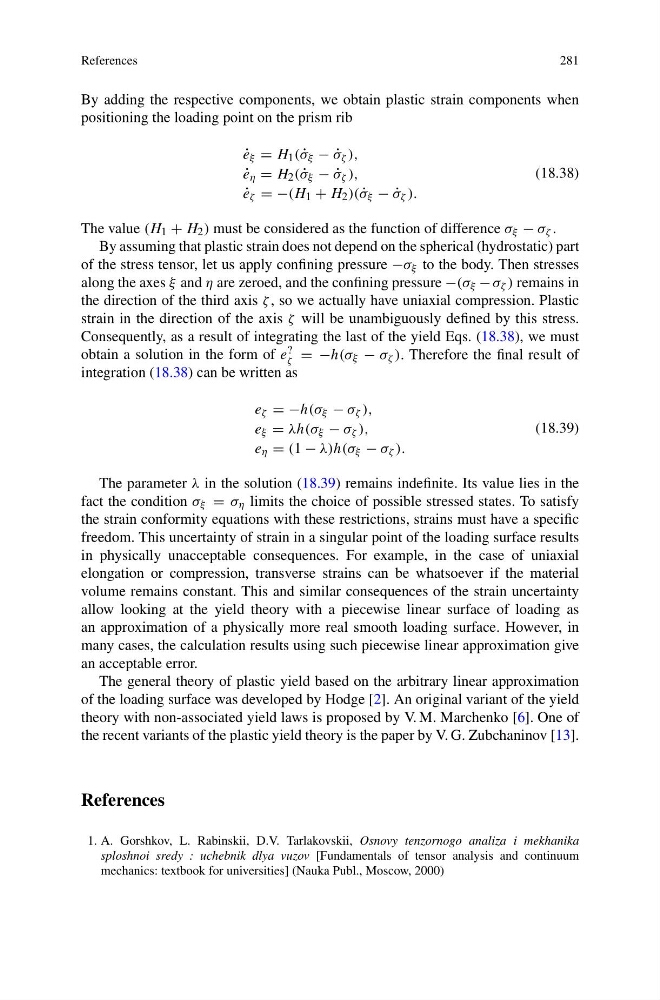
By adding the respective components, we obtain plastic strain components when
positioning the loading point on the prism rib
˙
e ξ = H 1 ( ˙
σ ξ − ˙
σ ζ ),
˙
e η = H 2 ( ˙
σ ξ − ˙
σ ζ ),
˙
e ζ = −(H 1 + H 2 )( ˙
σ ξ − ˙
σ ζ ).
(18.38)
The value (H 1 + H 2 ) must be considered as the function of difference σ ξ − σ ζ .
By assuming that plastic strain does not depend on the spherical (hydrostatic) part
of the stress tensor, let us apply confining pressure −σ ξ to the body. Then stresses
along the axes ξ and η are zeroed, and the confining pressure −(σ ξ − σ ζ ) remains in
the direction of the third axis ζ , so we actually have uniaxial compression. Plastic
strain in the direction of the axis ζ will be unambiguously defined by this stress.
Consequently, as a result of integrating the last of the yield Eqs. (18.38), we must
obtain a solution in the form of e ?
ζ = −h(σ ξ − σ ζ ). Therefore the final result of
integration (18.38) can be written as
e ζ = −h(σ ξ − σ ζ ),
e ξ = λh(σ ξ − σ ζ ),
e η = (1 − λ)h(σ ξ − σ ζ ).
(18.39)
The parameter λ in the solution (18.39) remains indefinite. Its value lies in the
fact the condition σ ξ = σ η limits the choice of possible stressed states. To satisfy
the strain conformity equations with these restrictions, strains must have a specific
freedom. This uncertainty of strain in a singular point of the loading surface results
in physically unacceptable consequences. For example, in the case of uniaxial
elongation or compression, transverse strains can be whatsoever if the material
volume remains constant. This and similar consequences of the strain uncertainty
allow looking at the yield theory with a piecewise linear surface of loading as
an approximation of a physically more real smooth loading surface. However, in
many cases, the calculation results using such piecewise linear approximation give
an acceptable error.
The general theory of plastic yield based on the arbitrary linear approximation
of the loading surface was developed by Hodge [2]. An original variant of the yield
theory with non-associated yield laws is proposed by V. M. Marchenko [6]. One of
the recent variants of the plastic yield theory is the paper by V. G. Zubchaninov [13].
References
1. A. Gorshkov, L. Rabinskii, D.V. Tarlakovskii, Osnovy tenzornogo analiza i mekhanika
sploshnoi sredy : uchebnik dlya vuzov [Fundamentals of tensor analysis and continuum
mechanics: textbook for universities] (Nauka Publ., Moscow, 2000)
281
By adding the respective components, we obtain plastic strain components when
positioning the loading point on the prism rib
˙
e ξ = H 1 ( ˙
σ ξ − ˙
σ ζ ),
˙
e η = H 2 ( ˙
σ ξ − ˙
σ ζ ),
˙
e ζ = −(H 1 + H 2 )( ˙
σ ξ − ˙
σ ζ ).
(18.38)
The value (H 1 + H 2 ) must be considered as the function of difference σ ξ − σ ζ .
By assuming that plastic strain does not depend on the spherical (hydrostatic) part
of the stress tensor, let us apply confining pressure −σ ξ to the body. Then stresses
along the axes ξ and η are zeroed, and the confining pressure −(σ ξ − σ ζ ) remains in
the direction of the third axis ζ , so we actually have uniaxial compression. Plastic
strain in the direction of the axis ζ will be unambiguously defined by this stress.
Consequently, as a result of integrating the last of the yield Eqs. (18.38), we must
obtain a solution in the form of e ?
ζ = −h(σ ξ − σ ζ ). Therefore the final result of
integration (18.38) can be written as
e ζ = −h(σ ξ − σ ζ ),
e ξ = λh(σ ξ − σ ζ ),
e η = (1 − λ)h(σ ξ − σ ζ ).
(18.39)
The parameter λ in the solution (18.39) remains indefinite. Its value lies in the
fact the condition σ ξ = σ η limits the choice of possible stressed states. To satisfy
the strain conformity equations with these restrictions, strains must have a specific
freedom. This uncertainty of strain in a singular point of the loading surface results
in physically unacceptable consequences. For example, in the case of uniaxial
elongation or compression, transverse strains can be whatsoever if the material
volume remains constant. This and similar consequences of the strain uncertainty
allow looking at the yield theory with a piecewise linear surface of loading as
an approximation of a physically more real smooth loading surface. However, in
many cases, the calculation results using such piecewise linear approximation give
an acceptable error.
The general theory of plastic yield based on the arbitrary linear approximation
of the loading surface was developed by Hodge [2]. An original variant of the yield
theory with non-associated yield laws is proposed by V. M. Marchenko [6]. One of
the recent variants of the plastic yield theory is the paper by V. G. Zubchaninov [13].
References
1. A. Gorshkov, L. Rabinskii, D.V. Tarlakovskii, Osnovy tenzornogo analiza i mekhanika
sploshnoi sredy : uchebnik dlya vuzov [Fundamentals of tensor analysis and continuum
mechanics: textbook for universities] (Nauka Publ., Moscow, 2000)