

18.7 Yield for Some Loading Surfaces
277
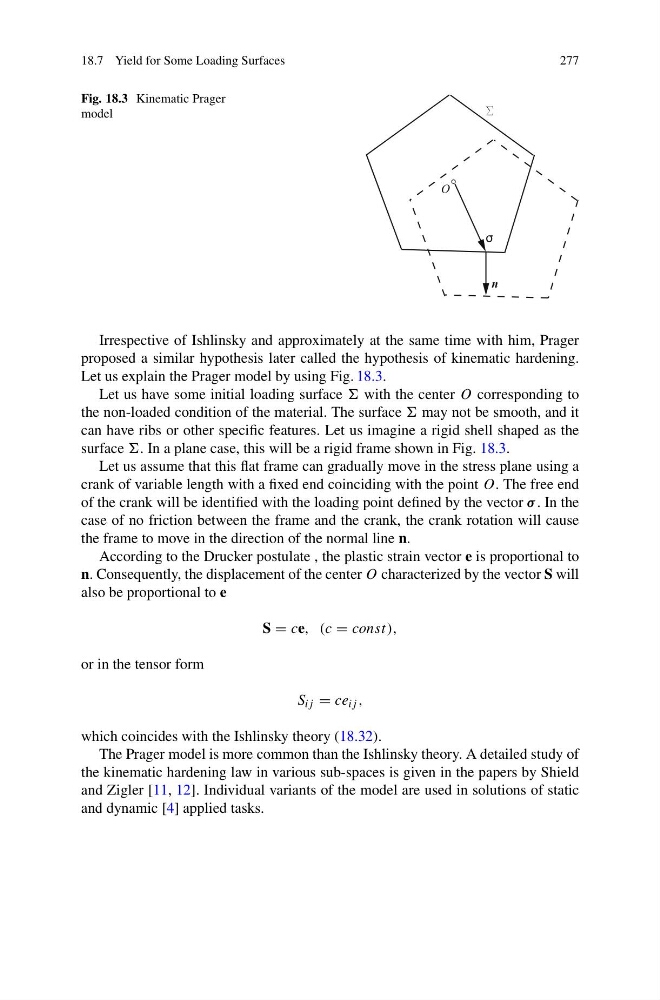
Fig. 18.3 Kinematic Prager
model
Irrespective of Ishlinsky and approximately at the same time with him, Prager
proposed a similar hypothesis later called the hypothesis of kinematic hardening.
Let us explain the Prager model by using Fig. 18.3.
Let us have some initial loading surface with the center O corresponding to
the non-loaded condition of the material. The surface may not be smooth, and it
can have ribs or other specific features. Let us imagine a rigid shell shaped as the
surface . In a plane case, this will be a rigid frame shown in Fig. 18.3.
Let us assume that this flat frame can gradually move in the stress plane using a
crank of variable length with a fixed end coinciding with the point O. The free end
of the crank will be identified with the loading point defined by the vector σ . In the
case of no friction between the frame and the crank, the crank rotation will cause
the frame to move in the direction of the normal line n.
According to the Drucker postulate , the plastic strain vector e is proportional to
n. Consequently, the displacement of the center O characterized by the vector S will
also be proportional to e
S = ce, (c = const),
or in the tensor form
S ij = ce ij ,
which coincides with the Ishlinsky theory (18.32).
The Prager model is more common than the Ishlinsky theory. A detailed study of
the kinematic hardening law in various sub-spaces is given in the papers by Shield
and Zigler [11, 12]. Individual variants of the model are used in solutions of static
and dynamic [4] applied tasks.
277
Fig. 18.3 Kinematic Prager
model
Irrespective of Ishlinsky and approximately at the same time with him, Prager
proposed a similar hypothesis later called the hypothesis of kinematic hardening.
Let us explain the Prager model by using Fig. 18.3.
Let us have some initial loading surface with the center O corresponding to
the non-loaded condition of the material. The surface may not be smooth, and it
can have ribs or other specific features. Let us imagine a rigid shell shaped as the
surface . In a plane case, this will be a rigid frame shown in Fig. 18.3.
Let us assume that this flat frame can gradually move in the stress plane using a
crank of variable length with a fixed end coinciding with the point O. The free end
of the crank will be identified with the loading point defined by the vector σ . In the
case of no friction between the frame and the crank, the crank rotation will cause
the frame to move in the direction of the normal line n.
According to the Drucker postulate , the plastic strain vector e is proportional to
n. Consequently, the displacement of the center O characterized by the vector S will
also be proportional to e
S = ce, (c = const),
or in the tensor form
S ij = ce ij ,
which coincides with the Ishlinsky theory (18.32).
The Prager model is more common than the Ishlinsky theory. A detailed study of
the kinematic hardening law in various sub-spaces is given in the papers by Shield
and Zigler [11, 12]. Individual variants of the model are used in solutions of static
and dynamic [4] applied tasks.