

276
18 Theories of Plastic Yield
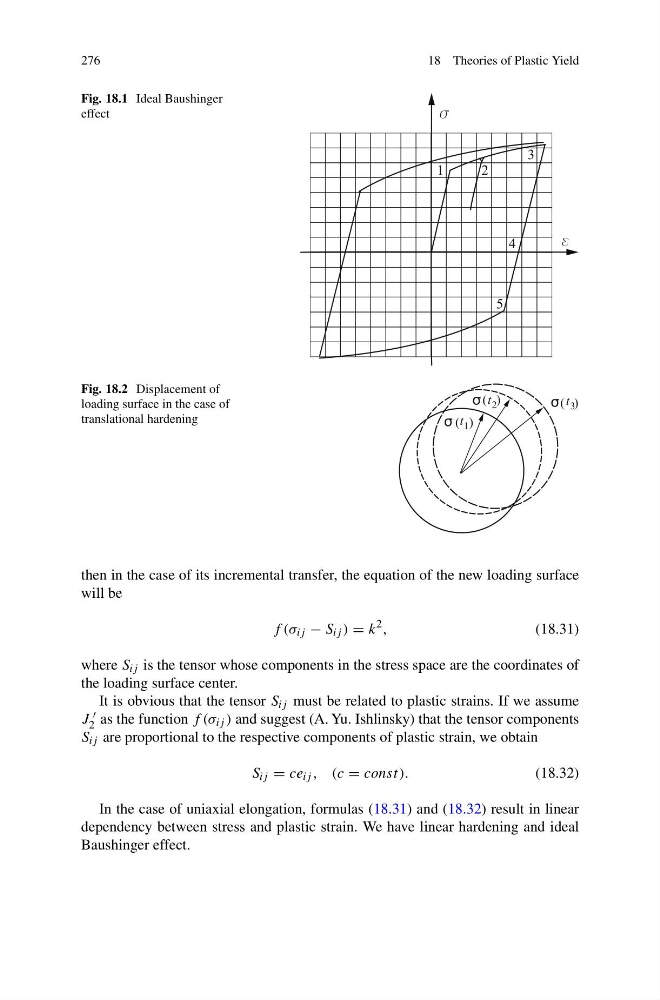
Fig. 18.1 Ideal Baushinger
effect
Fig. 18.2 Displacement of
loading surface in the case of
translational hardening
then in the case of its incremental transfer, the equation of the new loading surface
will be
f (σ ij − S ij ) = k
2 ,
(18.31)
where S ij is the tensor whose components in the stress space are the coordinates of
the loading surface center.
It is obvious that the tensor S ij must be related to plastic strains. If we assume
J
2 as the function f (σ ij ) and suggest (A. Yu. Ishlinsky) that the tensor components
S ij are proportional to the respective components of plastic strain, we obtain
S ij = ce ij , (c = const).
(18.32)
In the case of uniaxial elongation, formulas (18.31) and (18.32) result in linear
dependency between stress and plastic strain. We have linear hardening and ideal
Baushinger effect.
18 Theories of Plastic Yield
Fig. 18.1 Ideal Baushinger
effect
Fig. 18.2 Displacement of
loading surface in the case of
translational hardening
then in the case of its incremental transfer, the equation of the new loading surface
will be
f (σ ij − S ij ) = k
2 ,
(18.31)
where S ij is the tensor whose components in the stress space are the coordinates of
the loading surface center.
It is obvious that the tensor S ij must be related to plastic strains. If we assume
J
2 as the function f (σ ij ) and suggest (A. Yu. Ishlinsky) that the tensor components
S ij are proportional to the respective components of plastic strain, we obtain
S ij = ce ij , (c = const).
(18.32)
In the case of uniaxial elongation, formulas (18.31) and (18.32) result in linear
dependency between stress and plastic strain. We have linear hardening and ideal
Baushinger effect.