

18.3 Saint-Venant–Mises Yield Theory
269
18.2 Prandtl–Reuss Yield
As an additional ratio, let us take the Huber–Mises yield condition (14.15)
τ 0 = τ s ,
where τ s is the shear yield stress. Then we have as follows from the condition (18.5):
dλ =
dA p
2τ 2
s
.
(18.9)
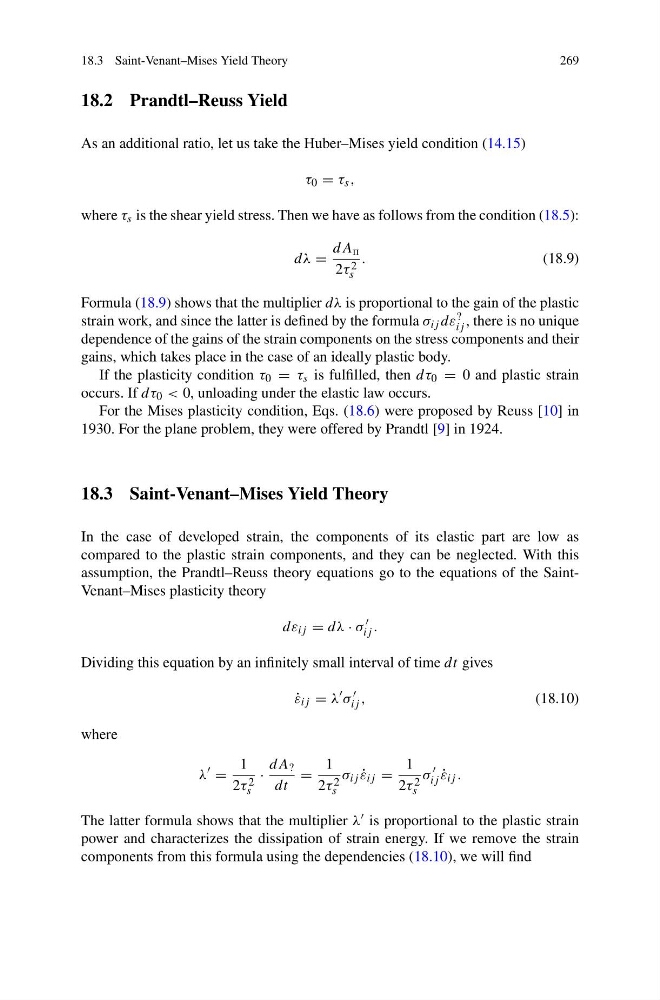
Formula (18.9) shows that the multiplier dλ is proportional to the gain of the plastic
strain work, and since the latter is defined by the formula σ ij dε ?
ij , there is no unique
dependence of the gains of the strain components on the stress components and their
gains, which takes place in the case of an ideally plastic body.
If the plasticity condition τ 0 = τ s is fulfilled, then dτ 0 = 0 and plastic strain
occurs. If dτ 0 < 0, unloading under the elastic law occurs.
For the Mises plasticity condition, Eqs. (18.6) were proposed by Reuss [10] in
1930. For the plane problem, they were offered by Prandtl [9] in 1924.
18.3 Saint-Venant–Mises Yield Theory
In the case of developed strain, the components of its elastic part are low as
compared to the plastic strain components, and they can be neglected. With this
assumption, the Prandtl–Reuss theory equations go to the equations of the SaintVenant–Mises plasticity theory
dε ij = dλ · σ
ij .
Dividing this equation by an infinitely small interval of time dt gives
˙
ε ij = λ
σ
ij ,
(18.10)
where
λ
=
1
2τ 2
s
·
dA ?
dt
=
1
2τ 2
s
σ ij ˙
ε ij =
1
2τ 2
s
σ
ij ˙
ε ij .
The latter formula shows that the multiplier λ is proportional to the plastic strain
power and characterizes the dissipation of strain energy. If we remove the strain
components from this formula using the dependencies (18.10), we will find
269
18.2 Prandtl–Reuss Yield
As an additional ratio, let us take the Huber–Mises yield condition (14.15)
τ 0 = τ s ,
where τ s is the shear yield stress. Then we have as follows from the condition (18.5):
dλ =
dA p
2τ 2
s
.
(18.9)
Formula (18.9) shows that the multiplier dλ is proportional to the gain of the plastic
strain work, and since the latter is defined by the formula σ ij dε ?
ij , there is no unique
dependence of the gains of the strain components on the stress components and their
gains, which takes place in the case of an ideally plastic body.
If the plasticity condition τ 0 = τ s is fulfilled, then dτ 0 = 0 and plastic strain
occurs. If dτ 0 < 0, unloading under the elastic law occurs.
For the Mises plasticity condition, Eqs. (18.6) were proposed by Reuss [10] in
1930. For the plane problem, they were offered by Prandtl [9] in 1924.
18.3 Saint-Venant–Mises Yield Theory
In the case of developed strain, the components of its elastic part are low as
compared to the plastic strain components, and they can be neglected. With this
assumption, the Prandtl–Reuss theory equations go to the equations of the SaintVenant–Mises plasticity theory
dε ij = dλ · σ
ij .
Dividing this equation by an infinitely small interval of time dt gives
˙
ε ij = λ
σ
ij ,
(18.10)
where
λ
=
1
2τ 2
s
·
dA ?
dt
=
1
2τ 2
s
σ ij ˙
ε ij =
1
2τ 2
s
σ
ij ˙
ε ij .
The latter formula shows that the multiplier λ is proportional to the plastic strain
power and characterizes the dissipation of strain energy. If we remove the strain
components from this formula using the dependencies (18.10), we will find