

268
18 Theories of Plastic Yield
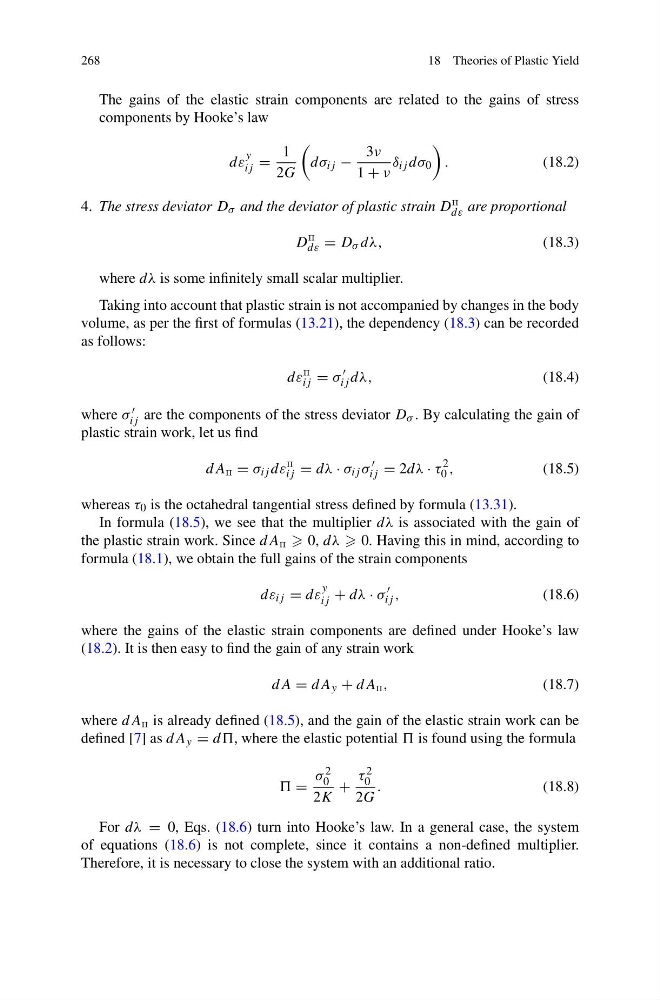
The gains of the elastic strain components are related to the gains of stress
components by Hooke’s law
dε
y
ij =
1
2G
dσ ij −
3ν
1 + ν
δ ij dσ 0
.
(18.2)
4. The stress deviator D σ and the deviator of plastic strain D p
dε are proportional
D
p
dε = D σ dλ,
(18.3)
where dλ is some infinitely small scalar multiplier.
Taking into account that plastic strain is not accompanied by changes in the body
volume, as per the first of formulas (13.21), the dependency (18.3) can be recorded
as follows:
dε
p
ij = σ
ij dλ,
(18.4)
where σ
ij are the components of the stress deviator D σ . By calculating the gain of
plastic strain work, let us find
dA p = σ ij dε
p
ij = dλ · σ ij σ
ij = 2dλ · τ
2
0 ,
(18.5)
whereas τ 0 is the octahedral tangential stress defined by formula (13.31).
In formula (18.5), we see that the multiplier dλ is associated with the gain of
the plastic strain work. Since dA p 0, dλ 0. Having this in mind, according to
formula (18.1), we obtain the full gains of the strain components
dε ij = dε
y
ij + dλ · σ
ij ,
(18.6)
where the gains of the elastic strain components are defined under Hooke’s law
(18.2). It is then easy to find the gain of any strain work
dA = dA y + dA p ,
(18.7)
where dA p is already defined (18.5), and the gain of the elastic strain work can be
defined [7] as dA y = dd, where the elastic potential is found using the formula
=
σ 2
0
2K
+
τ 2
0
2G
.
(18.8)
For dλ = 0, Eqs. (18.6) turn into Hooke’s law. In a general case, the system
of equations (18.6) is not complete, since it contains a non-defined multiplier.
Therefore, it is necessary to close the system with an additional ratio.
18 Theories of Plastic Yield
The gains of the elastic strain components are related to the gains of stress
components by Hooke’s law
dε
y
ij =
1
2G
dσ ij −
3ν
1 + ν
δ ij dσ 0
.
(18.2)
4. The stress deviator D σ and the deviator of plastic strain D p
dε are proportional
D
p
dε = D σ dλ,
(18.3)
where dλ is some infinitely small scalar multiplier.
Taking into account that plastic strain is not accompanied by changes in the body
volume, as per the first of formulas (13.21), the dependency (18.3) can be recorded
as follows:
dε
p
ij = σ
ij dλ,
(18.4)
where σ
ij are the components of the stress deviator D σ . By calculating the gain of
plastic strain work, let us find
dA p = σ ij dε
p
ij = dλ · σ ij σ
ij = 2dλ · τ
2
0 ,
(18.5)
whereas τ 0 is the octahedral tangential stress defined by formula (13.31).
In formula (18.5), we see that the multiplier dλ is associated with the gain of
the plastic strain work. Since dA p 0, dλ 0. Having this in mind, according to
formula (18.1), we obtain the full gains of the strain components
dε ij = dε
y
ij + dλ · σ
ij ,
(18.6)
where the gains of the elastic strain components are defined under Hooke’s law
(18.2). It is then easy to find the gain of any strain work
dA = dA y + dA p ,
(18.7)
where dA p is already defined (18.5), and the gain of the elastic strain work can be
defined [7] as dA y = dd, where the elastic potential is found using the formula
=
σ 2
0
2K
+
τ 2
0
2G
.
(18.8)
For dλ = 0, Eqs. (18.6) turn into Hooke’s law. In a general case, the system
of equations (18.6) is not complete, since it contains a non-defined multiplier.
Therefore, it is necessary to close the system with an additional ratio.