

248
17 Additions and Generalizations to the Strain Theory of Plasticity
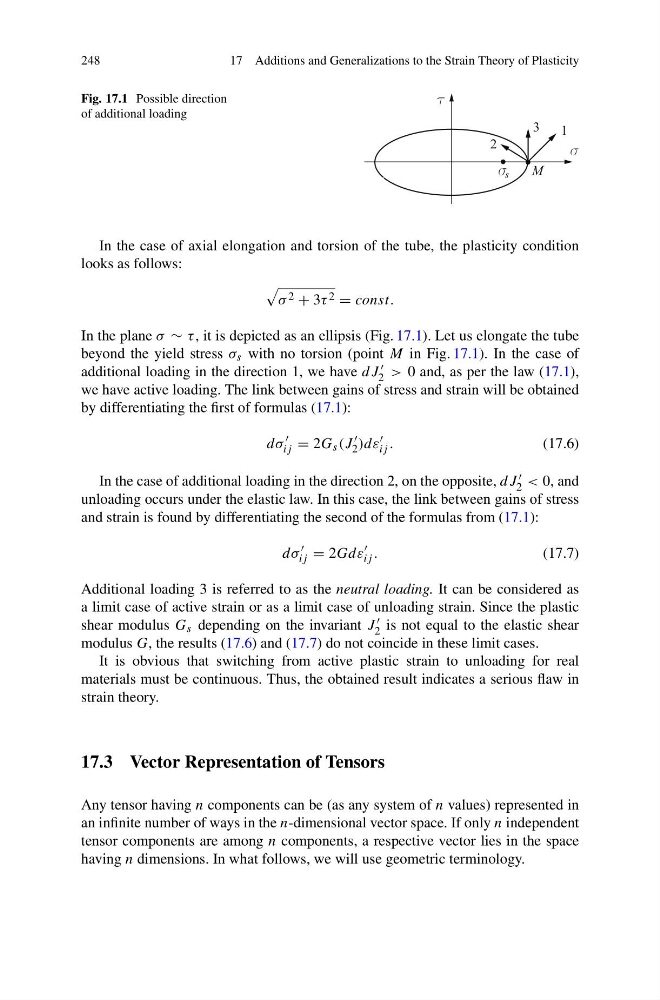
Fig. 17.1 Possible direction
of additional loading
In the case of axial elongation and torsion of the tube, the plasticity condition
looks as follows:
σ 2 + 3τ 2 = const.
In the plane σ ∼ τ , it is depicted as an ellipsis (Fig. 17.1). Let us elongate the tube
beyond the yield stress σ s with no torsion (point M in Fig. 17.1). In the case of
additional loading in the direction 1, we have dJ
2 > 0 and, as per the law (17.1),
we have active loading. The link between gains of stress and strain will be obtained
by differentiating the first of formulas (17.1):
dσ
ij = 2G s (J
2 )dε
ij .
(17.6)
In the case of additional loading in the direction 2, on the opposite, dJ
2 < 0, and
unloading occurs under the elastic law. In this case, the link between gains of stress
and strain is found by differentiating the second of the formulas from (17.1):
dσ
ij = 2Gdε
ij .
(17.7)
Additional loading 3 is referred to as the neutral loading. It can be considered as
a limit case of active strain or as a limit case of unloading strain. Since the plastic
shear modulus G s depending on the invariant J
2 is not equal to the elastic shear
modulus G, the results (17.6) and (17.7) do not coincide in these limit cases.
It is obvious that switching from active plastic strain to unloading for real
materials must be continuous. Thus, the obtained result indicates a serious flaw in
strain theory.
17.3 Vector Representation of Tensors
Any tensor having n components can be (as any system of n values) represented in
an infinite number of ways in the n-dimensional vector space. If only n independent
tensor components are among n components, a respective vector lies in the space
having n dimensions. In what follows, we will use geometric terminology.
17 Additions and Generalizations to the Strain Theory of Plasticity
Fig. 17.1 Possible direction
of additional loading
In the case of axial elongation and torsion of the tube, the plasticity condition
looks as follows:
σ 2 + 3τ 2 = const.
In the plane σ ∼ τ , it is depicted as an ellipsis (Fig. 17.1). Let us elongate the tube
beyond the yield stress σ s with no torsion (point M in Fig. 17.1). In the case of
additional loading in the direction 1, we have dJ
2 > 0 and, as per the law (17.1),
we have active loading. The link between gains of stress and strain will be obtained
by differentiating the first of formulas (17.1):
dσ
ij = 2G s (J
2 )dε
ij .
(17.6)
In the case of additional loading in the direction 2, on the opposite, dJ
2 < 0, and
unloading occurs under the elastic law. In this case, the link between gains of stress
and strain is found by differentiating the second of the formulas from (17.1):
dσ
ij = 2Gdε
ij .
(17.7)
Additional loading 3 is referred to as the neutral loading. It can be considered as
a limit case of active strain or as a limit case of unloading strain. Since the plastic
shear modulus G s depending on the invariant J
2 is not equal to the elastic shear
modulus G, the results (17.6) and (17.7) do not coincide in these limit cases.
It is obvious that switching from active plastic strain to unloading for real
materials must be continuous. Thus, the obtained result indicates a serious flaw in
strain theory.
17.3 Vector Representation of Tensors
Any tensor having n components can be (as any system of n values) represented in
an infinite number of ways in the n-dimensional vector space. If only n independent
tensor components are among n components, a respective vector lies in the space
having n dimensions. In what follows, we will use geometric terminology.