

17.2 Tensor–Linear Ratios in Plasticity Theories
247
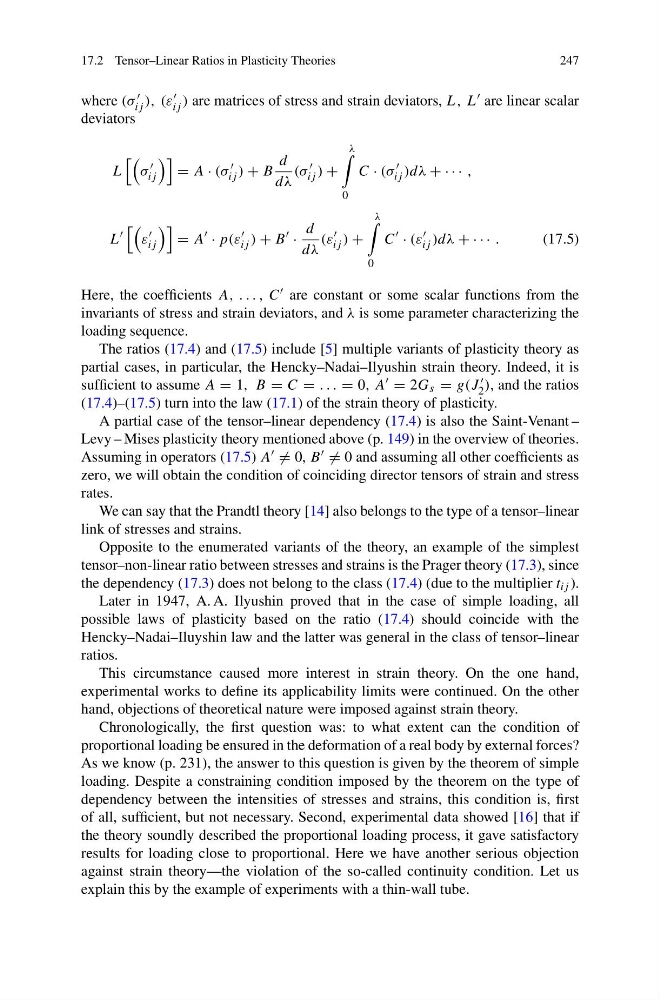
where (σ
ij ), (ε
ij ) are matrices of stress and strain deviators, L, L are linear scalar
deviators
L
σ
ij
= A · (σ
ij ) + B
d
dλ
(σ
ij ) +
λ
0
C · (σ
ij )dλ + · · · ,
L
ε
ij
= A
· p(ε
ij ) + B
·
d
dλ
(ε
ij ) +
λ
0
C
· (ε
ij )dλ + · · · .
(17.5)
Here, the coefficients A, . . . , C are constant or some scalar functions from the
invariants of stress and strain deviators, and λ is some parameter characterizing the
loading sequence.
The ratios (17.4) and (17.5) include [5] multiple variants of plasticity theory as
partial cases, in particular, the Hencky–Nadai–Ilyushin strain theory. Indeed, it is
sufficient to assume A = 1, B = C = . . . = 0, A = 2G s = g(J
2 ), and the ratios
(17.4)–(17.5) turn into the law (17.1) of the strain theory of plasticity.
A partial case of the tensor–linear dependency (17.4) is also the Saint-Venant –
Levy – Mises plasticity theory mentioned above (p. 149) in the overview of theories.
Assuming in operators (17.5) A = 0, B = 0 and assuming all other coefficients as
zero, we will obtain the condition of coinciding director tensors of strain and stress
rates.
We can say that the Prandtl theory [14] also belongs to the type of a tensor–linear
link of stresses and strains.
Opposite to the enumerated variants of the theory, an example of the simplest
tensor–non-linear ratio between stresses and strains is the Prager theory (17.3), since
the dependency (17.3) does not belong to the class (17.4) (due to the multiplier t ij ).
Later in 1947, A. A. Ilyushin proved that in the case of simple loading, all
possible laws of plasticity based on the ratio (17.4) should coincide with the
Hencky–Nadai–Iluyshin law and the latter was general in the class of tensor–linear
ratios.
This circumstance caused more interest in strain theory. On the one hand,
experimental works to define its applicability limits were continued. On the other
hand, objections of theoretical nature were imposed against strain theory.
Chronologically, the first question was: to what extent can the condition of
proportional loading be ensured in the deformation of a real body by external forces?
As we know (p. 231), the answer to this question is given by the theorem of simple
loading. Despite a constraining condition imposed by the theorem on the type of
dependency between the intensities of stresses and strains, this condition is, first
of all, sufficient, but not necessary. Second, experimental data showed [16] that if
the theory soundly described the proportional loading process, it gave satisfactory
results for loading close to proportional. Here we have another serious objection
against strain theory—the violation of the so-called continuity condition. Let us
explain this by the example of experiments with a thin-wall tube.
247
where (σ
ij ), (ε
ij ) are matrices of stress and strain deviators, L, L are linear scalar
deviators
L
σ
ij
= A · (σ
ij ) + B
d
dλ
(σ
ij ) +
λ
0
C · (σ
ij )dλ + · · · ,
L
ε
ij
= A
· p(ε
ij ) + B
·
d
dλ
(ε
ij ) +
λ
0
C
· (ε
ij )dλ + · · · .
(17.5)
Here, the coefficients A, . . . , C are constant or some scalar functions from the
invariants of stress and strain deviators, and λ is some parameter characterizing the
loading sequence.
The ratios (17.4) and (17.5) include [5] multiple variants of plasticity theory as
partial cases, in particular, the Hencky–Nadai–Ilyushin strain theory. Indeed, it is
sufficient to assume A = 1, B = C = . . . = 0, A = 2G s = g(J
2 ), and the ratios
(17.4)–(17.5) turn into the law (17.1) of the strain theory of plasticity.
A partial case of the tensor–linear dependency (17.4) is also the Saint-Venant –
Levy – Mises plasticity theory mentioned above (p. 149) in the overview of theories.
Assuming in operators (17.5) A = 0, B = 0 and assuming all other coefficients as
zero, we will obtain the condition of coinciding director tensors of strain and stress
rates.
We can say that the Prandtl theory [14] also belongs to the type of a tensor–linear
link of stresses and strains.
Opposite to the enumerated variants of the theory, an example of the simplest
tensor–non-linear ratio between stresses and strains is the Prager theory (17.3), since
the dependency (17.3) does not belong to the class (17.4) (due to the multiplier t ij ).
Later in 1947, A. A. Ilyushin proved that in the case of simple loading, all
possible laws of plasticity based on the ratio (17.4) should coincide with the
Hencky–Nadai–Iluyshin law and the latter was general in the class of tensor–linear
ratios.
This circumstance caused more interest in strain theory. On the one hand,
experimental works to define its applicability limits were continued. On the other
hand, objections of theoretical nature were imposed against strain theory.
Chronologically, the first question was: to what extent can the condition of
proportional loading be ensured in the deformation of a real body by external forces?
As we know (p. 231), the answer to this question is given by the theorem of simple
loading. Despite a constraining condition imposed by the theorem on the type of
dependency between the intensities of stresses and strains, this condition is, first
of all, sufficient, but not necessary. Second, experimental data showed [16] that if
the theory soundly described the proportional loading process, it gave satisfactory
results for loading close to proportional. Here we have another serious objection
against strain theory—the violation of the so-called continuity condition. Let us
explain this by the example of experiments with a thin-wall tube.