

16.6 Rod of a Variable Section: Method of Elastic Solutions
241
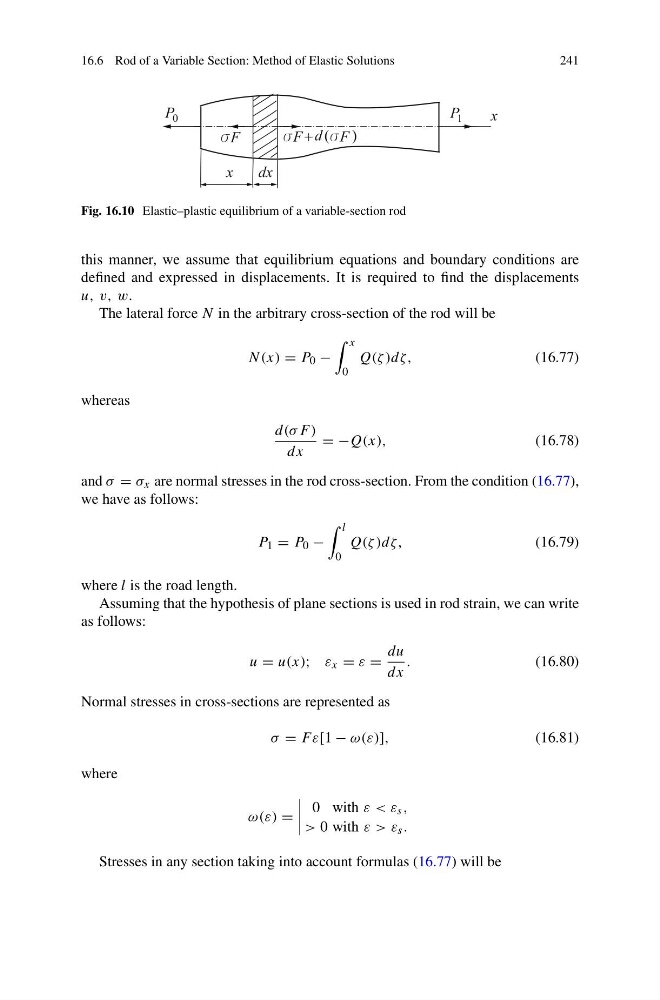
Fig. 16.10 Elastic–plastic equilibrium of a variable-section rod
this manner, we assume that equilibrium equations and boundary conditions are
defined and expressed in displacements. It is required to find the displacements
u, v, w.
The lateral force N in the arbitrary cross-section of the rod will be
N(x) = P 0 −
x
0
Q(ζ )dζ,
(16.77)
whereas
d(σ F )
dx
= −Q(x),
(16.78)
and σ = σ x are normal stresses in the rod cross-section. From the condition (16.77),
we have as follows:
P 1 = P 0 −
l
0
Q(ζ )dζ,
(16.79)
where l is the road length.
Assuming that the hypothesis of plane sections is used in rod strain, we can write
as follows:
u = u(x); ε x = ε =
du
dx
.
(16.80)
Normal stresses in cross-sections are represented as
σ = F ε[1 − ω(ε)],
(16.81)
where
ω(ε) =
0 with ε < ε s ,
> 0 with ε > ε s .
Stresses in any section taking into account formulas (16.77) will be
241
Fig. 16.10 Elastic–plastic equilibrium of a variable-section rod
this manner, we assume that equilibrium equations and boundary conditions are
defined and expressed in displacements. It is required to find the displacements
u, v, w.
The lateral force N in the arbitrary cross-section of the rod will be
N(x) = P 0 −
x
0
Q(ζ )dζ,
(16.77)
whereas
d(σ F )
dx
= −Q(x),
(16.78)
and σ = σ x are normal stresses in the rod cross-section. From the condition (16.77),
we have as follows:
P 1 = P 0 −
l
0
Q(ζ )dζ,
(16.79)
where l is the road length.
Assuming that the hypothesis of plane sections is used in rod strain, we can write
as follows:
u = u(x); ε x = ε =
du
dx
.
(16.80)
Normal stresses in cross-sections are represented as
σ = F ε[1 − ω(ε)],
(16.81)
where
ω(ε) =
0 with ε < ε s ,
> 0 with ε > ε s .
Stresses in any section taking into account formulas (16.77) will be