

240
16 Solution of the Simplest Problems for the Strain Theory of Plasticity
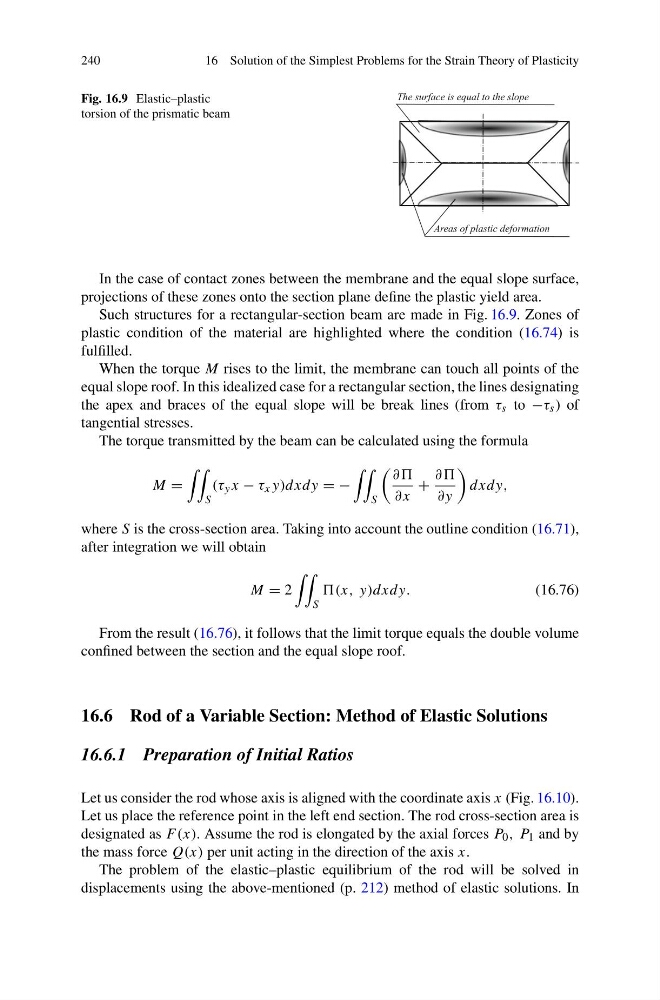
Fig. 16.9 Elastic–plastic
torsion of the prismatic beam
In the case of contact zones between the membrane and the equal slope surface,
projections of these zones onto the section plane define the plastic yield area.
Such structures for a rectangular-section beam are made in Fig. 16.9. Zones of
plastic condition of the material are highlighted where the condition (16.74) is
fulfilled.
When the torque M rises to the limit, the membrane can touch all points of the
equal slope roof. In this idealized case for a rectangular section, the lines designating
the apex and braces of the equal slope will be break lines (from τ s to −τ s ) of
tangential stresses.
The torque transmitted by the beam can be calculated using the formula
M =
S
(τ y x − τ x y)dxdy = −
S
∂∂
∂x
+
∂∂
∂y
dxdy,
where S is the cross-section area. Taking into account the outline condition (16.71),
after integration we will obtain
M = 2
S
(x, y)dxdy.
(16.76)
From the result (16.76), it follows that the limit torque equals the double volume
confined between the section and the equal slope roof.
16.6 Rod of a Variable Section: Method of Elastic Solutions
16.6.1 Preparation of Initial Ratios
Let us consider the rod whose axis is aligned with the coordinate axis x (Fig. 16.10).
Let us place the reference point in the left end section. The rod cross-section area is
designated as F (x). Assume the rod is elongated by the axial forces P 0 , P 1 and by
the mass force Q(x) per unit acting in the direction of the axis x.
The problem of the elastic–plastic equilibrium of the rod will be solved in
displacements using the above-mentioned (p. 212) method of elastic solutions. In
16 Solution of the Simplest Problems for the Strain Theory of Plasticity
Fig. 16.9 Elastic–plastic
torsion of the prismatic beam
In the case of contact zones between the membrane and the equal slope surface,
projections of these zones onto the section plane define the plastic yield area.
Such structures for a rectangular-section beam are made in Fig. 16.9. Zones of
plastic condition of the material are highlighted where the condition (16.74) is
fulfilled.
When the torque M rises to the limit, the membrane can touch all points of the
equal slope roof. In this idealized case for a rectangular section, the lines designating
the apex and braces of the equal slope will be break lines (from τ s to −τ s ) of
tangential stresses.
The torque transmitted by the beam can be calculated using the formula
M =
S
(τ y x − τ x y)dxdy = −
S
∂∂
∂x
+
∂∂
∂y
dxdy,
where S is the cross-section area. Taking into account the outline condition (16.71),
after integration we will obtain
M = 2
S
(x, y)dxdy.
(16.76)
From the result (16.76), it follows that the limit torque equals the double volume
confined between the section and the equal slope roof.
16.6 Rod of a Variable Section: Method of Elastic Solutions
16.6.1 Preparation of Initial Ratios
Let us consider the rod whose axis is aligned with the coordinate axis x (Fig. 16.10).
Let us place the reference point in the left end section. The rod cross-section area is
designated as F (x). Assume the rod is elongated by the axial forces P 0 , P 1 and by
the mass force Q(x) per unit acting in the direction of the axis x.
The problem of the elastic–plastic equilibrium of the rod will be solved in
displacements using the above-mentioned (p. 212) method of elastic solutions. In