

234
16 Solution of the Simplest Problems for the Strain Theory of Plasticity
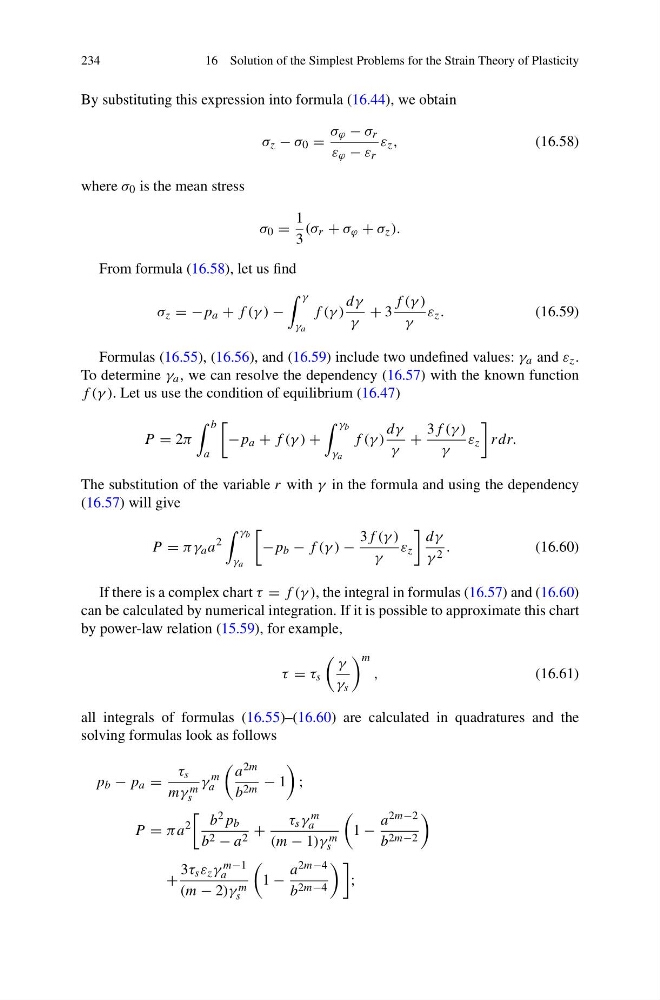
By substituting this expression into formula (16.44), we obtain
σ z − σ 0 =
σ ϕ − σ r
ε ϕ − ε r
ε z ,
(16.58)
where σ 0 is the mean stress
σ 0 =
1
3
(σ r + σ ϕ + σ z ).
From formula (16.58), let us find
σ z = −p a + f (γ ) −
γ
γ a
f (γ )
dγ
γ
+ 3
f (γ )
γ
ε z .
(16.59)
Formulas (16.55), (16.56), and (16.59) include two undefined values: γ a and ε z .
To determine γ a , we can resolve the dependency (16.57) with the known function
f (γ ). Let us use the condition of equilibrium (16.47)
P = 2π
b
a
−p a + f (γ ) +
γ b
γ a
f (γ )
dγ
γ
+
3f (γ )
γ
ε z
rdr.
The substitution of the variable r with γ in the formula and using the dependency
(16.57) will give
P = πγ a a
2
γ b
γ a
−p b − f (γ ) −
3f (γ )
γ
ε z
dγ
γ 2 .
(16.60)
If there is a complex chart τ = f (γ ), the integral in formulas (16.57) and (16.60)
can be calculated by numerical integration. If it is possible to approximate this chart
by power-law relation (15.59), for example,
τ = τ s
γ
γ s
m
,
(16.61)
all integrals of formulas (16.55)–(16.60) are calculated in quadratures and the
solving formulas look as follows
p b − p a =
τ s
mγ m
s
γ
m
a
a 2m
b 2m − 1
;
P = πa
2
b 2 p b
b 2 − a 2 +
τ s γ m
a
(m − 1)γ m
s
1 −
a 2m−2
b 2m−2
+
3τ s ε z γ m−1
a
(m − 2)γ m
s
1 −
a 2m−4
b 2m−4
;
16 Solution of the Simplest Problems for the Strain Theory of Plasticity
By substituting this expression into formula (16.44), we obtain
σ z − σ 0 =
σ ϕ − σ r
ε ϕ − ε r
ε z ,
(16.58)
where σ 0 is the mean stress
σ 0 =
1
3
(σ r + σ ϕ + σ z ).
From formula (16.58), let us find
σ z = −p a + f (γ ) −
γ
γ a
f (γ )
dγ
γ
+ 3
f (γ )
γ
ε z .
(16.59)
Formulas (16.55), (16.56), and (16.59) include two undefined values: γ a and ε z .
To determine γ a , we can resolve the dependency (16.57) with the known function
f (γ ). Let us use the condition of equilibrium (16.47)
P = 2π
b
a
−p a + f (γ ) +
γ b
γ a
f (γ )
dγ
γ
+
3f (γ )
γ
ε z
rdr.
The substitution of the variable r with γ in the formula and using the dependency
(16.57) will give
P = πγ a a
2
γ b
γ a
−p b − f (γ ) −
3f (γ )
γ
ε z
dγ
γ 2 .
(16.60)
If there is a complex chart τ = f (γ ), the integral in formulas (16.57) and (16.60)
can be calculated by numerical integration. If it is possible to approximate this chart
by power-law relation (15.59), for example,
τ = τ s
γ
γ s
m
,
(16.61)
all integrals of formulas (16.55)–(16.60) are calculated in quadratures and the
solving formulas look as follows
p b − p a =
τ s
mγ m
s
γ
m
a
a 2m
b 2m − 1
;
P = πa
2
b 2 p b
b 2 − a 2 +
τ s γ m
a
(m − 1)γ m
s
1 −
a 2m−2
b 2m−2
+
3τ s ε z γ m−1
a
(m − 2)γ m
s
1 −
a 2m−4
b 2m−4
;