

16.3 Elastic–Plastic Inflation of a Spherical Vessel
227
where
p 0 = p
a 3
b 3 − a 3 .
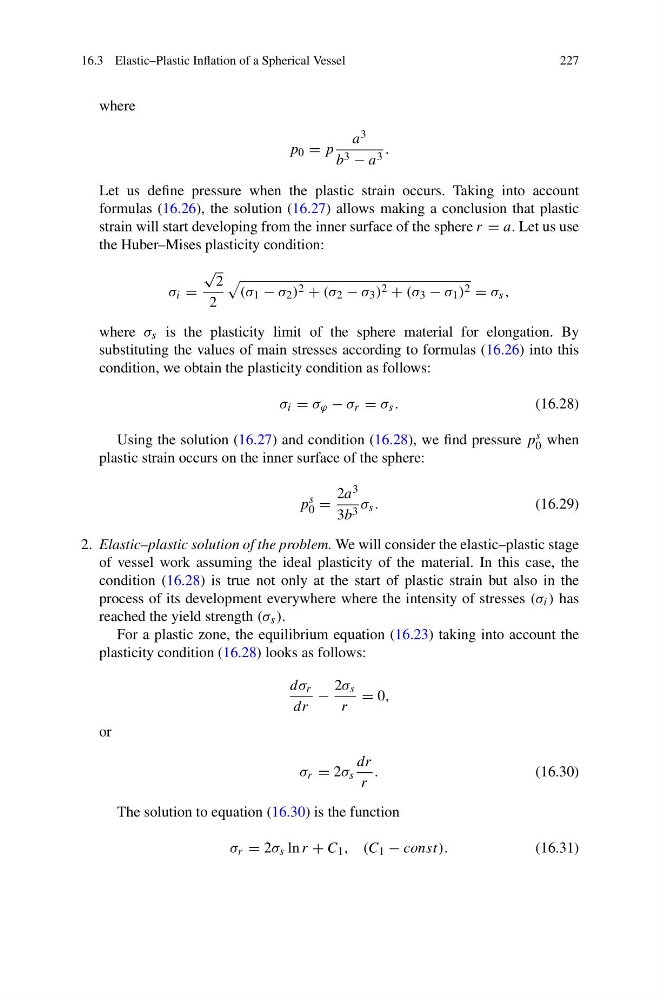
Let us define pressure when the plastic strain occurs. Taking into account
formulas (16.26), the solution (16.27) allows making a conclusion that plastic
strain will start developing from the inner surface of the sphere r = a. Let us use
the Huber–Mises plasticity condition:
σ i =
√
2
2
(σ 1 − σ 2 ) 2 + (σ 2 − σ 3 ) 2 + (σ 3 − σ 1 ) 2 = σ s ,
where σ s is the plasticity limit of the sphere material for elongation. By
substituting the values of main stresses according to formulas (16.26) into this
condition, we obtain the plasticity condition as follows:
σ i = σ ϕ − σ r = σ s .
(16.28)
Using the solution (16.27) and condition (16.28), we find pressure p s
0 when
plastic strain occurs on the inner surface of the sphere:
p
s
0 =
2a 3
3b 3 σ s .
(16.29)
2. Elastic–plastic solution of the problem. We will consider the elastic–plastic stage
of vessel work assuming the ideal plasticity of the material. In this case, the
condition (16.28) is true not only at the start of plastic strain but also in the
process of its development everywhere where the intensity of stresses (σ i ) has
reached the yield strength (σ s ).
For a plastic zone, the equilibrium equation (16.23) taking into account the
plasticity condition (16.28) looks as follows:
dσ r
dr
−
2σ s
r
= 0,
or
σ r = 2σ s
dr
r
.
(16.30)
The solution to equation (16.30) is the function
σ r = 2σ s ln r + C 1 , (C 1 − const).
(16.31)
227
where
p 0 = p
a 3
b 3 − a 3 .
Let us define pressure when the plastic strain occurs. Taking into account
formulas (16.26), the solution (16.27) allows making a conclusion that plastic
strain will start developing from the inner surface of the sphere r = a. Let us use
the Huber–Mises plasticity condition:
σ i =
√
2
2
(σ 1 − σ 2 ) 2 + (σ 2 − σ 3 ) 2 + (σ 3 − σ 1 ) 2 = σ s ,
where σ s is the plasticity limit of the sphere material for elongation. By
substituting the values of main stresses according to formulas (16.26) into this
condition, we obtain the plasticity condition as follows:
σ i = σ ϕ − σ r = σ s .
(16.28)
Using the solution (16.27) and condition (16.28), we find pressure p s
0 when
plastic strain occurs on the inner surface of the sphere:
p
s
0 =
2a 3
3b 3 σ s .
(16.29)
2. Elastic–plastic solution of the problem. We will consider the elastic–plastic stage
of vessel work assuming the ideal plasticity of the material. In this case, the
condition (16.28) is true not only at the start of plastic strain but also in the
process of its development everywhere where the intensity of stresses (σ i ) has
reached the yield strength (σ s ).
For a plastic zone, the equilibrium equation (16.23) taking into account the
plasticity condition (16.28) looks as follows:
dσ r
dr
−
2σ s
r
= 0,
or
σ r = 2σ s
dr
r
.
(16.30)
The solution to equation (16.30) is the function
σ r = 2σ s ln r + C 1 , (C 1 − const).
(16.31)