

226
16 Solution of the Simplest Problems for the Strain Theory of Plasticity
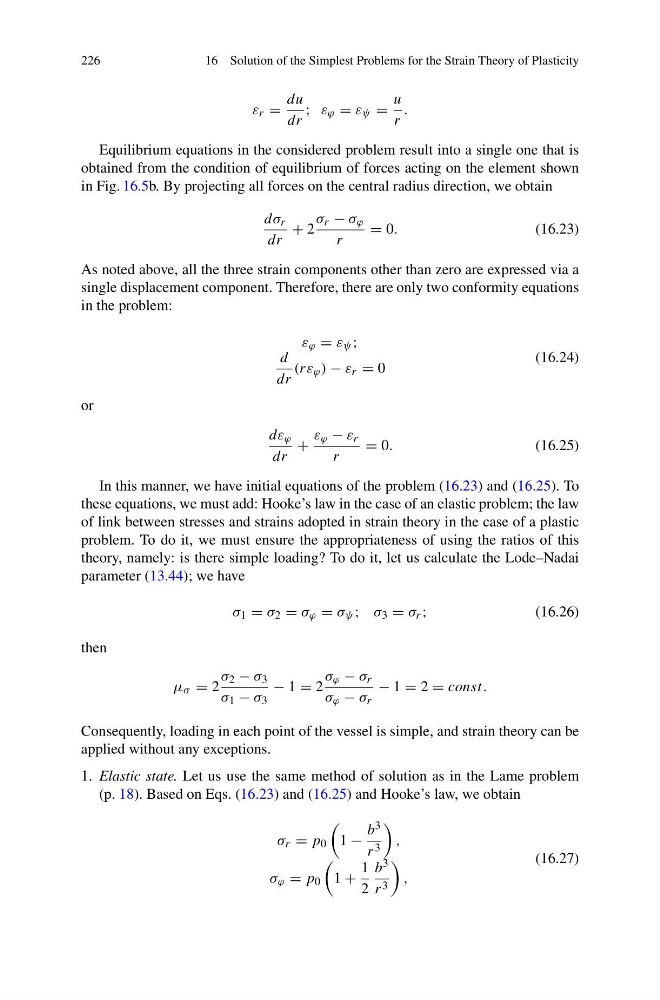
ε r =
du
dr
; ε ϕ = ε ψ =
u
r
.
Equilibrium equations in the considered problem result into a single one that is
obtained from the condition of equilibrium of forces acting on the element shown
in Fig. 16.5b. By projecting all forces on the central radius direction, we obtain
dσ r
dr
+ 2
σ r − σ ϕ
r
= 0.
(16.23)
As noted above, all the three strain components other than zero are expressed via a
single displacement component. Therefore, there are only two conformity equations
in the problem:
ε ϕ = ε ψ ;
d
dr
(rε ϕ ) − ε r = 0
(16.24)
or
dε ϕ
dr
+
ε ϕ − ε r
r
= 0.
(16.25)
In this manner, we have initial equations of the problem (16.23) and (16.25). To
these equations, we must add: Hooke’s law in the case of an elastic problem; the law
of link between stresses and strains adopted in strain theory in the case of a plastic
problem. To do it, we must ensure the appropriateness of using the ratios of this
theory, namely: is there simple loading? To do it, let us calculate the Lode–Nadai
parameter (13.44); we have
σ 1 = σ 2 = σ ϕ = σ ψ ; σ 3 = σ r ;
(16.26)
then
μ σ = 2
σ 2 − σ 3
σ 1 − σ 3
− 1 = 2
σ ϕ − σ r
σ ϕ − σ r
− 1 = 2 = const.
Consequently, loading in each point of the vessel is simple, and strain theory can be
applied without any exceptions.
1. Elastic state. Let us use the same method of solution as in the Lame problem
(p. 18). Based on Eqs. (16.23) and (16.25) and Hooke’s law, we obtain
σ r = p 0
1 −
b 3
r 3
,
σ ϕ = p 0
1 +
1
2
b 3
r 3
,
(16.27)
16 Solution of the Simplest Problems for the Strain Theory of Plasticity
ε r =
du
dr
; ε ϕ = ε ψ =
u
r
.
Equilibrium equations in the considered problem result into a single one that is
obtained from the condition of equilibrium of forces acting on the element shown
in Fig. 16.5b. By projecting all forces on the central radius direction, we obtain
dσ r
dr
+ 2
σ r − σ ϕ
r
= 0.
(16.23)
As noted above, all the three strain components other than zero are expressed via a
single displacement component. Therefore, there are only two conformity equations
in the problem:
ε ϕ = ε ψ ;
d
dr
(rε ϕ ) − ε r = 0
(16.24)
or
dε ϕ
dr
+
ε ϕ − ε r
r
= 0.
(16.25)
In this manner, we have initial equations of the problem (16.23) and (16.25). To
these equations, we must add: Hooke’s law in the case of an elastic problem; the law
of link between stresses and strains adopted in strain theory in the case of a plastic
problem. To do it, we must ensure the appropriateness of using the ratios of this
theory, namely: is there simple loading? To do it, let us calculate the Lode–Nadai
parameter (13.44); we have
σ 1 = σ 2 = σ ϕ = σ ψ ; σ 3 = σ r ;
(16.26)
then
μ σ = 2
σ 2 − σ 3
σ 1 − σ 3
− 1 = 2
σ ϕ − σ r
σ ϕ − σ r
− 1 = 2 = const.
Consequently, loading in each point of the vessel is simple, and strain theory can be
applied without any exceptions.
1. Elastic state. Let us use the same method of solution as in the Lame problem
(p. 18). Based on Eqs. (16.23) and (16.25) and Hooke’s law, we obtain
σ r = p 0
1 −
b 3
r 3
,
σ ϕ = p 0
1 +
1
2
b 3
r 3
,
(16.27)