

15.11 Theorem of Unloading
215
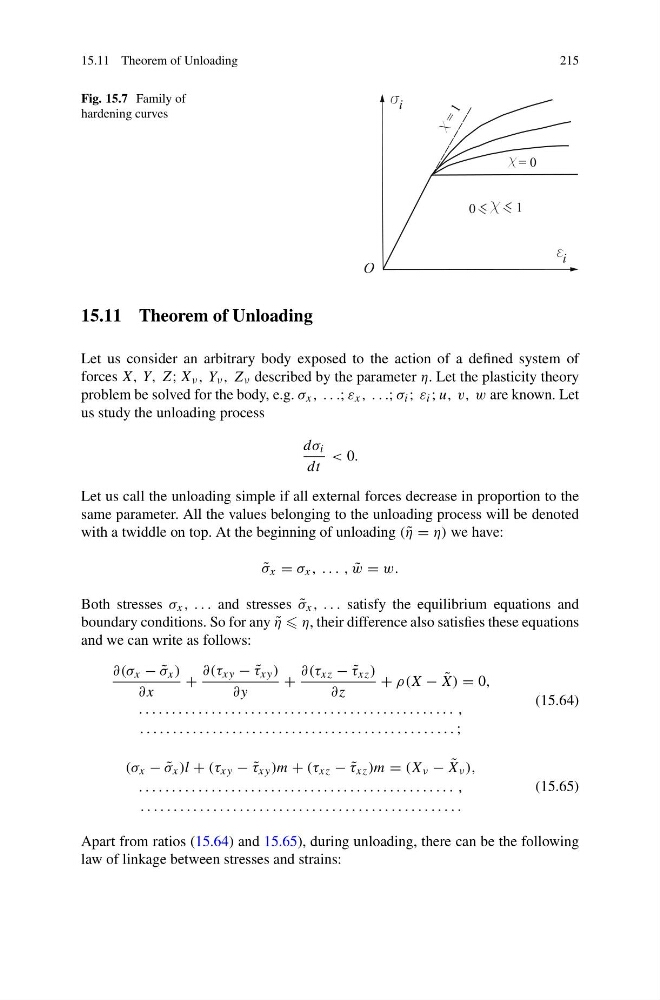
Fig. 15.7 Family of
hardening curves
15.11 Theorem of Unloading
Let us consider an arbitrary body exposed to the action of a defined system of
forces X, Y, Z; X ν , Y ν , Z ν described by the parameter η. Let the plasticity theory
problem be solved for the body, e.g. σ x , . . .; ε x , . . .; σ i ; ε i ; u, v, w are known. Let
us study the unloading process
dσ i
dt
< 0.
Let us call the unloading simple if all external forces decrease in proportion to the
same parameter. All the values belonging to the unloading process will be denoted
with a twiddle on top. At the beginning of unloading ( ˜
η = η) we have:
˜
σ x = σ x , . . . , ˜
w = w.
Both stresses σ x , . . . and stresses ˜
σ x , . . . satisfy the equilibrium equations and
boundary conditions. So for any ˜
η η, their difference also satisfies these equations
and we can write as follows:
∂(σ x − ˜
σ x )
∂x
+
∂(τ xy − ˜
τ xy )
∂y
+
∂(τ xz − ˜
τ xz )
∂z
+ ρ(X − ˜
X) = 0,
. . . . . . . . . . . . . . . . . . . . . . . . . . . . . . . . . . . . . . . . . . . . . . . . ,
. . . . . . . . . . . . . . . . . . . . . . . . . . . . . . . . . . . . . . . . . . . . . . . . ;
(15.64)
(σ x − ˜
σ x )l + (τ xy − ˜
τ xy )m + (τ xz − ˜
τ xz )m = (X ν − ˜
X ν ),
. . . . . . . . . . . . . . . . . . . . . . . . . . . . . . . . . . . . . . . . . . . . . . . . ,
. . . . . . . . . . . . . . . . . . . . . . . . . . . . . . . . . . . . . . . . . . . . . . . . .
(15.65)
Apart from ratios (15.64) and 15.65), during unloading, there can be the following
law of linkage between stresses and strains:
215
Fig. 15.7 Family of
hardening curves
15.11 Theorem of Unloading
Let us consider an arbitrary body exposed to the action of a defined system of
forces X, Y, Z; X ν , Y ν , Z ν described by the parameter η. Let the plasticity theory
problem be solved for the body, e.g. σ x , . . .; ε x , . . .; σ i ; ε i ; u, v, w are known. Let
us study the unloading process
dσ i
dt
< 0.
Let us call the unloading simple if all external forces decrease in proportion to the
same parameter. All the values belonging to the unloading process will be denoted
with a twiddle on top. At the beginning of unloading ( ˜
η = η) we have:
˜
σ x = σ x , . . . , ˜
w = w.
Both stresses σ x , . . . and stresses ˜
σ x , . . . satisfy the equilibrium equations and
boundary conditions. So for any ˜
η η, their difference also satisfies these equations
and we can write as follows:
∂(σ x − ˜
σ x )
∂x
+
∂(τ xy − ˜
τ xy )
∂y
+
∂(τ xz − ˜
τ xz )
∂z
+ ρ(X − ˜
X) = 0,
. . . . . . . . . . . . . . . . . . . . . . . . . . . . . . . . . . . . . . . . . . . . . . . . ,
. . . . . . . . . . . . . . . . . . . . . . . . . . . . . . . . . . . . . . . . . . . . . . . . ;
(15.64)
(σ x − ˜
σ x )l + (τ xy − ˜
τ xy )m + (τ xz − ˜
τ xz )m = (X ν − ˜
X ν ),
. . . . . . . . . . . . . . . . . . . . . . . . . . . . . . . . . . . . . . . . . . . . . . . . ,
. . . . . . . . . . . . . . . . . . . . . . . . . . . . . . . . . . . . . . . . . . . . . . . . .
(15.65)
Apart from ratios (15.64) and 15.65), during unloading, there can be the following
law of linkage between stresses and strains: