

214
15 Plasticity Theory of Henky–Nadai–Ilyushin
∂σ ∗
x
∂x
+
τ ∗
xy
∂y
+
∂τ ∗
xz
∂z
= 0,
. . . . . . . . . . . . . . . . . . . . . . . . . . . ,
σ ∗
x l + τ ∗
xy m + τ ∗
xz = X ν ,
. . . . . . . . . . . . . . . . . . . . . . . . . . . ,
σ ∗
x − σ 0
σ i
=
2
3
ε ∗
x
ε i
,
3ε 0 =
∂u ∗
∂x
+
∂v ∗
∂y
+
∂w ∗
∂z
= 0.
(15.61)
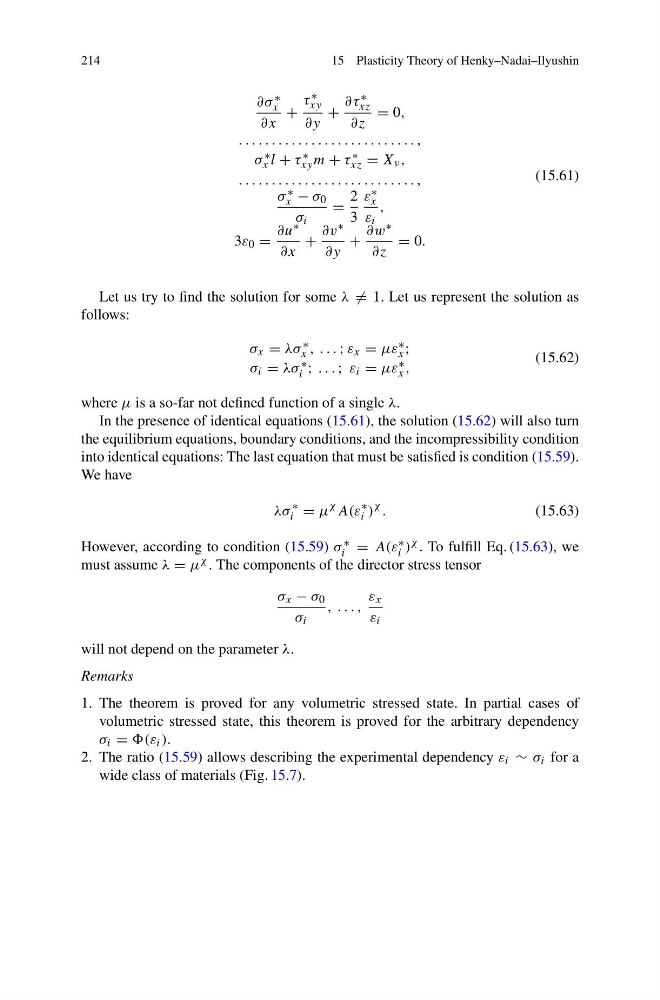
Let us try to find the solution for some λ = 1. Let us represent the solution as
follows:
σ x = λσ ∗
x , . . . ; ε x = με ∗
x ;
σ i = λσ ∗
i ; . . . ; ε i = με ∗
x ,
(15.62)
where μ is a so-far not defined function of a single λ.
In the presence of identical equations (15.61), the solution (15.62) will also turn
the equilibrium equations, boundary conditions, and the incompressibility condition
into identical equations: The last equation that must be satisfied is condition (15.59).
We have
λσ
∗
i = μ
χ A(ε
∗
i )
χ .
(15.63)
However, according to condition (15.59) σ ∗
i = A(ε ∗
i ) χ . To fulfill Eq. (15.63), we
must assume λ = μ χ . The components of the director stress tensor
σ x − σ 0
σ i
, . . . ,
ε x
ε i
will not depend on the parameter λ.
Remarks
1. The theorem is proved for any volumetric stressed state. In partial cases of
volumetric stressed state, this theorem is proved for the arbitrary dependency
σ i = i ).
2. The ratio (15.59) allows describing the experimental dependency ε i ∼ σ i for a
wide class of materials (Fig. 15.7).
15 Plasticity Theory of Henky–Nadai–Ilyushin
∂σ ∗
x
∂x
+
τ ∗
xy
∂y
+
∂τ ∗
xz
∂z
= 0,
. . . . . . . . . . . . . . . . . . . . . . . . . . . ,
σ ∗
x l + τ ∗
xy m + τ ∗
xz = X ν ,
. . . . . . . . . . . . . . . . . . . . . . . . . . . ,
σ ∗
x − σ 0
σ i
=
2
3
ε ∗
x
ε i
,
3ε 0 =
∂u ∗
∂x
+
∂v ∗
∂y
+
∂w ∗
∂z
= 0.
(15.61)
Let us try to find the solution for some λ = 1. Let us represent the solution as
follows:
σ x = λσ ∗
x , . . . ; ε x = με ∗
x ;
σ i = λσ ∗
i ; . . . ; ε i = με ∗
x ,
(15.62)
where μ is a so-far not defined function of a single λ.
In the presence of identical equations (15.61), the solution (15.62) will also turn
the equilibrium equations, boundary conditions, and the incompressibility condition
into identical equations: The last equation that must be satisfied is condition (15.59).
We have
λσ
∗
i = μ
χ A(ε
∗
i )
χ .
(15.63)
However, according to condition (15.59) σ ∗
i = A(ε ∗
i ) χ . To fulfill Eq. (15.63), we
must assume λ = μ χ . The components of the director stress tensor
σ x − σ 0
σ i
, . . . ,
ε x
ε i
will not depend on the parameter λ.
Remarks
1. The theorem is proved for any volumetric stressed state. In partial cases of
volumetric stressed state, this theorem is proved for the arbitrary dependency
σ i = i ).
2. The ratio (15.59) allows describing the experimental dependency ε i ∼ σ i for a
wide class of materials (Fig. 15.7).