

212
15 Plasticity Theory of Henky–Nadai–Ilyushin
1. Find three functions u, v, w so that for arbitrary continuums with continuous
derivatives of variations δu, δv, δw, there is a variation equation of equilibrium
(15.48).
In this setting, one of the variation methods can be used to solve the problem, for
example, the Ritz method. Let us explain the essence of the method.
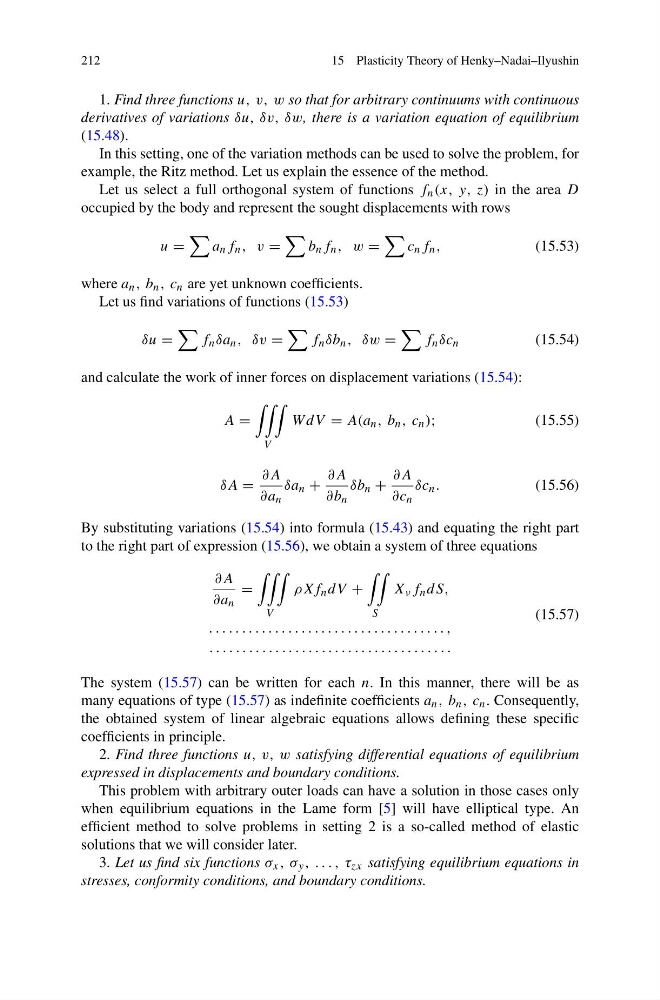
Let us select a full orthogonal system of functions f n (x, y, z) in the area D
occupied by the body and represent the sought displacements with rows
u =
a n f n , v =
b n f n , w =
c n f n ,
(15.53)
where a n , b n , c n are yet unknown coefficients.
Let us find variations of functions (15.53)
δu =
f n δa n , δv =
f n δb n , δw =
f n δc n
(15.54)
and calculate the work of inner forces on displacement variations (15.54):
A =
V
W dV = A(a n , b n , c n );
(15.55)
δA =
∂A
∂a n
δa n +
∂A
∂b n
δb n +
∂A
∂c n
δc n .
(15.56)
By substituting variations (15.54) into formula (15.43) and equating the right part
to the right part of expression (15.56), we obtain a system of three equations
∂A
∂a n
=
V
ρXf n dV +
S
X ν f n dS,
. . . . . . . . . . . . . . . . . . . . . . . . . . . . . . . . . . . . ,
. . . . . . . . . . . . . . . . . . . . . . . . . . . . . . . . . . . . .
(15.57)
The system (15.57) can be written for each n. In this manner, there will be as
many equations of type (15.57) as indefinite coefficients a n , b n , c n . Consequently,
the obtained system of linear algebraic equations allows defining these specific
coefficients in principle.
2. Find three functions u, v, w satisfying differential equations of equilibrium
expressed in displacements and boundary conditions.
This problem with arbitrary outer loads can have a solution in those cases only
when equilibrium equations in the Lame form [5] will have elliptical type. An
efficient method to solve problems in setting 2 is a so-called method of elastic
solutions that we will consider later.
3. Let us find six functions σ x , σ y , . . . , τ zx satisfying equilibrium equations in
stresses, conformity conditions, and boundary conditions.
15 Plasticity Theory of Henky–Nadai–Ilyushin
1. Find three functions u, v, w so that for arbitrary continuums with continuous
derivatives of variations δu, δv, δw, there is a variation equation of equilibrium
(15.48).
In this setting, one of the variation methods can be used to solve the problem, for
example, the Ritz method. Let us explain the essence of the method.
Let us select a full orthogonal system of functions f n (x, y, z) in the area D
occupied by the body and represent the sought displacements with rows
u =
a n f n , v =
b n f n , w =
c n f n ,
(15.53)
where a n , b n , c n are yet unknown coefficients.
Let us find variations of functions (15.53)
δu =
f n δa n , δv =
f n δb n , δw =
f n δc n
(15.54)
and calculate the work of inner forces on displacement variations (15.54):
A =
V
W dV = A(a n , b n , c n );
(15.55)
δA =
∂A
∂a n
δa n +
∂A
∂b n
δb n +
∂A
∂c n
δc n .
(15.56)
By substituting variations (15.54) into formula (15.43) and equating the right part
to the right part of expression (15.56), we obtain a system of three equations
∂A
∂a n
=
V
ρXf n dV +
S
X ν f n dS,
. . . . . . . . . . . . . . . . . . . . . . . . . . . . . . . . . . . . ,
. . . . . . . . . . . . . . . . . . . . . . . . . . . . . . . . . . . . .
(15.57)
The system (15.57) can be written for each n. In this manner, there will be as
many equations of type (15.57) as indefinite coefficients a n , b n , c n . Consequently,
the obtained system of linear algebraic equations allows defining these specific
coefficients in principle.
2. Find three functions u, v, w satisfying differential equations of equilibrium
expressed in displacements and boundary conditions.
This problem with arbitrary outer loads can have a solution in those cases only
when equilibrium equations in the Lame form [5] will have elliptical type. An
efficient method to solve problems in setting 2 is a so-called method of elastic
solutions that we will consider later.
3. Let us find six functions σ x , σ y , . . . , τ zx satisfying equilibrium equations in
stresses, conformity conditions, and boundary conditions.