

210
15 Plasticity Theory of Henky–Nadai–Ilyushin
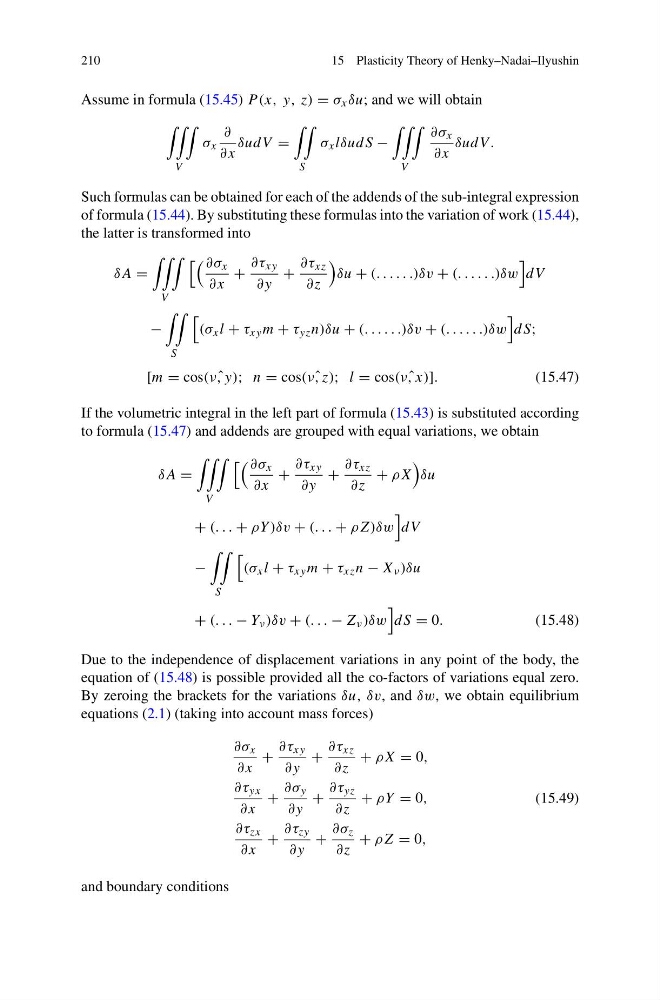
Assume in formula (15.45) P (x, y, z) = σ x δu; and we will obtain
V
σ x
∂
∂x
δudV =
S
σ x lδudS −
V
∂σ x
∂x
δudV .
Such formulas can be obtained for each of the addends of the sub-integral expression
of formula (15.44). By substituting these formulas into the variation of work (15.44),
the latter is transformed into
δA =
V
∂σ x
∂x
+
∂τ xy
∂y
+
∂τ xz
∂z
δu + (. . . . . .)δv + (. . . . . .)δw
dV
−
S
(σ x l + τ xy m + τ yz n)δu + (. . . . . .)δv + (. . . . . .)δw
dS;
[m = cos( ˆ
ν, y); n = cos( ˆ
ν, z); l = cos( ˆ
ν, x)].
(15.47)
If the volumetric integral in the left part of formula (15.43) is substituted according
to formula (15.47) and addends are grouped with equal variations, we obtain
δA =
V
∂σ x
∂x
+
∂τ xy
∂y
+
∂τ xz
∂z
+ ρX
δu
+ (. . . + ρY )δv + (. . . + ρZ)δw
dV
−
S
(σ x l + τ xy m + τ xz n − X ν )δu
+ (. . . − Y ν )δv + (. . . − Z ν )δw
dS = 0.
(15.48)
Due to the independence of displacement variations in any point of the body, the
equation of (15.48) is possible provided all the co-factors of variations equal zero.
By zeroing the brackets for the variations δu, δv, and δw, we obtain equilibrium
equations (2.1) (taking into account mass forces)
∂σ x
∂x
+
∂τ xy
∂y
+
∂τ xz
∂z
+ ρX = 0,
∂τ yx
∂x
+
∂σ y
∂y
+
∂τ yz
∂z
+ ρY = 0,
∂τ zx
∂x
+
∂τ zy
∂y
+
∂σ z
∂z
+ ρZ = 0,
(15.49)
and boundary conditions
15 Plasticity Theory of Henky–Nadai–Ilyushin
Assume in formula (15.45) P (x, y, z) = σ x δu; and we will obtain
V
σ x
∂
∂x
δudV =
S
σ x lδudS −
V
∂σ x
∂x
δudV .
Such formulas can be obtained for each of the addends of the sub-integral expression
of formula (15.44). By substituting these formulas into the variation of work (15.44),
the latter is transformed into
δA =
V
∂σ x
∂x
+
∂τ xy
∂y
+
∂τ xz
∂z
δu + (. . . . . .)δv + (. . . . . .)δw
dV
−
S
(σ x l + τ xy m + τ yz n)δu + (. . . . . .)δv + (. . . . . .)δw
dS;
[m = cos( ˆ
ν, y); n = cos( ˆ
ν, z); l = cos( ˆ
ν, x)].
(15.47)
If the volumetric integral in the left part of formula (15.43) is substituted according
to formula (15.47) and addends are grouped with equal variations, we obtain
δA =
V
∂σ x
∂x
+
∂τ xy
∂y
+
∂τ xz
∂z
+ ρX
δu
+ (. . . + ρY )δv + (. . . + ρZ)δw
dV
−
S
(σ x l + τ xy m + τ xz n − X ν )δu
+ (. . . − Y ν )δv + (. . . − Z ν )δw
dS = 0.
(15.48)
Due to the independence of displacement variations in any point of the body, the
equation of (15.48) is possible provided all the co-factors of variations equal zero.
By zeroing the brackets for the variations δu, δv, and δw, we obtain equilibrium
equations (2.1) (taking into account mass forces)
∂σ x
∂x
+
∂τ xy
∂y
+
∂τ xz
∂z
+ ρX = 0,
∂τ yx
∂x
+
∂σ y
∂y
+
∂τ yz
∂z
+ ρY = 0,
∂τ zx
∂x
+
∂τ zy
∂y
+
∂σ z
∂z
+ ρZ = 0,
(15.49)
and boundary conditions