

208
15 Plasticity Theory of Henky–Nadai–Ilyushin
δr = iδu + jδv + kδw.
Apart from continuity, the virtual displacement property is that it turns zero at the
body boundary. Possible strains and stresses are defined through the vector r in the
same manner as actual stresses and strains are defined through the vector r.
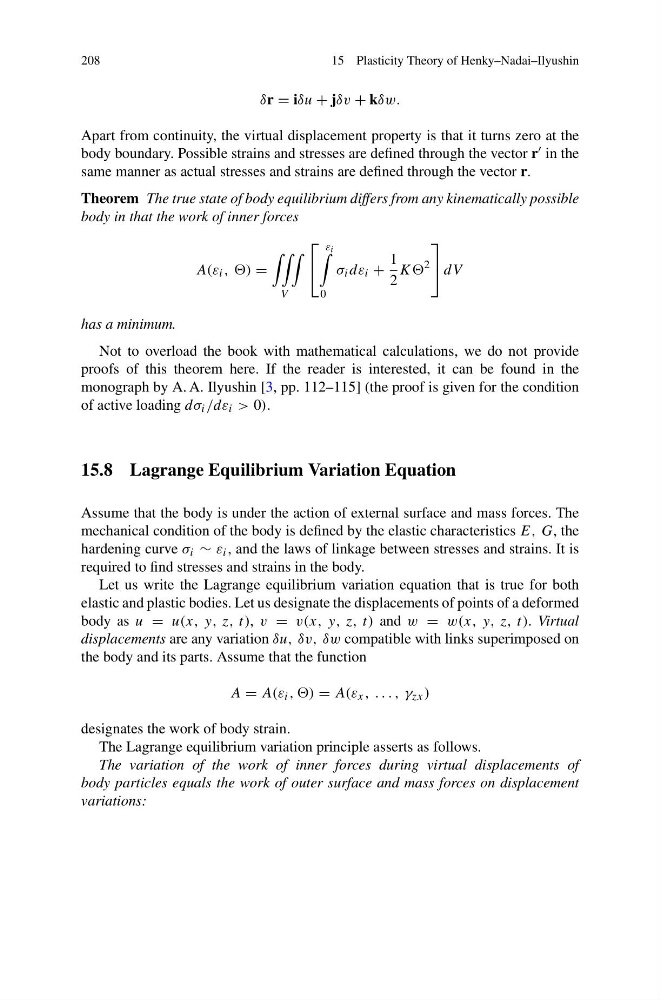
Theorem The true state of body equilibrium differs from any kinematically possible
body in that the work of inner forces
A(ε i , ,) =
V
⎡
⎣
ε i
0
σ i dε i +
1
2
KK
2
⎤
⎦ dV
has a minimum.
Not to overload the book with mathematical calculations, we do not provide
proofs of this theorem here. If the reader is interested, it can be found in the
monograph by A. A. Ilyushin [3, pp. 112–115] (the proof is given for the condition
of active loading dσ i /dε i > 0).
15.8 Lagrange Equilibrium Variation Equation
Assume that the body is under the action of external surface and mass forces. The
mechanical condition of the body is defined by the elastic characteristics E, G, the
hardening curve σ i ∼ ε i , and the laws of linkage between stresses and strains. It is
required to find stresses and strains in the body.
Let us write the Lagrange equilibrium variation equation that is true for both
elastic and plastic bodies. Let us designate the displacements of points of a deformed
body as u = u(x, y, z, t), v = v(x, y, z, t) and w = w(x, y, z, t). Virtual
displacements are any variation δu, δv, δw compatible with links superimposed on
the body and its parts. Assume that the function
A = A(ε i , ,) = A(ε x , . . . , γ zx )
designates the work of body strain.
The Lagrange equilibrium variation principle asserts as follows.
The variation of the work of inner forces during virtual displacements of
body particles equals the work of outer surface and mass forces on displacement
variations:
15 Plasticity Theory of Henky–Nadai–Ilyushin
δr = iδu + jδv + kδw.
Apart from continuity, the virtual displacement property is that it turns zero at the
body boundary. Possible strains and stresses are defined through the vector r in the
same manner as actual stresses and strains are defined through the vector r.
Theorem The true state of body equilibrium differs from any kinematically possible
body in that the work of inner forces
A(ε i , ,) =
V
⎡
⎣
ε i
0
σ i dε i +
1
2
KK
2
⎤
⎦ dV
has a minimum.
Not to overload the book with mathematical calculations, we do not provide
proofs of this theorem here. If the reader is interested, it can be found in the
monograph by A. A. Ilyushin [3, pp. 112–115] (the proof is given for the condition
of active loading dσ i /dε i > 0).
15.8 Lagrange Equilibrium Variation Equation
Assume that the body is under the action of external surface and mass forces. The
mechanical condition of the body is defined by the elastic characteristics E, G, the
hardening curve σ i ∼ ε i , and the laws of linkage between stresses and strains. It is
required to find stresses and strains in the body.
Let us write the Lagrange equilibrium variation equation that is true for both
elastic and plastic bodies. Let us designate the displacements of points of a deformed
body as u = u(x, y, z, t), v = v(x, y, z, t) and w = w(x, y, z, t). Virtual
displacements are any variation δu, δv, δw compatible with links superimposed on
the body and its parts. Assume that the function
A = A(ε i , ,) = A(ε x , . . . , γ zx )
designates the work of body strain.
The Lagrange equilibrium variation principle asserts as follows.
The variation of the work of inner forces during virtual displacements of
body particles equals the work of outer surface and mass forces on displacement
variations: