

15.7 Theorem of the Minimal Work of Inner Forces
207
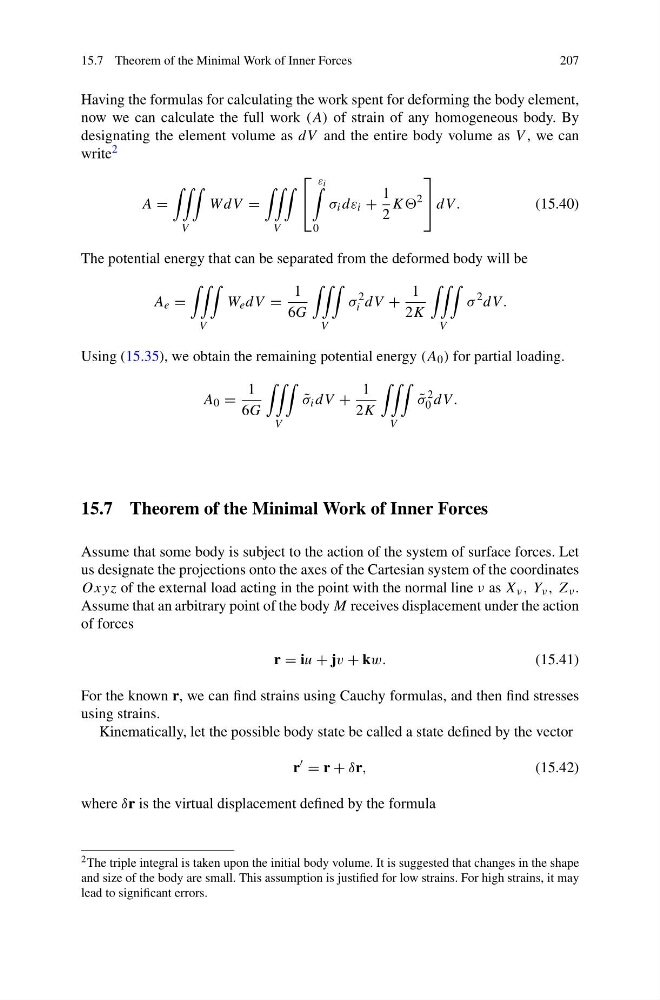
Having the formulas for calculating the work spent for deforming the body element,
now we can calculate the full work (A) of strain of any homogeneous body. By
designating the element volume as dV and the entire body volume as V , we can
write 2
A =
V
W dV =
V
⎡
⎣
ε i
0
σ i dε i +
1
2
KK
2
⎤
⎦ dV .
(15.40)
The potential energy that can be separated from the deformed body will be
A e =
V
W e dV =
1
6G
V
σ
2
i dV +
1
2K
V
σ
2 dV .
Using (15.35), we obtain the remaining potential energy (A 0 ) for partial loading.
A 0 =
1
6G
V
˜
σ i dV +
1
2K
V
˜
σ
2
0 dV .
15.7 Theorem of the Minimal Work of Inner Forces
Assume that some body is subject to the action of the system of surface forces. Let
us designate the projections onto the axes of the Cartesian system of the coordinates
Oxyz of the external load acting in the point with the normal line ν as X ν , Y ν , Z ν .
Assume that an arbitrary point of the body M receives displacement under the action
of forces
r = iu + jv + kw.
(15.41)
For the known r, we can find strains using Cauchy formulas, and then find stresses
using strains.
Kinematically, let the possible body state be called a state defined by the vector
r
= r + δr,
(15.42)
where δr is the virtual displacement defined by the formula
2 The triple integral is taken upon the initial body volume. It is suggested that changes in the shape
and size of the body are small. This assumption is justified for low strains. For high strains, it may
lead to significant errors.
207
Having the formulas for calculating the work spent for deforming the body element,
now we can calculate the full work (A) of strain of any homogeneous body. By
designating the element volume as dV and the entire body volume as V , we can
write 2
A =
V
W dV =
V
⎡
⎣
ε i
0
σ i dε i +
1
2
KK
2
⎤
⎦ dV .
(15.40)
The potential energy that can be separated from the deformed body will be
A e =
V
W e dV =
1
6G
V
σ
2
i dV +
1
2K
V
σ
2 dV .
Using (15.35), we obtain the remaining potential energy (A 0 ) for partial loading.
A 0 =
1
6G
V
˜
σ i dV +
1
2K
V
˜
σ
2
0 dV .
15.7 Theorem of the Minimal Work of Inner Forces
Assume that some body is subject to the action of the system of surface forces. Let
us designate the projections onto the axes of the Cartesian system of the coordinates
Oxyz of the external load acting in the point with the normal line ν as X ν , Y ν , Z ν .
Assume that an arbitrary point of the body M receives displacement under the action
of forces
r = iu + jv + kw.
(15.41)
For the known r, we can find strains using Cauchy formulas, and then find stresses
using strains.
Kinematically, let the possible body state be called a state defined by the vector
r
= r + δr,
(15.42)
where δr is the virtual displacement defined by the formula
2 The triple integral is taken upon the initial body volume. It is suggested that changes in the shape
and size of the body are small. This assumption is justified for low strains. For high strains, it may
lead to significant errors.