

196
15 Plasticity Theory of Henky–Nadai–Ilyushin
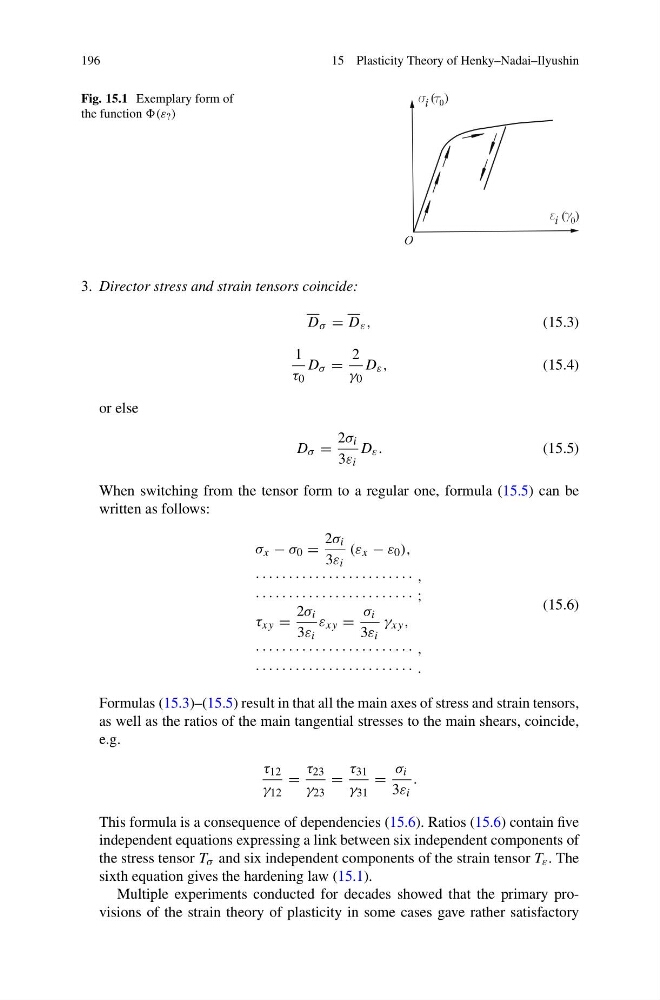
Fig. 15.1 Exemplary form of
the function ? )
3. Director stress and strain tensors coincide:
D σ = D ε ,
(15.3)
1
τ 0
D σ =
2
γ 0
D ε ,
(15.4)
or else
D σ =
2σ i
3ε i
D ε .
(15.5)
When switching from the tensor form to a regular one, formula (15.5) can be
written as follows:
σ x − σ 0 =
2σ i
3ε i
(ε x − ε 0 ),
· · · · · · · · · · · · · · · · · · · · · · · · ,
· · · · · · · · · · · · · · · · · · · · · · · · ;
τ xy =
2σ i
3ε i
ε xy =
σ i
3ε i
γ xy ,
· · · · · · · · · · · · · · · · · · · · · · · · ,
· · · · · · · · · · · · · · · · · · · · · · · · .
(15.6)
Formulas (15.3)–(15.5) result in that all the main axes of stress and strain tensors,
as well as the ratios of the main tangential stresses to the main shears, coincide,
e.g.
τ 12
γ 12
=
τ 23
γ 23
=
τ 31
γ 31
=
σ i
3ε i
.
This formula is a consequence of dependencies (15.6). Ratios (15.6) contain five
independent equations expressing a link between six independent components of
the stress tensor T σ and six independent components of the strain tensor T ε . The
sixth equation gives the hardening law (15.1).
Multiple experiments conducted for decades showed that the primary provisions of the strain theory of plasticity in some cases gave rather satisfactory
15 Plasticity Theory of Henky–Nadai–Ilyushin
Fig. 15.1 Exemplary form of
the function ? )
3. Director stress and strain tensors coincide:
D σ = D ε ,
(15.3)
1
τ 0
D σ =
2
γ 0
D ε ,
(15.4)
or else
D σ =
2σ i
3ε i
D ε .
(15.5)
When switching from the tensor form to a regular one, formula (15.5) can be
written as follows:
σ x − σ 0 =
2σ i
3ε i
(ε x − ε 0 ),
· · · · · · · · · · · · · · · · · · · · · · · · ,
· · · · · · · · · · · · · · · · · · · · · · · · ;
τ xy =
2σ i
3ε i
ε xy =
σ i
3ε i
γ xy ,
· · · · · · · · · · · · · · · · · · · · · · · · ,
· · · · · · · · · · · · · · · · · · · · · · · · .
(15.6)
Formulas (15.3)–(15.5) result in that all the main axes of stress and strain tensors,
as well as the ratios of the main tangential stresses to the main shears, coincide,
e.g.
τ 12
γ 12
=
τ 23
γ 23
=
τ 31
γ 31
=
σ i
3ε i
.
This formula is a consequence of dependencies (15.6). Ratios (15.6) contain five
independent equations expressing a link between six independent components of
the stress tensor T σ and six independent components of the strain tensor T ε . The
sixth equation gives the hardening law (15.1).
Multiple experiments conducted for decades showed that the primary provisions of the strain theory of plasticity in some cases gave rather satisfactory