

190
14 On the Plasticity Conditions of an Isotropic Body
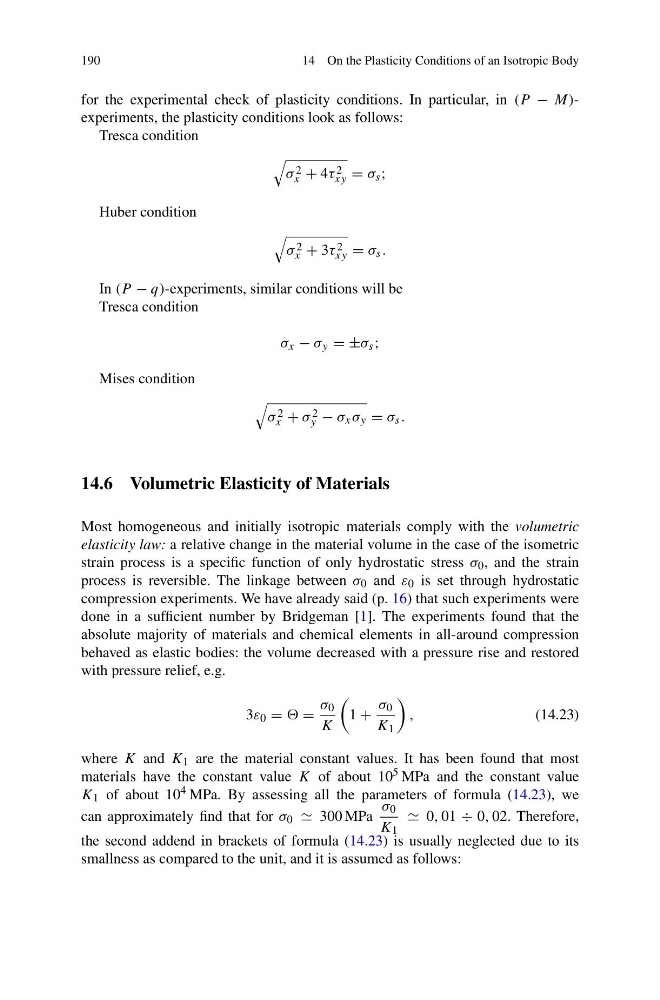
for the experimental check of plasticity conditions. In particular, in (P − M)experiments, the plasticity conditions look as follows:
Tresca condition
σ 2
x + 4τ 2
xy = σ s ;
Huber condition
σ 2
x + 3τ 2
xy = σ s .
In (P − q)-experiments, similar conditions will be
Tresca condition
σ x − σ y = ±σ s ;
Mises condition
σ 2
x + σ 2
y − σ x σ y = σ s .
14.6 Volumetric Elasticity of Materials
Most homogeneous and initially isotropic materials comply with the volumetric
elasticity law: a relative change in the material volume in the case of the isometric
strain process is a specific function of only hydrostatic stress σ 0 , and the strain
process is reversible. The linkage between σ 0 and ε 0 is set through hydrostatic
compression experiments. We have already said (p. 16) that such experiments were
done in a sufficient number by Bridgeman [1]. The experiments found that the
absolute majority of materials and chemical elements in all-around compression
behaved as elastic bodies: the volume decreased with a pressure rise and restored
with pressure relief, e.g.
3ε 0 = =
σ 0
K
1 +
σ 0
K 1
,
(14.23)
where K and K 1 are the material constant values. It has been found that most
materials have the constant value K of about 10 5 MPa and the constant value
K 1 of about 10 4 MPa. By assessing all the parameters of formula (14.23), we
can approximately find that for σ 0 300 MPa
σ 0
K 1
0, 01 ÷ 0, 02. Therefore,
the second addend in brackets of formula (14.23) is usually neglected due to its
smallness as compared to the unit, and it is assumed as follows:
14 On the Plasticity Conditions of an Isotropic Body
for the experimental check of plasticity conditions. In particular, in (P − M)experiments, the plasticity conditions look as follows:
Tresca condition
σ 2
x + 4τ 2
xy = σ s ;
Huber condition
σ 2
x + 3τ 2
xy = σ s .
In (P − q)-experiments, similar conditions will be
Tresca condition
σ x − σ y = ±σ s ;
Mises condition
σ 2
x + σ 2
y − σ x σ y = σ s .
14.6 Volumetric Elasticity of Materials
Most homogeneous and initially isotropic materials comply with the volumetric
elasticity law: a relative change in the material volume in the case of the isometric
strain process is a specific function of only hydrostatic stress σ 0 , and the strain
process is reversible. The linkage between σ 0 and ε 0 is set through hydrostatic
compression experiments. We have already said (p. 16) that such experiments were
done in a sufficient number by Bridgeman [1]. The experiments found that the
absolute majority of materials and chemical elements in all-around compression
behaved as elastic bodies: the volume decreased with a pressure rise and restored
with pressure relief, e.g.
3ε 0 = =
σ 0
K
1 +
σ 0
K 1
,
(14.23)
where K and K 1 are the material constant values. It has been found that most
materials have the constant value K of about 10 5 MPa and the constant value
K 1 of about 10 4 MPa. By assessing all the parameters of formula (14.23), we
can approximately find that for σ 0 300 MPa
σ 0
K 1
0, 01 ÷ 0, 02. Therefore,
the second addend in brackets of formula (14.23) is usually neglected due to its
smallness as compared to the unit, and it is assumed as follows: