

130
11 The Beginning of the Theory of Stability of Equilibrium
or
Df I V (z) + H I I f (z)
m(z)f (z)
= −
¨
T (t) +
b(z)
m(z)
˙
T (t)
T (t)
.
(11.14)
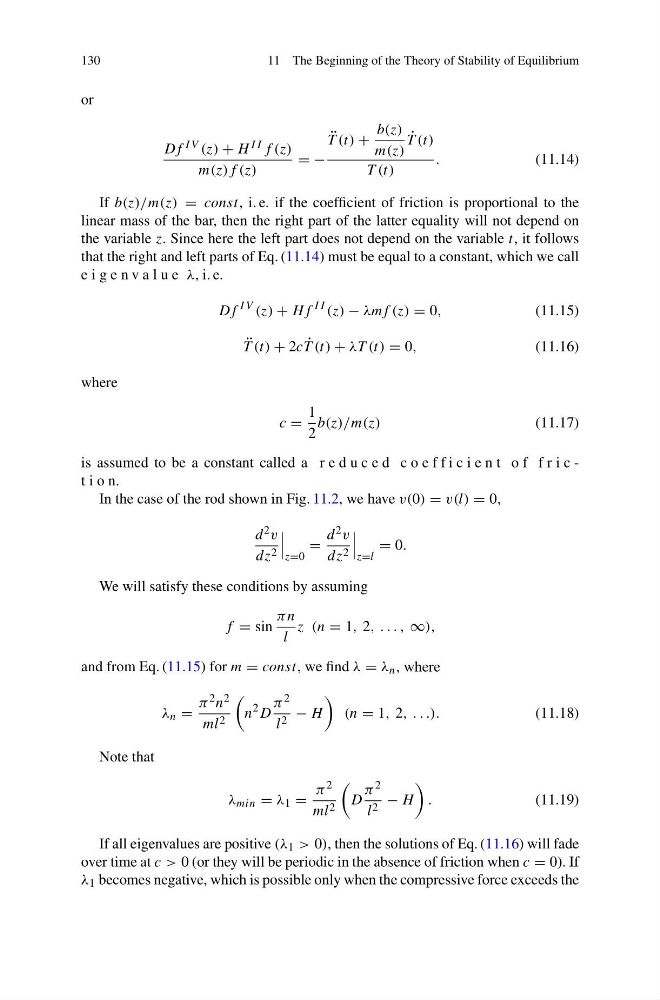
If b(z)/m(z) = const, i. e. if the coefficient of friction is proportional to the
linear mass of the bar, then the right part of the latter equality will not depend on
the variable z. Since here the left part does not depend on the variable t, it follows
that the right and left parts of Eq. (11.14) must be equal to a constant, which we call
e i g e n v a l u e λ, i. e.
Df
I V (z) + Hf
I I (z) − λmf (z) = 0,
(11.15)
¨
T (t) + 2c ˙
T (t) + λT (t) = 0,
(11.16)
where
c =
1
2
b(z)/m(z)
(11.17)
is assumed to be a constant called a r e d u c e d c o e f f i c i e n t o f f r i c -
t i o n.
In the case of the rod shown in Fig. 11.2, we have v(0) = v(l) = 0,
d 2 v
dz 2
z=0
=
d 2 v
dz 2
z=l
= 0.
We will satisfy these conditions by assuming
f = sin
πn
l
z (n = 1, 2, . . . , ∞),
and from Eq. (11.15) for m = const, we find λ = λ n , where
λ n =
π 2 n 2
ml 2
n
2 D
π 2
l 2 − H
(n = 1, 2, . . .).
(11.18)
Note that
λ min = λ 1 =
π 2
ml 2
D
π 2
l 2 − H
.
(11.19)
If all eigenvalues are positive (λ 1 > 0), then the solutions of Eq. (11.16) will fade
over time at c > 0 (or they will be periodic in the absence of friction when c = 0). If
λ 1 becomes negative, which is possible only when the compressive force exceeds the
11 The Beginning of the Theory of Stability of Equilibrium
or
Df I V (z) + H I I f (z)
m(z)f (z)
= −
¨
T (t) +
b(z)
m(z)
˙
T (t)
T (t)
.
(11.14)
If b(z)/m(z) = const, i. e. if the coefficient of friction is proportional to the
linear mass of the bar, then the right part of the latter equality will not depend on
the variable z. Since here the left part does not depend on the variable t, it follows
that the right and left parts of Eq. (11.14) must be equal to a constant, which we call
e i g e n v a l u e λ, i. e.
Df
I V (z) + Hf
I I (z) − λmf (z) = 0,
(11.15)
¨
T (t) + 2c ˙
T (t) + λT (t) = 0,
(11.16)
where
c =
1
2
b(z)/m(z)
(11.17)
is assumed to be a constant called a r e d u c e d c o e f f i c i e n t o f f r i c -
t i o n.
In the case of the rod shown in Fig. 11.2, we have v(0) = v(l) = 0,
d 2 v
dz 2
z=0
=
d 2 v
dz 2
z=l
= 0.
We will satisfy these conditions by assuming
f = sin
πn
l
z (n = 1, 2, . . . , ∞),
and from Eq. (11.15) for m = const, we find λ = λ n , where
λ n =
π 2 n 2
ml 2
n
2 D
π 2
l 2 − H
(n = 1, 2, . . .).
(11.18)
Note that
λ min = λ 1 =
π 2
ml 2
D
π 2
l 2 − H
.
(11.19)
If all eigenvalues are positive (λ 1 > 0), then the solutions of Eq. (11.16) will fade
over time at c > 0 (or they will be periodic in the absence of friction when c = 0). If
λ 1 becomes negative, which is possible only when the compressive force exceeds the