

11.11 The Perturbed Motion of the Compressed Rod
129
11.11 The Perturbed Motion of the Compressed Rod
Let the resistance force of the external environment be proportional to the speed.
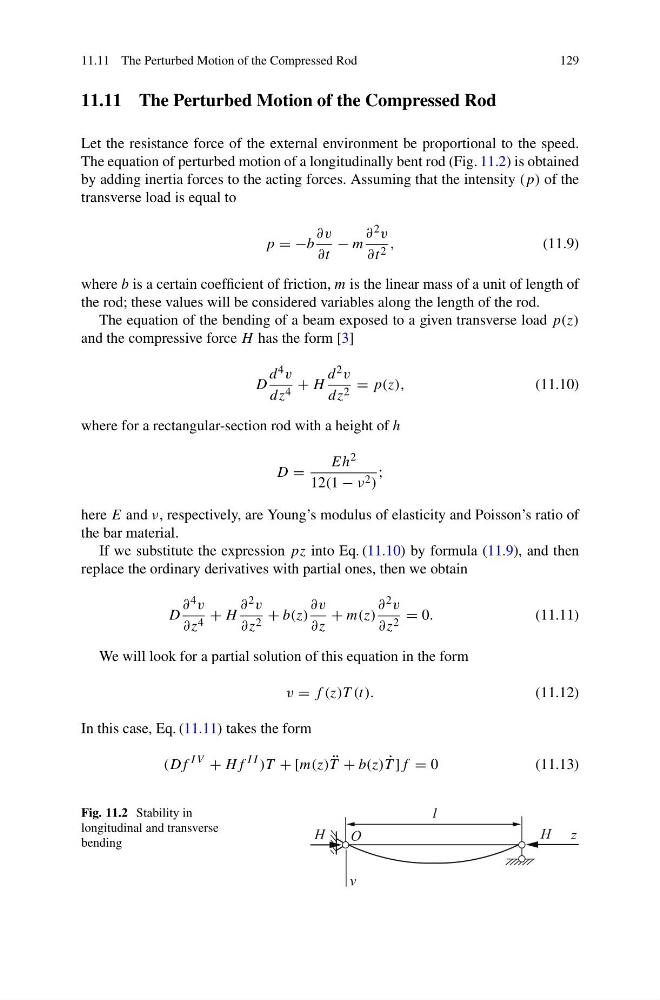
The equation of perturbed motion of a longitudinally bent rod (Fig. 11.2) is obtained
by adding inertia forces to the acting forces. Assuming that the intensity (p) of the
transverse load is equal to
p = −b
∂v
∂t
− m
∂ 2 v
∂t 2 ,
(11.9)
where b is a certain coefficient of friction, m is the linear mass of a unit of length of
the rod; these values will be considered variables along the length of the rod.
The equation of the bending of a beam exposed to a given transverse load p(z)
and the compressive force H has the form [3]
D
d 4 v
dz 4 + H
d 2 v
dz 2 = p(z),
(11.10)
where for a rectangular-section rod with a height of h
D =
Eh 2
12(1 − ν 2 )
;
here E and ν, respectively, are Young’s modulus of elasticity and Poisson’s ratio of
the bar material.
If we substitute the expression pz into Eq. (11.10) by formula (11.9), and then
replace the ordinary derivatives with partial ones, then we obtain
D
∂ 4 v
∂z 4 + H
∂ 2 v
∂z 2 + b(z)
∂v
∂z
+ m(z)
∂ 2 v
∂z 2 = 0.
(11.11)
We will look for a partial solution of this equation in the form
v = f (z)T (t).
(11.12)
In this case, Eq. (11.11) takes the form
(Df
I V
+ Hf
I I )T + [m(z) ¨
T + b(z) ˙
T ]f = 0
(11.13)
Fig. 11.2 Stability in
longitudinal and transverse
bending
129
11.11 The Perturbed Motion of the Compressed Rod
Let the resistance force of the external environment be proportional to the speed.
The equation of perturbed motion of a longitudinally bent rod (Fig. 11.2) is obtained
by adding inertia forces to the acting forces. Assuming that the intensity (p) of the
transverse load is equal to
p = −b
∂v
∂t
− m
∂ 2 v
∂t 2 ,
(11.9)
where b is a certain coefficient of friction, m is the linear mass of a unit of length of
the rod; these values will be considered variables along the length of the rod.
The equation of the bending of a beam exposed to a given transverse load p(z)
and the compressive force H has the form [3]
D
d 4 v
dz 4 + H
d 2 v
dz 2 = p(z),
(11.10)
where for a rectangular-section rod with a height of h
D =
Eh 2
12(1 − ν 2 )
;
here E and ν, respectively, are Young’s modulus of elasticity and Poisson’s ratio of
the bar material.
If we substitute the expression pz into Eq. (11.10) by formula (11.9), and then
replace the ordinary derivatives with partial ones, then we obtain
D
∂ 4 v
∂z 4 + H
∂ 2 v
∂z 2 + b(z)
∂v
∂z
+ m(z)
∂ 2 v
∂z 2 = 0.
(11.11)
We will look for a partial solution of this equation in the form
v = f (z)T (t).
(11.12)
In this case, Eq. (11.11) takes the form
(Df
I V
+ Hf
I I )T + [m(z) ¨
T + b(z) ˙
T ]f = 0
(11.13)
Fig. 11.2 Stability in
longitudinal and transverse
bending