

11.6 Critical Load
125
11.5 Instability in the First Approximation
Let the equations of perturbed motion near the considered equilibrium position
(q 1 , q 2 , . . . , q n = 0) contain only terms that are linear with respect to generalized
coordinates, their velocities and accelerations. Such equations are called first
approximation equations. If they have only bounded solutions, then the considered
equilibrium state is called stable in the first approximation.
Theorem If only conservative forces act on the system, then its stability is
guaranteed by stability as a first approximation
An interested reader will find a proof of the theorem in a course on the theory
of oscillations (see, for example, [2]). It is based on the use of the main (normal)
coordinates, at which the kinetic and potential energy for the perturbed motion in
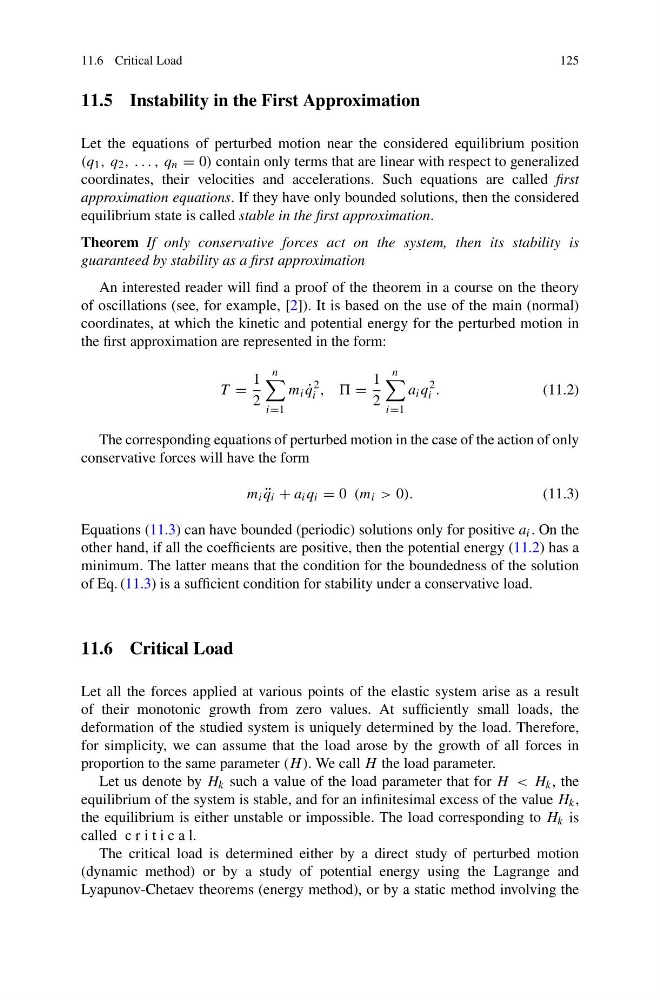
the first approximation are represented in the form:
T =
1
2
n
i=1
m i ˙
q
2
i , , =
1
2
n
i=1
a i q
2
i .
(11.2)
The corresponding equations of perturbed motion in the case of the action of only
conservative forces will have the form
m i ¨
q i + a i q i = 0 (m i > 0).
(11.3)
Equations (11.3) can have bounded (periodic) solutions only for positive a i . On the
other hand, if all the coefficients are positive, then the potential energy (11.2) has a
minimum. The latter means that the condition for the boundedness of the solution
of Eq. (11.3) is a sufficient condition for stability under a conservative load.
11.6 Critical Load
Let all the forces applied at various points of the elastic system arise as a result
of their monotonic growth from zero values. At sufficiently small loads, the
deformation of the studied system is uniquely determined by the load. Therefore,
for simplicity, we can assume that the load arose by the growth of all forces in
proportion to the same parameter (H ). We call H the load parameter.
Let us denote by H k such a value of the load parameter that for H < H k , the
equilibrium of the system is stable, and for an infinitesimal excess of the value H k ,
the equilibrium is either unstable or impossible. The load corresponding to H k is
called c r i t i c a l.
The critical load is determined either by a direct study of perturbed motion
(dynamic method) or by a study of potential energy using the Lagrange and
Lyapunov-Chetaev theorems (energy method), or by a static method involving the
125
11.5 Instability in the First Approximation
Let the equations of perturbed motion near the considered equilibrium position
(q 1 , q 2 , . . . , q n = 0) contain only terms that are linear with respect to generalized
coordinates, their velocities and accelerations. Such equations are called first
approximation equations. If they have only bounded solutions, then the considered
equilibrium state is called stable in the first approximation.
Theorem If only conservative forces act on the system, then its stability is
guaranteed by stability as a first approximation
An interested reader will find a proof of the theorem in a course on the theory
of oscillations (see, for example, [2]). It is based on the use of the main (normal)
coordinates, at which the kinetic and potential energy for the perturbed motion in
the first approximation are represented in the form:
T =
1
2
n
i=1
m i ˙
q
2
i , , =
1
2
n
i=1
a i q
2
i .
(11.2)
The corresponding equations of perturbed motion in the case of the action of only
conservative forces will have the form
m i ¨
q i + a i q i = 0 (m i > 0).
(11.3)
Equations (11.3) can have bounded (periodic) solutions only for positive a i . On the
other hand, if all the coefficients are positive, then the potential energy (11.2) has a
minimum. The latter means that the condition for the boundedness of the solution
of Eq. (11.3) is a sufficient condition for stability under a conservative load.
11.6 Critical Load
Let all the forces applied at various points of the elastic system arise as a result
of their monotonic growth from zero values. At sufficiently small loads, the
deformation of the studied system is uniquely determined by the load. Therefore,
for simplicity, we can assume that the load arose by the growth of all forces in
proportion to the same parameter (H ). We call H the load parameter.
Let us denote by H k such a value of the load parameter that for H < H k , the
equilibrium of the system is stable, and for an infinitesimal excess of the value H k ,
the equilibrium is either unstable or impossible. The load corresponding to H k is
called c r i t i c a l.
The critical load is determined either by a direct study of perturbed motion
(dynamic method) or by a study of potential energy using the Lagrange and
Lyapunov-Chetaev theorems (energy method), or by a static method involving the