

124
11 The Beginning of the Theory of Stability of Equilibrium
initial velocities of the perturbed motion, the potential energy will tend to zero, and
the position of the system will differ infinitely little from the equilibrium or coincide
with it, which proves the Lagrange theorem.
The Lagrange theorem defines only a sufficient, but, generally speaking, not a
necessary condition for stability. In particular, in systems with dissipative forces
such as Coulomb friction, the equilibrium can be stable in the absence of a minimum
of potential energy.
11.4 Lyapunov–Chetaev Theorem
Suppose that there is a certain equilibrium position of a conservative system in
which its potential energy is not minimal. The following statement is true.
Theorem If the absence of a minimum of potential energy is determined by the
lowest order terms that are in the expansion of the potential energy in a power
series in generalized coordinates, then the equilibrium state under consideration is
u n s t a b l e.
The proof of this theorem is very complicated. In order not to bother the reader
with mathematical calculations, here we give only an explanation of the theorem.
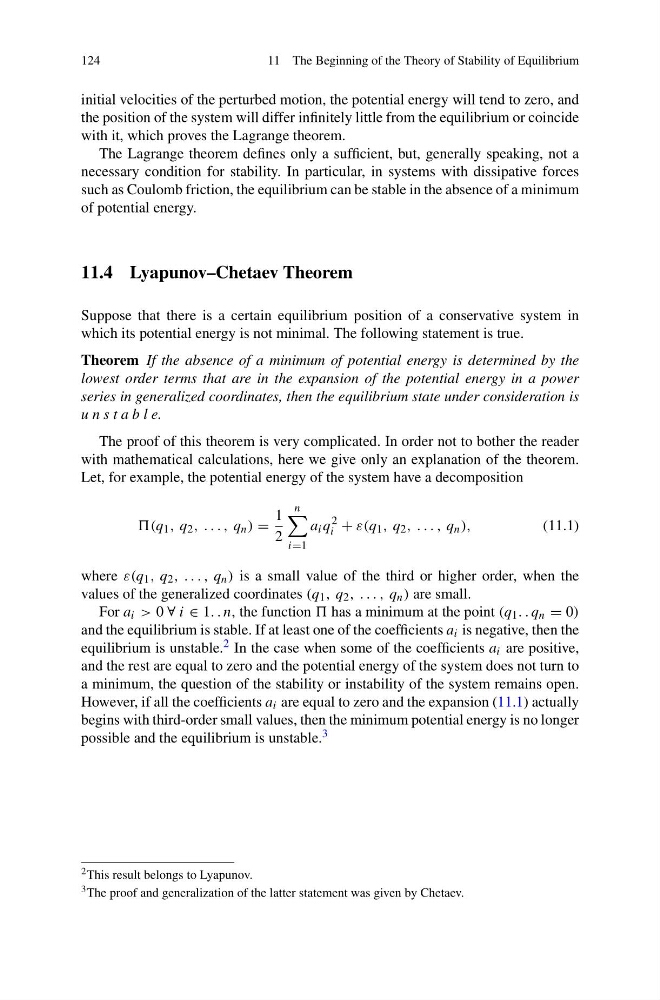
Let, for example, the potential energy of the system have a decomposition
1 , q 2 , . . . , q n ) =
1
2
n
i=1
a i q
2
i + ε(q 1 , q 2 , . . . , q n ),
(11.1)
where ε(q 1 , q 2 , . . . , q n ) is a small value of the third or higher order, when the
values of the generalized coordinates (q 1 , q 2 , . . . , q n ) are small.
For a i > 0 ∀ i ∈ 1. . n, the function has a minimum at the point (q 1 . . q n = 0)
and the equilibrium is stable. If at least one of the coefficients a i is negative, then the
equilibrium is unstable. 2 In the case when some of the coefficients a i are positive,
and the rest are equal to zero and the potential energy of the system does not turn to
a minimum, the question of the stability or instability of the system remains open.
However, if all the coefficients a i are equal to zero and the expansion (11.1) actually
begins with third-order small values, then the minimum potential energy is no longer
possible and the equilibrium is unstable. 3
2 This result belongs to Lyapunov.
3 The proof and generalization of the latter statement was given by Chetaev.
11 The Beginning of the Theory of Stability of Equilibrium
initial velocities of the perturbed motion, the potential energy will tend to zero, and
the position of the system will differ infinitely little from the equilibrium or coincide
with it, which proves the Lagrange theorem.
The Lagrange theorem defines only a sufficient, but, generally speaking, not a
necessary condition for stability. In particular, in systems with dissipative forces
such as Coulomb friction, the equilibrium can be stable in the absence of a minimum
of potential energy.
11.4 Lyapunov–Chetaev Theorem
Suppose that there is a certain equilibrium position of a conservative system in
which its potential energy is not minimal. The following statement is true.
Theorem If the absence of a minimum of potential energy is determined by the
lowest order terms that are in the expansion of the potential energy in a power
series in generalized coordinates, then the equilibrium state under consideration is
u n s t a b l e.
The proof of this theorem is very complicated. In order not to bother the reader
with mathematical calculations, here we give only an explanation of the theorem.
Let, for example, the potential energy of the system have a decomposition
1 , q 2 , . . . , q n ) =
1
2
n
i=1
a i q
2
i + ε(q 1 , q 2 , . . . , q n ),
(11.1)
where ε(q 1 , q 2 , . . . , q n ) is a small value of the third or higher order, when the
values of the generalized coordinates (q 1 , q 2 , . . . , q n ) are small.
For a i > 0 ∀ i ∈ 1. . n, the function has a minimum at the point (q 1 . . q n = 0)
and the equilibrium is stable. If at least one of the coefficients a i is negative, then the
equilibrium is unstable. 2 In the case when some of the coefficients a i are positive,
and the rest are equal to zero and the potential energy of the system does not turn to
a minimum, the question of the stability or instability of the system remains open.
However, if all the coefficients a i are equal to zero and the expansion (11.1) actually
begins with third-order small values, then the minimum potential energy is no longer
possible and the equilibrium is unstable. 3
2 This result belongs to Lyapunov.
3 The proof and generalization of the latter statement was given by Chetaev.