

9.6 Annex to the Brazilian Test
97
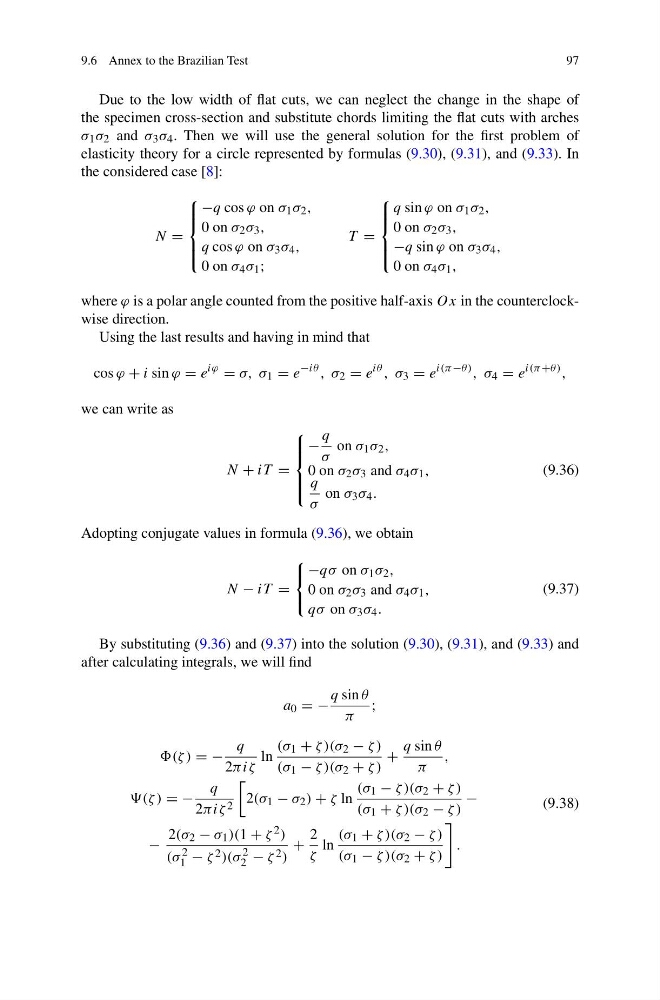
Due to the low width of flat cuts, we can neglect the change in the shape of
the specimen cross-section and substitute chords limiting the flat cuts with arches
σ 1 σ 2 and σ 3 σ 4 . Then we will use the general solution for the first problem of
elasticity theory for a circle represented by formulas (9.30), (9.31), and (9.33). In
the considered case [8]:
N =
⎧
⎪ ⎪ ⎨
⎪ ⎪ ⎩
−q cos ϕ on σ 1 σ 2 ,
0 on σ 2 σ 3 ,
q cos ϕ on σ 3 σ 4 ,
0 on σ 4 σ 1 ;
T =
⎧
⎪ ⎪ ⎨
⎪ ⎪ ⎩
q sin ϕ on σ 1 σ 2 ,
0 on σ 2 σ 3 ,
−q sin ϕ on σ 3 σ 4 ,
0 on σ 4 σ 1 ,
where ϕ is a polar angle counted from the positive half-axis Ox in the counterclockwise direction.
Using the last results and having in mind that
cos ϕ + i sin ϕ = e
iϕ
= σ, σ 1 = e
−iθ , σ 2 = e
iθ , σ 3 = e
i(π−θ) , σ 4 = e
i(π+θ) ,
we can write as
N + iT =
⎧
⎪ ⎪ ⎨
⎪ ⎪ ⎩
−
q
σ
on σ 1 σ 2 ,
0 on σ 2 σ 3 and σ 4 σ 1 ,
q
σ
on σ 3 σ 4 .
(9.36)
Adopting conjugate values in formula (9.36), we obtain
N − iT =
⎧
⎨
⎩
−qσ on σ 1 σ 2 ,
0 on σ 2 σ 3 and σ 4 σ 1 ,
qσ on σ 3 σ 4 .
(9.37)
By substituting (9.36) and (9.37) into the solution (9.30), (9.31), and (9.33) and
after calculating integrals, we will find
a 0 = −
q sin θ
π
;
) = −
q
2πiζ
ln
(σ 1 + ζ )(σ 2 − ζ )
(σ 1 − ζ )(σ 2 + ζ )
+
q sin θ
π
,
(ζ ) = −
q
2πiζ 2
2(σ 1 − σ 2 ) + ζ ln
(σ 1 − ζ )(σ 2 + ζ )
(σ 1 + ζ )(σ 2 − ζ )
−
−
2(σ 2 − σ 1 )(1 + ζ 2 )
(σ 2
1 − ζ 2 )(σ 2
2 − ζ 2 )
+
2
ζ
ln
(σ 1 + ζ )(σ 2 − ζ )
(σ 1 − ζ )(σ 2 + ζ )
.
(9.38)
97
Due to the low width of flat cuts, we can neglect the change in the shape of
the specimen cross-section and substitute chords limiting the flat cuts with arches
σ 1 σ 2 and σ 3 σ 4 . Then we will use the general solution for the first problem of
elasticity theory for a circle represented by formulas (9.30), (9.31), and (9.33). In
the considered case [8]:
N =
⎧
⎪ ⎪ ⎨
⎪ ⎪ ⎩
−q cos ϕ on σ 1 σ 2 ,
0 on σ 2 σ 3 ,
q cos ϕ on σ 3 σ 4 ,
0 on σ 4 σ 1 ;
T =
⎧
⎪ ⎪ ⎨
⎪ ⎪ ⎩
q sin ϕ on σ 1 σ 2 ,
0 on σ 2 σ 3 ,
−q sin ϕ on σ 3 σ 4 ,
0 on σ 4 σ 1 ,
where ϕ is a polar angle counted from the positive half-axis Ox in the counterclockwise direction.
Using the last results and having in mind that
cos ϕ + i sin ϕ = e
iϕ
= σ, σ 1 = e
−iθ , σ 2 = e
iθ , σ 3 = e
i(π−θ) , σ 4 = e
i(π+θ) ,
we can write as
N + iT =
⎧
⎪ ⎪ ⎨
⎪ ⎪ ⎩
−
q
σ
on σ 1 σ 2 ,
0 on σ 2 σ 3 and σ 4 σ 1 ,
q
σ
on σ 3 σ 4 .
(9.36)
Adopting conjugate values in formula (9.36), we obtain
N − iT =
⎧
⎨
⎩
−qσ on σ 1 σ 2 ,
0 on σ 2 σ 3 and σ 4 σ 1 ,
qσ on σ 3 σ 4 .
(9.37)
By substituting (9.36) and (9.37) into the solution (9.30), (9.31), and (9.33) and
after calculating integrals, we will find
a 0 = −
q sin θ
π
;
) = −
q
2πiζ
ln
(σ 1 + ζ )(σ 2 − ζ )
(σ 1 − ζ )(σ 2 + ζ )
+
q sin θ
π
,
(ζ ) = −
q
2πiζ 2
2(σ 1 − σ 2 ) + ζ ln
(σ 1 − ζ )(σ 2 + ζ )
(σ 1 + ζ )(σ 2 − ζ )
−
−
2(σ 2 − σ 1 )(1 + ζ 2 )
(σ 2
1 − ζ 2 )(σ 2
2 − ζ 2 )
+
2
ζ
ln
(σ 1 + ζ )(σ 2 − ζ )
(σ 1 − ζ )(σ 2 + ζ )
.
(9.38)