

96
9 Plane Problem of Elasticity Theory
a
b
c
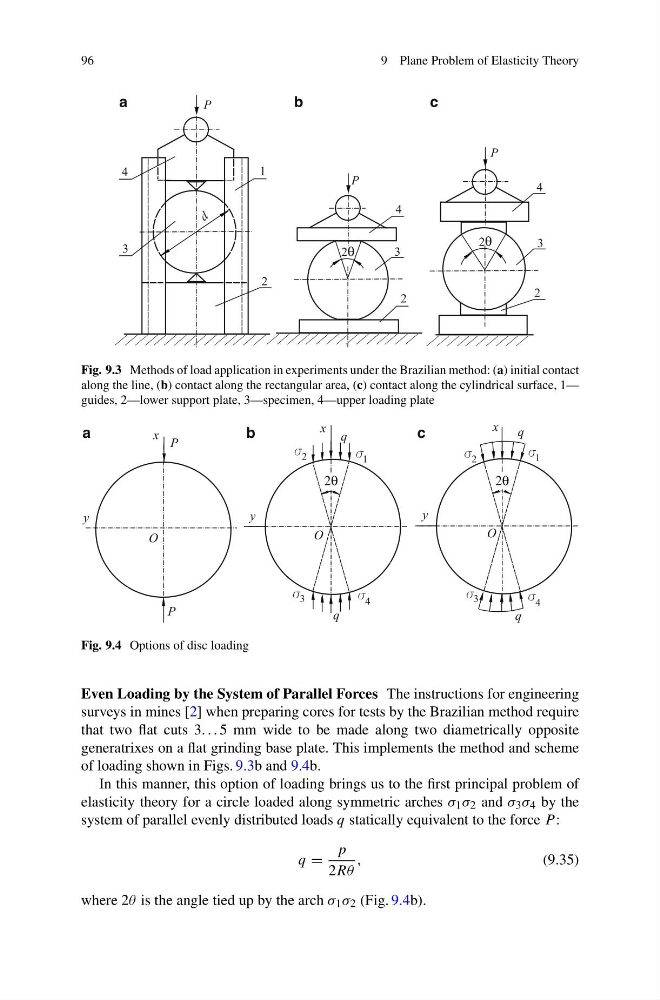
Fig. 9.3 Methods of load application in experiments under the Brazilian method: (a) initial contact
along the line, (b) contact along the rectangular area, (c) contact along the cylindrical surface, 1—
guides, 2—lower support plate, 3—specimen, 4—upper loading plate
a
b
c
Fig. 9.4 Options of disc loading
Even Loading by the System of Parallel Forces The instructions for engineering
surveys in mines [2] when preparing cores for tests by the Brazilian method require
that two flat cuts 3. . . 5 mm wide to be made along two diametrically opposite
generatrixes on a flat grinding base plate. This implements the method and scheme
of loading shown in Figs. 9.3b and 9.4b.
In this manner, this option of loading brings us to the first principal problem of
elasticity theory for a circle loaded along symmetric arches σ 1 σ 2 and σ 3 σ 4 by the
system of parallel evenly distributed loads q statically equivalent to the force P :
q =
p
2Rθ
,
(9.35)
where 2θ is the angle tied up by the arch σ 1 σ 2 (Fig. 9.4b).
9 Plane Problem of Elasticity Theory
a
b
c
Fig. 9.3 Methods of load application in experiments under the Brazilian method: (a) initial contact
along the line, (b) contact along the rectangular area, (c) contact along the cylindrical surface, 1—
guides, 2—lower support plate, 3—specimen, 4—upper loading plate
a
b
c
Fig. 9.4 Options of disc loading
Even Loading by the System of Parallel Forces The instructions for engineering
surveys in mines [2] when preparing cores for tests by the Brazilian method require
that two flat cuts 3. . . 5 mm wide to be made along two diametrically opposite
generatrixes on a flat grinding base plate. This implements the method and scheme
of loading shown in Figs. 9.3b and 9.4b.
In this manner, this option of loading brings us to the first principal problem of
elasticity theory for a circle loaded along symmetric arches σ 1 σ 2 and σ 3 σ 4 by the
system of parallel evenly distributed loads q statically equivalent to the force P :
q =
p
2Rθ
,
(9.35)
where 2θ is the angle tied up by the arch σ 1 σ 2 (Fig. 9.4b).