

9.1 Functions of Stresses
89
σ r =
1
r 2
∂ 2 U
∂ϑ 2 +
1
r
∂U
∂r
,
σ ϑ =
∂ 2 U
∂r 2 ,
τ rϑ = −
∂
∂r
1
r
∂U
∂ϑ
(9.7)
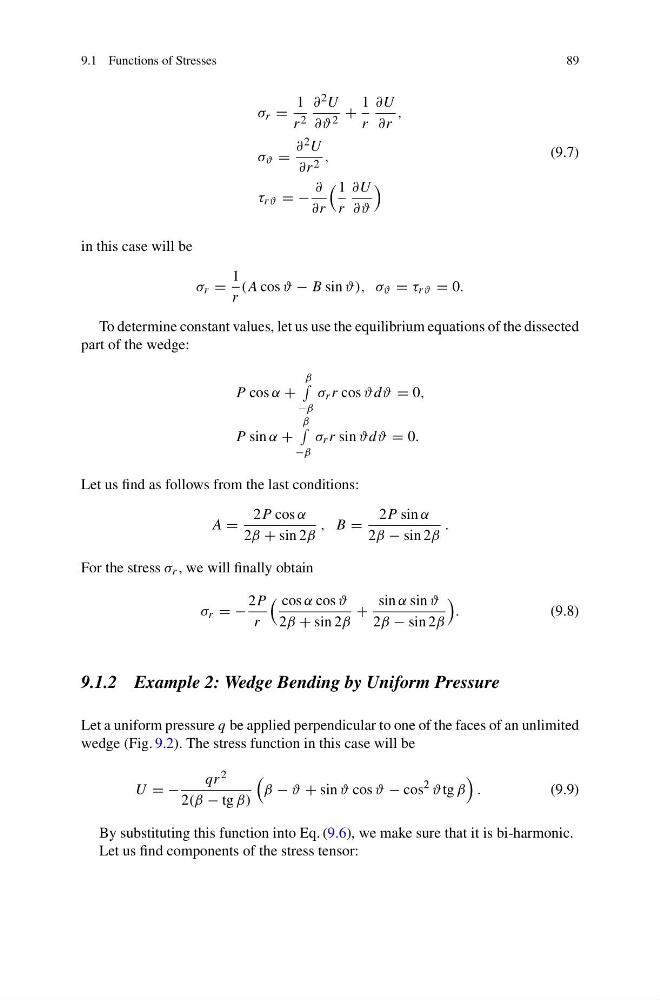
in this case will be
σ r =
1
r
(A cos ϑ − B sin ϑ), σ ϑ = τ rϑ = 0.
To determine constant values, let us use the equilibrium equations of the dissected
part of the wedge:
P cos α +
β
−β
σ r r cos ϑdϑ = 0,
P sin α +
β
−β
σ r r sin ϑdϑ = 0.
Let us find as follows from the last conditions:
A =
2P cos α
2β + sin 2β
, B =
2P sin α
2β − sin 2β
.
For the stress σ r , we will finally obtain
σ r = −
2P
r
cos α cos ϑ
2β + sin 2β
+
sin α sin ϑ
2β − sin 2β
.
(9.8)
9.1.2 Example 2: Wedge Bending by Uniform Pressure
Let a uniform pressure q be applied perpendicular to one of the faces of an unlimited
wedge (Fig. 9.2). The stress function in this case will be
U = −
qr 2
2(β − tg β)
β − ϑ + sin ϑ cos ϑ − cos
2 ϑtg β
.
(9.9)
By substituting this function into Eq. (9.6), we make sure that it is bi-harmonic.
Let us find components of the stress tensor:
89
σ r =
1
r 2
∂ 2 U
∂ϑ 2 +
1
r
∂U
∂r
,
σ ϑ =
∂ 2 U
∂r 2 ,
τ rϑ = −
∂
∂r
1
r
∂U
∂ϑ
(9.7)
in this case will be
σ r =
1
r
(A cos ϑ − B sin ϑ), σ ϑ = τ rϑ = 0.
To determine constant values, let us use the equilibrium equations of the dissected
part of the wedge:
P cos α +
β
−β
σ r r cos ϑdϑ = 0,
P sin α +
β
−β
σ r r sin ϑdϑ = 0.
Let us find as follows from the last conditions:
A =
2P cos α
2β + sin 2β
, B =
2P sin α
2β − sin 2β
.
For the stress σ r , we will finally obtain
σ r = −
2P
r
cos α cos ϑ
2β + sin 2β
+
sin α sin ϑ
2β − sin 2β
.
(9.8)
9.1.2 Example 2: Wedge Bending by Uniform Pressure
Let a uniform pressure q be applied perpendicular to one of the faces of an unlimited
wedge (Fig. 9.2). The stress function in this case will be
U = −
qr 2
2(β − tg β)
β − ϑ + sin ϑ cos ϑ − cos
2 ϑtg β
.
(9.9)
By substituting this function into Eq. (9.6), we make sure that it is bi-harmonic.
Let us find components of the stress tensor: