

88
9 Plane Problem of Elasticity Theory
The condition (9.2) equals the requirements of inadmissibility of structural distortions in the material during deformation at these stresses. With this assumption,
it follows from the two last formulas:
∂ 2
∂x 2 +
∂ 2
∂y 2
2
U = 0.
(9.4)
Consequently, for an elastic plane, the stress function is bi-harmonic.
9.1.1 Example 1: Concentrated Force in the Wedge Apex
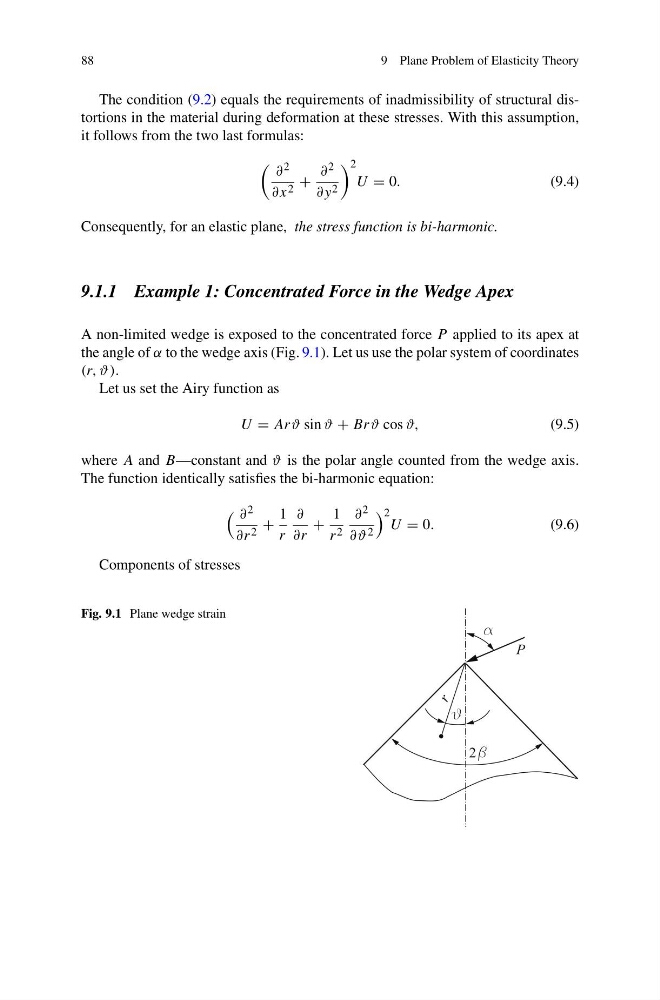
A non-limited wedge is exposed to the concentrated force P applied to its apex at
the angle of α to the wedge axis (Fig. 9.1). Let us use the polar system of coordinates
(r, ϑ).
Let us set the Airy function as
U = Arϑ sin ϑ + Brϑ cos ϑ,
(9.5)
where A and B—constant and ϑ is the polar angle counted from the wedge axis.
The function identically satisfies the bi-harmonic equation:
∂ 2
∂r 2 +
1
r
∂
∂r
+
1
r 2
∂ 2
∂ϑ 2
2
U = 0.
(9.6)
Components of stresses
Fig. 9.1 Plane wedge strain
9 Plane Problem of Elasticity Theory
The condition (9.2) equals the requirements of inadmissibility of structural distortions in the material during deformation at these stresses. With this assumption,
it follows from the two last formulas:
∂ 2
∂x 2 +
∂ 2
∂y 2
2
U = 0.
(9.4)
Consequently, for an elastic plane, the stress function is bi-harmonic.
9.1.1 Example 1: Concentrated Force in the Wedge Apex
A non-limited wedge is exposed to the concentrated force P applied to its apex at
the angle of α to the wedge axis (Fig. 9.1). Let us use the polar system of coordinates
(r, ϑ).
Let us set the Airy function as
U = Arϑ sin ϑ + Brϑ cos ϑ,
(9.5)
where A and B—constant and ϑ is the polar angle counted from the wedge axis.
The function identically satisfies the bi-harmonic equation:
∂ 2
∂r 2 +
1
r
∂
∂r
+
1
r 2
∂ 2
∂ϑ 2
2
U = 0.
(9.6)
Components of stresses
Fig. 9.1 Plane wedge strain